Re-Blogging the Net's New Visual Poetry
December 08, 2011

Kayla's lovely touchy-feely post about our current squeamishness when it comes to internet feelings got me thinking about how just the opposite's en vogue over in the Tumblr World of TeenGirldom. So I put together a list of text/image-confessional sites and had a good think about why they arouse my inner Humbert Humbert.

Read More
Did David Foster Wallace Lie on His Syllabi?
December 05, 2011

"[Y]ou hire a fiction writer to do nonfiction, there's going to be the occasional bit of embellishment.” David Foster Wallace

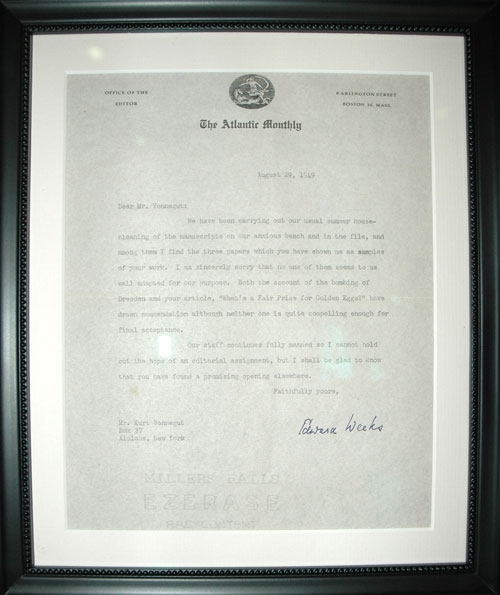
Last week, Katie Roiphe gushed in Slate about the "rigorous" and "honorable" syllabi from David Foster Wallace's teaching days, currently housed at the Harry Ransom Center at the University of Texas, Austin. Of his 1994 course in Literary Analysis at Illinois State University (which Wallace taught when he was in his early 30s), Roiphe writes, "There is in his syllabus...nothing but rigorous honesty and tireless interrogation."

Read More
Internet Feelings: Embarrassment, Lit Blogs, and the NYC Marathon

There’s been some talk on the internet about being embarrassed to talk on the internet. Htmlgiant has a post about being embarrassed over sharing one writer’s favorite poems in the context of htmlgiant, which spreads to a post on the writer’s personal resistance to participating in the kind of social/group context that htmlgiant inherently is. But htmlgiant is a particular literary online context, in which expressing one’s personal embarrassment is fairly common: there’s a recent post on the humiliation of being a writer, encouraging further confessions of other people’s thoughts on the humiliation of being a writer.

The general form that many literary posts take is one of confession: addressing first the writer’s justifications or apologies for speaking in the first place before moving on to discuss the issue at hand. To an extent, these confessions create a sense of intimacy between reader and writer, but they also tend to make the piece of writing more about the speaker.

Freud said, “...every individual is virtually an enemy of civilization, though civilization is supposed to be an object of universal human interest.” All groups press for the individual to fall in line. There’s no way around it. But there’s also the possibility of greatness in numbers, which I was surprisingly reminded of last month—an abrupt encounter with the New York City Marathon.

To add my own confessional preamble, I might have been in an emotionally delicate state due to my triumphant hangover. Nonetheless, when I rose up from the subway and heard the mass cheering, when I saw the crowd of strangers applauding and whistling for other strangers, I almost started crying. I do not like crowds, and yet here I was, ready to hug and weep with all of them.

Without doubt, a large, public group of strangers calls for very different codes of behavior than an anonymous gathering online. The street doesn't allow us access to every spectator's feelings about being there (only I get to do that). But maybe we could try emulating a similar kind of enthusiasm that lacks this uncomfortable, stilting sense of self-presentation that seems to be plaguing internet reviewers. Maybe we could pretend that the crowd is gathered for a different purpose than staring down whoever speaks.

Really, how hard would it be to inject pure, unabashed celebration into the internet? To simply cheer and gush over that which excites us? 

Photo: rosemis.com

Read More
Writing and Brain Disease

Am I the only one who believes—without hesitation and with no medical knowledge beyond a few Oliver Sacks books—that neurological disorders tell us who we really are? Is anyone else enamored by mind diseases and their relationship to language? Reading through an interview in HarvardMedicine with a neurologist who experiences bouts of hypergraphia (“the medical term for an overpowering desire to write,” as explained in the interview), I suddenly become like a sports fan of the human condition. I cheer and rally. Look at us and how awesomely our brains respond to stress and trauma! Go team!

Alice Flaherty, the neurologist, describes the compulsion as all-encompassing: “That’s all I was conscious of—I had important ideas that I needed to write down because otherwise I would forget them.” What strikes me is her emphasis on documentation, and that the anxiety compelling the act of writing is so entangled with memory. Her hypergraphic writing was not fueled by a desire for self-expression or to engage in communication with others; she wrote so she wouldn't forget.

To me, one of the most fascinating aspects of neurological dysfunction is the idea that they inherently reveal something ancient and essential about human beings. And while no doubt Alice Flaherty’s hypergraphia manifests differently from anyone else’s, is it so outlandish to conclude that writing is a very basic human need? That we are hard-wired not only to form language, but to put that language down in an attempt at preservation? Language can save us!

My monkey brain knows this is true. Putting the words down, the simple everyday act of getting them written, is often what gets us by.

Photo: Rick Friedman for The New York Times

Read More
Whatever Happened to Giving the Finger?
October 31, 2011

Coming across “The World’s Rudest Hand Gestures” in The Atlantic made me wonder if people really gave the finger anymore. Surely the decline in my own personal usage of the finger is not a result of my waning adolescent scorn but rather an example of how the finger, as a viable means of communication, has gone out of style. Can you imagine giving the finger with sincerity? Can you imagine receiving it? 

Read More
Viral Science
October 21, 2011

 “Someone had a Grade A lungfish decorate their home for a merry fool’s function.”

This line came from a Rick Perry endorsement ad audio-doctored by the brilliant dub artists at Bad Lip Reading. Remember Audio-Tune the News? Bad Lip Reading is like that, except they graft absurd voiceovers onto video clips of everyone from pop singers (Bruno Mars) to politicians (Obama)—none of them as hysterical as Perry’s sabotaged campaign ad, which went viral and gathered almost two million views.

Read More
How to Cosell
September 19, 2011

The New York Times Magazine recently published a “riff” by frequent contributor Dwight Garner arguing that “important novelists” should be publishing more frequently than once every ten years in order to be “central to the cultural conversation.” Garner’s essay was titled “Dear Important Novelists: Be Less Like Moses and More Like Howard Cosell.”

Read More