



While not technically a celebration of pervy exhibitionism, Flash Fiction Day can still be a grand opportunity to expose yourself...to good writing. If you’re in the mood to produce, David Gaffney has some tips up at The Guardian on how to write flash fiction. Though I have to admit, Gaffney sounds more like a short story writer writing in extra-condensed form than a true flash fiction writer. Oh yes: there is a difference.
This is not to say his advice is bad or not useful. Condensing sentences to their essential components is a valiant and essential practice. But I think flash fiction (which I’m defining as any piece of fiction under 1,000 words) doesn’t have to consider plot as an adjustment of traditional notions, such as Gaffney’s advice to “Start in the middle” and to “Make sure the ending isn't at the end.” One of the things I adore about flash fiction is that it can provide the kind of space and attention so that "what happens" is more attuned to the effects on the reader than the characters. If you want to feel that for yourself, check out this barrage of Lydia Davis stories, courtesy ofConjunctions.
For me, flash fiction isn’t just about concision and brevity; it's about allowing for a kind of stillness. It’s there on one page, maybe two. There’s no pressure to rush through it to find out what happens next. Good flash fiction can have such careful, loaded sentences that they can stop you in your tracks. It can allow for a kind of complexity that isn’t about sentences being difficult but about sentences that transform how we think. Economy can give rise to mystery, to tensions underneath and between words.
J. Gabriel Boylen, in a review for Bookforum of George Prochnik’s In Pursuit of Silence notes that “the peak of brain activity, of thinking, comes in the tiny pauses between sounds, when we simultaneously process the previous sound and anticipate the next. When noise never abates, brain activity tends to flatline.” Flash fiction, for me, can allow for this kind of stillness, for a kind of quiet filled with transformative activity.
image: undercheese101.deviantart.com


Ah, flash fiction—or, if you prefer, micro-fiction, short-shorts, prose poems. Or, if you're a little skeptical of the whole genre, "writing exercises." The practice has existed longer than our short-term cultural memory reaches back, and it has spawned publications, websites and brands, like Smithmagazine's Six-Word Memoir. And as of right now, this svelte form has been given its own day. May 16 (or "16 May," in deference to our friends across the pond) is National Flash-Fiction Day. Don't worry, you didn't forget. You didn't know about it because this is the first year for the UK-based event.
Here's what the organizers have to say about this new holiday: “[I]n recent years, with the growth of the internet, more people reading on e-Readers and mobile phones, and the sheer pace of life, the very short story has taken on a life of its own. And we now think this is a life worth celebrating.”
No reason not to dedicate a day to these little nuggets, some of which can be quite inspired. Hell, compared with Twitter, flash fiction can come off like War and Peace. But herein lies the danger of championing flash fiction as a genre. There's much to be said for writing an evocative, arresting short scene, but giving readers a reason to remain interested in your words—dare I say, committed to them—requires a bit more endurance and, frankly, talent.
To me, there's a big difference between being a good writer and a good storyteller. Good writers know how to string together words properly. It is the storyteller that synthesizes the many moving parts of a long-form story or novel and brings into focus areas of our own lives that we didn't realize were out of focus. Great micro-fiction might spark some such sensation, but it doesn't last long enough to ignite.
It is de rigueur to bemoan the lack of time we have in this culture of instant gratification and info-ADD. While I would never dream of thwarting another person's creative release, I do think we should classify these short offerings as a component of a serious storyteller's tool kit, albeit an important component. If we are to rally behind these groupings of a few hundred words, let's encourage them to be used as building blocks that can be incorporated into something larger, more sturdy and lasting: a story we can get lost in and be challenged by.
Yeah, yeah, I know, the definition of a “short story” is up for grabs and plenty of people will want to call me out for being cursory. There are plenty of flash fictions that tell stories in which dramatic tension is introduced and resolved. They can be creative, fun and sometimes even memorable. But think of it like this: Would you rather spend the rest of your life eating nothing but cotton candy or three square meals per day?
So on this micro-auspicious day, go out and flash yourself silly (but don't blame me if you get arrested). And on May 17, get back to work.
Image: nationalflashfictionday.co.uk


In Granta, Jaspreet Singh recently described how her mother, in translating the daughter’s book from English to Punjabi, “preserved the emotional impact” of the fourteen stories she had written, up until the final piece, which read very differently.
My mother translated the story I never wrote...This new fourteenth story was my mother’s story and not mine. No translator, no one has a right to change my story, I thought. Not even my mother.
It is a strange and unsettling thought that a translator might deliberately or, worse, unconsciously present us with a story only tangentially related to the original-language text. But what, exactly, do we feel if we realize that we've read a false or unfaithful translation? Loss? Rage? What exactly have we lost, if we cannot read the original, and where should we direct our anger, if we have been given something that otherwise we would not have had at all?
Translation is the last remaining vestige of rewriting; it is a career not unlike that of being a scribe in medieval times or a typist in the twentieth century. “There’s nothing glamorous about it,” my friend said of working as a translator at UNESCO in Paris. “I switch the words from French to English, make sure it sounds logical, and then pass it on to my reviser.”
Readers (and even editors!) often assume that a fluid translation is accurate, and reviewers consistently declare English-language books from abroad "ably translated," without much thought given to the underlying process. Even when the translation is read and annotated by the publisher, questions about the text are usually posed to the translator, rather than being answered by looking at the original. So rogue translations are all the more discomfiting when their dissemblances are discovered.
If the rewriting Jaspreet Singh’s mother performed feels like theft, then where do you draw the line between transducing something and traducing it? Are all translators thieves?
I detest the Italian adage “traduttore, traditore” ("translator, traitor" would be the most literal rendering). There is something available now in the target language whereas previously there had been nothing. That is no betrayal; indeed, it’s a gift. Sometimes the translation is for the better, as when writers like Paul Auster find themselves more famous abroad than at home. Really, attempting to moralize this recalls the recent (and inconclusive) brouhaha over facts and truth in John D’Agata and Jim Fingal’s The Lifespan of a Fact.
I don’t think a question so polarizing can be answered, and the futility of the thought itself only merits satire—as in this piece from Dezső Kosztolányi’s Kornél Esti, translated by Bernard Adams, about a kleptomaniac translator:
In the course of translation our misguided colleague had, illegally and improperly, appropriated from the English text £1,579,251, together with 177 gold rings, 947 pearl necklaces, 181 pocket watches, 309 earrings, and 435 suitcases...Where did he put these chattels and real estate, which, after all, existed only on paper, in the realm of the imagination, and what was his purpose in stealing them?
image credit: Igor Kopelnitsky, corbisimages.com


“I WANT A PSEUDONYM.”
I looked at my friend like he was saying he wanted manicured eyebrows.
“Come again?” I asked.
“You heard me. I don’t want to use my real name.”
“Sure, but a pseudonym? Why not just get it legally changed?”
“I don’t need to get a new driver’s license. I just don’t want my name on the manuscript.”
“Look at me. You’re cool. You’re brilliant. Your name is awesome. “
“It’s not about what I like or don’t like. Did you see that one HTMLGiant post? Sylvia Plath went as Victoria Lucas in the first editions of The Bell Jar. There's a whole book on pseudonyms." He poured himself a shot of Cutty Sark. “I like my real name just fine. But I don’t want an editor googling my name when she or he picks it up.”
I sighed. “Okay, fine. But you’ll get it published with your real name?”
“Sure, if you say so. We’ll have to see what the marketing people say. They got Jo Rowling to call herself J.K. Rowling, and it worked.”
“So what kind of name were you thinking of?”
“I don’t know. Something classy, something aristocratic.”
“Well, F. Scott Fitzgerald is taken. So's Edward St. Aubyn.”
“Wasn’t Evelyn Waugh good?”
“Sure, but why copy him?” I thought for a second. “Hey, I knew this guy named Cambrian.”
He snorted. “Cambrian? The geologic era?”
“Hey, you wanted sophisticated. You can’t do better than Latin. Throw on a double-barreled name, and you’ll fit right in at the Crillon Ball.”
“Okay. So I could be Cambrian Williams-Burke.” He emptied his glass. I poured him another.
“I think you should be a bit more honest, though. You’re from the South. Say you’re from the South.”
“I could do that. If I want to say I’m like Breece D’J Pancake or that Confederacy of Dunces guy, I’ll just find myself a hillybilly name. Clayton Rambler. Colt McCoy!”
“That’s a cheap joke,” I said as I poured myself some Cutty as well. “You can do better than that. Come on, make it an honest pseudonym. Just use your pet and street name and make a Porn Star name.”
“I never had a pet, though. I’ll make my first name Wythe.”
“I like first names as last names. James, Ryan, Kirby...”
“Kirby. Wythe Kirby. That works.”
I smirked. “Hey, that rhymes with your real name. See, I told you your real name was good enough.”
“Nah, man. ‘Wythe Kirby’ doesn’t pull anything real up on Google. I’m using it.”
“Great. Does that mean you’re ready to start writing your book now?”
image: vice.com


While I did find the recent note from Werner Herzog to his cleaning lady up on Sabotage Times to be really quite hilarious, I think I’d be at fault if I didn’t extrapolate on the obvious lesson learned: We should all be cleaning ladies. How many times have I attempted—in vain—to invade other people’s houses? There’s so much to learn! So much to explore! Do you have any idea what you can learn from people’s objects? Have you stolen this information and put it in a story? Maybe it’s time.
While my cleaning lady credentials really aren’t up to snuff—the last time I cleaned anyone’s toilet, it was 1994 and occurred in the previous residence of Soul Asylum frontman Dave Pirner (he wasn’t living there anymore, but he totally pooped there!)—I have had a vast amount of experience dog-sitting, which grants you a similar type of access to people's private lives. Sure, there is a bunch of actual work involved, but you need to focus on what can be gleamed from your physical surround.
First off, there’s no need for snooping. Secret drawers and hidden cabinets don’t need your attention. That’s for perverts. You are a writer. Presumably. And anyhow, there are too many details out in the open that you need to pay attention to in order to reconstruct the proper environs for your next American novella. Here’s a run-through of the most important rooms and what you’ll need to consider.
The Bathroom. How I love bathrooms. What kind of soap do they use? How many of the items are purely aesthetic flourishes, e.g. is that loofah there for a calm bath or to insert personality? Do perfumes or a rusty razor grace the counter? An overflow of cosmetic devices or a pristine assortment of decided upkeep? Remember: you are not here to judge, but to learn.
Kitchen. A whole book could be written about what’s left in the sink. Do your hosts require the most advanced of gadgetry or is it difficult to even locate a working can opener? Is there a smell? What have they left in their cupboards and fridge? Capers and produce? Perhaps a can of soup and something sour with packaging from the 1980s? Feed on this! For information. There should be take-out menus in the left hand drawer.
Bedroom. And how do they sleep? Is that shit a pillow-top? Does a television sit alone in the corner? Is there any reading to be had at night or do your absent hosts sleep fast to chillwave performed by whales?
Having made these rounds, you'll have all you need to reconstruct your unwitting clients. A house, even a one-bedroom apartment, as long as it’s not yours, should provide years of fiction fodder. Screw your corporate longings with the health insurance and dependable pay; what you need are some rubber gloves and a vacuum.
But please, please, be careful. Just in case you end up with a client like Mr. Herzog. "The situation regarding spoons remains unchanged. If I see one, I will kill it."
image: theadventuresofmothertucker.blogspot.com


When the 2012 Pulitzer Prizes were announced this week, no award was presented for fiction. Bewildered fans of fiction such as myself could find no sufficient explanation. Juror Maureen Corrigan wrote in the Washington Post that she and her two co-jurors "have heard only the same explanation that everyone else has heard: The board could not reach a majority vote on any of the novels.” An explanation so lame, so absolutely devoid of effort, that it smells to me like a cover-up.
I wouldn’t be surprised if the eighteen board members were too busy with Columbian prostitutes to pick a winner. What happens to the $10,000 prize? More prostitutes?
The conspiracy theorist in me suspects a hidden motive of ill will toward publishers of fiction. Novels have perhaps sold too well this past year, and it’d be extravagant, even congratulatory, for one book to get the extra sales boost that inevitably results from the Pulitzer stamp. We can still award poetry because poetry needs the help, but those uppity fiction bitches can suck it.
As suspicious as such negligent behavior is, this has happened before. The last year no prize was awarded in fiction was 1977. No prize was awarded in 1974 or 1971 either. Do these years have any special significance? Was fiction just too good for one book to stand out? Maybe these years were more somber than others (Vietnam and the death of Elvis come to mind); maybe they were so distraught that prizes and celebrations seemed inappropriate. Sorry, Denis Johnson, but we don’t have the energy to anoint Train Dreams because we’re too sad about the Republican primaries.
What if Karen Russell’s Swamplandia! was the top choice but the board thought that exclamation point was just too enthusiastic in the face of the 100th anniversary of the sinking of the Titanic? Maybe David Foster Wallace, whose unfinished novel The Pale King was also a finalist, is haunting all of the board members. Or simply confusing them by adding footnotes to each eligible novel by means of his awesome ghost powers.
One last thing to consider. The Pulitzer Prize in fiction is “For distinguished fiction by an American author, preferably dealing with American life.” Maybe the board doesn’t believe in America. Maybe it’s American life, rather than fiction, that can’t get a majority vote.
Image: Wikipedia


Scoping out Tati Luboviski-Acosta's frenetic, awesomely collaged journal on HTMLGiant last week, I started thinking about all the things I've written that I really don't want the internet to see. Sure, it's usually a fun surprise to trip through old journals. If you're disciplined about it, you could even keep a record of all the books you've read, like Pamela Paul's Book of Books. But keep them long enough and the memory jostle becomes a bit more jarring: who was I when I wore this stuff?
I experienced this sort of selfhood-whiplash a while back, when I finally got around to arranging my books. Part of this involved getting my motley collection of sketchbooks, handbound diaries, travelogues, collage binders, classroom notebooks, and the like into chronological order. Then I started fingering through my earlier journals—tailing a shadowy figure I'll call Younger Me.
Younger Me never ceases to impress me with his lack of all discernment and much judgment. Oh, and his poetry. He wrote about girls and sex, of course, and wild parties and domestic disputes. Sounds entertaining, maybe some of it even lurid. But Younger Me left out too many of the details that anyone other than him would want to read. Presumably he had those tasty little bits firmly in mind while he wrote, confident that they were permanently etched in voluptuous red cursive on his brain. Problem is, I don’t know where he etched them. In the mind we share, those finer, fleshier details are lost. So much for posterity.
I journal now because it helps me understand the tacit construction of my sense of identity. No one cares what my favorite movie was when I was 16, not even me, but I am interested in who Y.M. thought he was when he wrote about it. Revisiting his entries prods my eyes with how much I've changed.
Over time, I've developed a system to highlight this. I leave wide margins with enough space to allow Current Me to annotate Younger Me’s concerns. The thought was that I’d reevaluate and expand upon significant events, building a layered record of this process of self-fashioning. These pages, with their multiple hands and inks, reveal how perception of the self, like every other perception, arises out of processes involving subject and object, observer and observed: each time you think about yourself, you're remaking yourself.
And so I return, irregularly, to the chickenscratch of my late teens or the not-quite-graceful italic of my mid twenties (thank you, Arrighi), jot down some notes in my current fashion, whatever that is, and reshelve the volume, my self to be rediscovered there in a year or three, a month or two.
Blogging is a similar monster. It's just already out there for all the webby world to remember. And judging by fascinating/terrifying resources like this one, it's not going anywhere soon.
Image from flickr user Richard Winchell

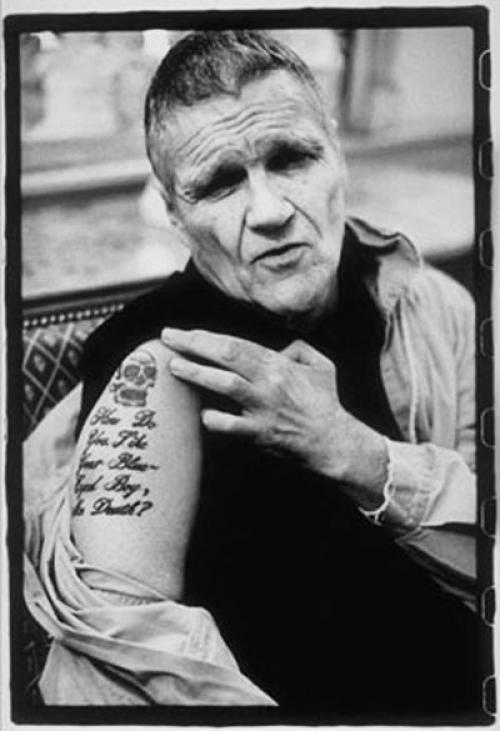
It was with great sadness, and a tremendous sense of unfairness, that I learned of the death of Harry Crews, the Georgia-bred author of The Gospel Singer and A Childhood: The Biography of a Place. The unfairness is somewhat illogical, given Crews’ many years of drinking, fist fights, punishing self-abuse, etc. That Harry Crews should die, even at the age of 76, is not exactly unfair. Nonetheless, we were robbed.
Trying to come up with an appropriate response to my grief-struck sullenness, I decided to take a cue from the man himself. Beyond his literary prowess, Crews was in possession of what I consider to be the very best literary tattoo ever penned and pecked into flesh. On his right forearm, beneath a looming skull, is the ee cummings line, “How do you like your blueeyed boy, Mr. Death?” What better way to pay homage, I thought, than to riffle up some similarly badass literary quotations that would make killer tats? Below is my selection.
It's easier to bleed than sweat, Mr. Motes.
—Flannery O’Connor, Wise Blood
Talk into my bullet hole. Tell me I’m fine.
—Denis Johnson, Jesus’ Son
What business is it of yours where I’m from, friendo?
—Cormac McCarthy, No Country For Old Men
It wasn’t even me when I was trying to be that face.
—Ken Kesey, One Flew Over the Cuckoo's Nest
They can’t tell so much about you if you got your eyes closed.
—Ibid.
I am free and that is why I am lost.
—Franz Kafka
Now I can look at you in peace; I don’t eat you anymore.
—Ibid.
But really, you don't have to look any further than Crews' own New York Times obit for killer tat fodder: "Fight On Deadly Rattlers." What other Crews-worthy ink is out there? What tremendously badass quotes should we all brand ourselves with?
Image: coilhouse.net


Bowker, an organization that generates (and sells) all sorts of information—logistical, sales, customer preference—about the publishing industry, just released the results of a study on ebook buying habits in 10 countries, “major world markets” all. The study presents a daunting array of data: correlating likelihood to buy with age, gender, and income; predicting increases in ebook sales in certain markets; differentiating pace of growth across regional markets; et ceteraz. There's a lot to say about the study’s intrinsically fascinating details, but what I really like is the flurry of responses popping up throughout the publishing blogworld—and usually revealing way more about the responders than the data.
Lots of the responses smack of confirmation bias. Printing Impressions, a business publication for American printers—who, obvs, want to find hope for pulp-n-fiber books—highlights a post pronouncing that the breathless predictions of ebooks eradicating printed books and brick-and-mortar stores are “way off the mark.” (Although, R.I.P. Borders.) Meanwhile, Digital Book World looks into the morass of data and sees that “the world has caught up to the U.S. when it comes to e-book buying.” On the internet, everyone wins! But where do I get my ice cream?
And then there are the thought-tickling observations. At MobyLives, Kelly Burdick was struck by the fact that both the French and the Japanese seem less than enthusiastic about purchasing ebooks. French insistence on the sensuous pleasures of reading a bound book? Or, as Burdick suggests, simply a result of the Amazon ebook store being relatively new in France? Time will tell; there’s nothing in the current study to say. Other people found other things significant. And more people will likely write more, shortly: watch them do it, in real time!
That’s the thing about studies like this one. Bowker generated so much data, and then correlated it in so many ways, that without some sober (boh-ring!) statistical thinking, extrapolations begin to look meaningless. They suggest that data can be bent to support virtually any argument. Which means these broad interpretations may reveal less about what’s going to happen with ebook sales and more about what the people jockeying the data want to believe.
For my part, I find it interesting that India leads the globe in percentage of people who have purchased ebooks: I want to see that correlated with pricing in Indian ebook outlets, access to old-fashioned print books, and availability of ereaders, as well as some remarks about the culture of the book in the subcontinent.
I could avail myself of Google and the lieberry. Or I could take my cue from the blogosphere: extrapolate first, ask questions later.
Image via flickr user Josh Bancroft

In the wake of The Lifespan of a Fact and the agony of Mike Daisey, The Awl has rounded up almost a dozen quotations on David Sedaris and his often slippery handling of facts. Reading them, I realized that this issue had been more or less settled in my mind since I heard him read "I Like Guys" on This American Life—a recording that begins...
Read More
 A Black Balloon Publication ©