



"‘This is an historic day,’ Kerr said. ‘For the first time in our nation's history, a federal court heard arguments as to whether living, breathing, feeling beings have rights and can be enslaved simply because they happen to not have been born human.’ …. [Sea World attorney] Shaw warned the ruling would have profound implications … ‘We're talking about hell unleashed,’ he said.” —CBS News, February 7, 2012, reporting on PETA attorney Jeffrey Kerr and his 13th amendment lawsuit on behalf of five killer whales
“Dr. Navarre refers, in his work on excommunication, to a case in which anathemas were fulminated against certain large sea-creatures called terones, which infested the waters of Sorrento and destroyed the nets of the fishermen. He speaks of them as ‘fish or caco-demons’… and maintains that they are subject to anathematization not as fish, but only as devils.” —from E.P. Evans' 1906 study Criminal Prosecution and Capital Punishment of Animals: The Lost History of Europe’s Animal Trials
“…as for me, I am tormented with an everlasting itch for things remote. I love to sail forbidden seas, and land on barbarous coasts. Not ignoring what is good, I am quick to perceive a horror, and could still be social with it—would they let me—since it is but well to be on friendly terms with all the inmates of the place one lodges in.” —Ishmael, in Moby Dick (1851); part of this passage is cited in D. Graham Burnett’s new book The Sounding of the Whale
Let Me Recite What History Teaches (LMRWHT) is a weekly column that flashes the lavalamp, gaslight, candlelight, campfire, torch, sometimes even the starlight of the past on something that is happening now. The form of the column strives to recover what might be best about the “wide-eyed presentation of mere facts.” Each week you will find here some citational constellation, offered with astonishment and without comment, that can serve as an end in itself, dinner party fodder, or an occasion for further thought or writing. The title is taken from the last line of Stein’s poem “If I Told Him (A Completed Portrait of Picasso)."
Image: Autocowrecks

Say what you will about Lana Del Rey, the pop singer whose recent Saturday Night Live debut Brian Williams called “one of the worst outings in SNL history”; at least she didn’t pull an Ashlee Simpson. So let’s take a break from the whole Del Rey shitstorm and look at a few brave artists who have refused to lip-sync in their music videos.
Read More

Is there a point where the editor edits too much that it ceases to be the work of its author?
The answer to that question may make a good plot for a literary-themed crime novel.
Though crime novels are coming under fire now that crime itself is on its way out in the big bad city.
Good thing you can still turn to the movies to see some good examples of breaking and entering.
But just be careful since you don't want to end up with a lousy obituary.
Maybe you could hire Ben Marcus, whose literary star is on fire right now.
At the very least, you'll never be as ill-remembered as Lana del Ray is right now.
Photo credit: Mask for 'Day of the Dead' (dia de los muertos) in Mexico Photo: Getty images


Cormac McCarthy has finished and sold his script for The Counselor before finishing the novel, and I find the whole situation out of control. Sure, McCarthy has time to finish the novel before the film goes into production, but what if he doesn’t care? What if, by finishing the script, he has created a dead plot for himself that he now only fills in with scribbles and kittens?
On the other hand, how can this script not be the best script ever? From Deadline: “Since McCarthy himself wrote the script, we get his own muscular prose directly, with its sexual obsessions. It’s a masculine world into which, unusually, two women intrude to play leading roles. McCarthy’s wit and humor in the dialogue make the nightmare even scarier. This may be one of McCarthy’s most disturbing and powerful works.’”
Most disturbing and powerful? Muscular and masculine? Wit and humor make “the nightmare” scarier? How are my bodily fluids even contained right now?
In order to calm down just a little bit and try to find a little focus, I decided it might be nice to come up with a couple of casting ideas. Without even the slightest hint about what these female characters are like, I would like to suggest four women I think would be brilliant. My suggestions are based on who I think would survive in a Cormac McCarthy landscape. You know: can they hack an animal to death? Can they fashion tourniquets out of sheets? Can they kill a man with their silence?

Image: mubi.com
In the film Movern Callar, Samantha Morton played a woman who hacked up her dead boyfriend’s body in the bathtub while listening to the Velvet Underground. Movern Callar is not a horror film. Done.

Image: deadline.com
Because Carey Mulligan looks so damn sweet all the time, everyone thinks she’s child-like and needs protecting. So when she’s quiet for just a little too long, not smiling, there’s an intensity and depth that’s disturbing. Like Kelly Macdonald in No Country For Old Men, Carey Mulligan knows what the hell is going on.

Image: moviespad.com
Have you seen We Need to Talk About Kevin? Yes, it’s the worst title for a film ever, but Tilda Swinton rocks it as the kinda psycho cold-ass mother to the totally psycho wacked out kid. Tilda Swinton could skin babies alive. I don't doubt it for a second.

Image: tvguide.com
Years after the horrifying Requiem for a Dream, my adoration for Ellen Burstyn was renewed in her stunning portrayal of a harsh, clinically upsetting suburban matriarch in Another Happy Day. Have you seenAnother Happy Day? Get out your depression shoes and start walking down sad street. No one alive could kill Ellen Burstyn before Ellen Burstyn kills them with her contempt.
Cormac McCarthy image: twitchfilm.com

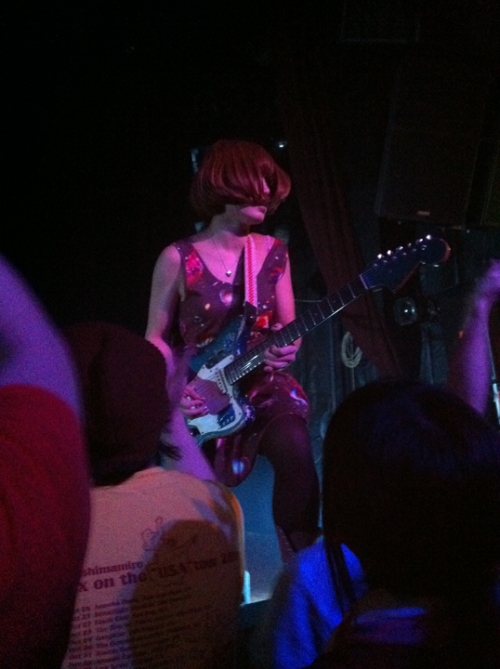
December, 2011: Fresh off two flights totaling 14 hours, I hit the streets of Tokyo. The thrilling all-female band TsushiMaMire had scheduled a one-off ahead of their big 2012 tour, at a stupidly named but promisingly chic Shibuya venue called clubasia. I'd met these riot grrrls at Santos Party House, and I was aching to catch them again on their home turf. So I did what any ballsy foreigner would do: I emailed them, including a brief message how we'd met in New York and that I'd be in town. Mari, the ballistically cute, ferocious singer/guitarist, immediately wrote me back, all excited. I was in.
Tickets to Tokyo rock shows cost up to 30 American smackers, which is likeTerminal 5 prices for a dude used to dropping $7 for an absolutely bonkers night at Death By Audio. But remember: this is Tokyo, where a Starbucks double espresso goes for $7. Luckily, most tickets factor in a one-drink pass, and drinking at Tokyo live music venues is good, from the smoothest draft beer to the surprisingly ubiquitous Zima.
Photography at shows is generally discouraged, and while you won't be ram-jammed for having your iPhone out, you also won't see people paying more attention to their smartphones than the band. What you can do is smoke cigarettes, so sensitive types should consider donning the ubiquitous "surgical" face-mask.
Locals can reserve tickets online via Lawson Ticket or EPlus and pick them up at their neighborhood 7-Eleven, which is awesome. But for us live-music freaks without local permanent addresses, that's a no-go. Bummer: after all those plane-hours getting stoked about bands, I wanted some guarantee that I'd get in. Good thing I'd sent that email.
On my way to the show, I traversed the rolling avenues of Love Hotel Hill in Dogenzaka, Shibuya. Picture gaudy-ass façades, pink neon and sex advertseverywhere. As Mari had reserved my ticket, I queued up opposite the physical-tickets group, which I noticed was assembled in "waves": like 1 to 4, similar to boarding an aircraft. Outside clubasia's stage room, I noted coin-lockers lining the corridor, where one could stash gear for a 300-yen fee. The importance of these lockers became very clear to me moments later, when the show erupted.
The floor was two-thirds the size of Music Hall of Williamsburg, including elevated stage, and everyone in the first three rows was decked in TsushiMaMire merch: t-shirts, multicolored scarf-towels, buttons, that jazz. I got to know my neighbors, like this reed-thin young dude who was stoked to see TsushiMaMire for the first time, these two cute girls, and this young salaryman-type, still wearing his suit and tie. Then TsushiMaMire ripped into their set…and I found myself slam-dancing. Yes: the front-row types were the hardcore fans, throwing up heavy metal horns in unison, hollering on cue to Mari's riffs, and moshing up a frenzy.
OK, I thought, boosting up the reed-thin dude so he could crowd surf, that'swhy the coin-lockers.
Image: courtesy the author


Several questions came to me while reading Garth Risk Hallberg’s Timesriff, "Why Write Novels At All?" And by "questions," I really mean "moments of skeptical irritation."
To Hallberg, “The central question driving literary aesthetics in the age of the iPad is no longer ‘How should novels be?’ but ‘Why write novels at all?’.” He identifies Jonathan Franzen, Zadie Smith, David Foster Wallace, and Jeffrey Eugenides as the new literary big guns, and then, from what I understand, asserts that the challenges these writers face are not so much questions of form or craft; the new shit to ponder and be judged by is how well the work manifests a sense of connectedness with other people.
Hallberg seems to be saying that these writers have eschewed an exploration of formal principles and standards that would separate themselves from "lower" forms of art. The challenge now, for the, like,super good top literary writers, is to run with this whole empathy thing, making sure not only to "delight" readers, but to "instruct" them as well. But simply because these writers have asked similar questions in and about their work doesn't mean they've ceased to concern themselves with matters of craft. Jonathan Franzen is deeply invested in the style and forms of domestic, realist fiction. David Foster Wallace was an enormous influence on bringing hyper-realism into mainstream culture. These writers have in no way ignored the questions involved in how novels should be.
Another issue I have is Hallberg’s identification of Franzen, Smith, Wallace and Eugenides as writers who are driving literary aesthetics. While these writers are the more literary on the top-seller lists, they are not working in a vacuum. There are other writers at work. Whole pockets of lesser known (even "experimental") writers have been playing with language and style in very serious, exciting, and different ways. They may be on the outer edge of well-known fiction, yet the very fact of their play with language and form pushes its boundaries all the same. To claim that the new "literary" standard is a warm gooey center of feeling surrounded by some sort of message is simply a mistake.
The other boner to be contended with, as far as I see it, is the underlying assumption that the hallmark of "special feelings of togetherness" has usurped formal considerations. Special feelings have always been at work in literary fiction. This whole "not being alone" moralist emotionality has always been at play, in conjunction with formal considerations. Not a dichotomy. Great literature has very special feelings! Great literature stirs very special feelings in the reader!
Screw the whole "message" nonsense (I’d need a whole other post to slog through that wad of sunshine), but feelings! And standards. My god, please, standards, rules, principles. Not everyone can get a gold star. The "age of the iPad" doesn’t change that.
Image: tullamorearts.com

Following yesterday's post on the correlation between creativity and personal space, James R. checks out a study that, seriously, could revolutionize the way we go about writing. But first, some brain teasers.
Read More

"[T]hey were on the 7 train…that goes out to Flushing, and a transit officer saw them filming the tracks on the line, and they professed not to be able to speak English and we were able to bring to the scene one of our Farsi-speaking officers, and they were questioned…ultimately, they were ejected from the country…persona non grata.” –NYPD Commissioner Raymond Kelly, “Bonus Footage” The Third Jihad, produced by the Clarion Fund and screened to roughly 1500 members of the NYPD in 2010.
"'A foreigner, dressed like an Arab, with a great bundle on his head, took two single thirds for Hull by the midnight express' [...] ‘Why were they not detained?’ ‘We had no authority to detain them, nor any reason.’” –from Richard Marsh’s 1897 novel, The Beetle.
"An accumulation of coarse sawdust around the base of infested trees…is also a sign of the presence of the Asian Longhorn Beetle…If you suspect you have an infestation of ALB, please collect an adult beetle in a jar, place the jar in the freezer, and immediately contact the Bureau of Forestry at 717-948-3941." –Lebanon County Preservation District “Tree Vitalize” Program.
Let Me Recite What History Teaches (LMRWHT) is a weekly column that flashes the lavalamp, gaslight, candlelight, campfire, torch, sometimes even the starlight of the past on something that is happening now. The form of the column strives to recover what might be best about the “wide-eyed presentation of mere facts.” Each week you will find here some citational constellation, offered with astonishment and without comment, that can serve as an end in itself, or an occasion for further thought or writing. The title is taken from the last line of Stein’s poem “If I Told Him (A Completed Portrait of Picasso)."

In last week's New Yorker, science writer Jonah Lehrer presents an interesting correlation between creativity and physical space. He sums it up with a quote from Isaac Kohane, a Harvard Medical School researcher: "Even in the era of big science, when researchers spend so much time on the internet, it's still so important to create intimate spaces."
Read More

I just dug up my copy of The Great Gatsby, full of my highlighting and marginalia from junior year. I can’t think of a friend who didn’t read it for American Lit in high school, and I’ve only met one person who didn't love its clarity and beauty. I looked at the dedication: “Once again to Zelda.” But the epigraph took me by surprise.
Then wear the gold hat, if that will move her;
If you can bounce high, bounce for her too,
Till she cry “Lover, gold-hatted, high-bouncing lover,
I must have you!”
—Thomas Parke D’Invilliers
Plenty of books have interesting epigraphs, as Kayla recently pointed out, but I couldn’t believe I had missed this one completely. The poem’s inclusion does make sense, I suppose: the whole book is about self-interested characters trying to charm each other. And there’s a visible shift across the novel from Gatsby’s aloofness, with his showy library (“Knew when to stop too—didn’t cut the pages,” a guest at one of his parties declares), all the way to his final, embarrassingly honest determination to “fix everything the way it was” in order to woo Daisy once more. So the D’Invilliers quotation is a fitting epigraph—another green light leading Gatsby on.
But then I decided to look up Thomas Parke D’Invilliers, figuring he was a nineteenth-century author or a British dignitary. I was wrong. D’Invilliers is a pseudonym for Fitzgerald himself. I was struck by this subtle trick. A pseudonymous epigraph per se isn't all that dishonest, but F. Scott could just as easily have left it unsigned. The same name had surfaced in This Side of Paradise, actually: in that case, D’Invilliers was a stand-in for F. Scott's friend, John Peale Bishop, and in the novel he was an aspiring poet. In real life, as is implied in The Great Gatsby's placing his pseudonym next to several lines of verse, he became an accomplished poet.
But the line's been blurred here: is the Thomas Parke D'Invilliers of the epigraph supposed to refer to John Peale Bishop or Fitzgerald himself? If the author had chosen to call his masterwork Gold-Hatted Gatsby or The High-Bouncing Lover, this question might have been an even more significant one. As it is, it reads like a fumbling attempt on the author's part to erase his presence in the book.
Nick says of himself, “I am one of the few honest people I have ever known.” I didn't always buy that Nick was a fully reliable narrator, given the way he often withheld information from me. So I wonder: if Fitzgerald has been playing with truth from that prefatory page of the book, what else has remained buried under his words, undermining or contradicting the seemingly straight trajectory of his story? Few interpretations of The Great Gatsby have succeeded in aligning F. Scott Fitzgerald with any of the characters within, so why does a trace of him linger here? And if Nick is a liar by virtue of his author's manipulations, then how much has he, as a narrator, been hiding from us about the American Dream?
 A Black Balloon Publication ©