


When it's said and done we haven't told you a thing
We all know that crap is king, give us dirty laundry.


Images: NYTimes, Jezebel, logotv.com, CBS News, Huffington Post
Answers to last week's installment:
- "The 12 Most Cringe-Worthy Debate Moments in History" (ABC News)
- "Sikhs Bristle at JK Rowling's Hairy Female Character" (Times of India)
- "Kanye West's Second Paris Fashion Show: A Recap" (MTV)
- "Robert Pattinson & Kristen Stewart Will Promote 'Breaking Dawn'" (YourTango)
- "Arthur O. Sulzberger, Publisher Who Transformed The Times for New Era, Dies at 86" (NYTimes)
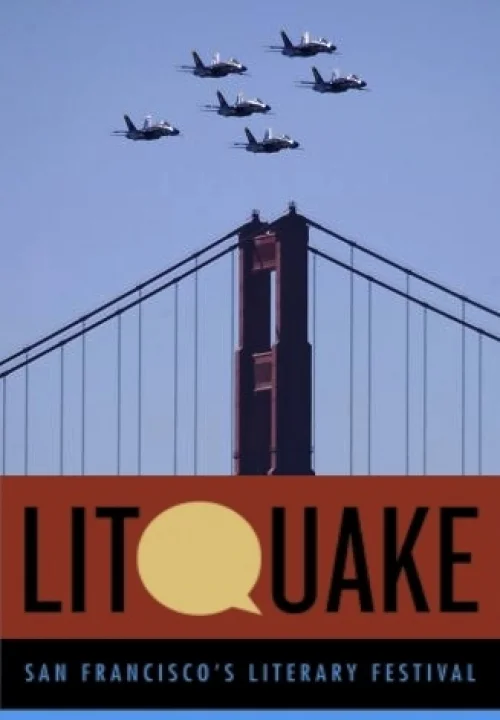

The first day of Litquake, San Francisco’s annual literary binge, had some serious competition: on Saturday afternoon, the SF Giants were in the playoffs; Hardly Strictly Bluegrass drew hundreds of thousands to Golden Gate Park; the America’s Cup occupied the waterfront with 1%-ers; and it was Fleet Week, that quaint local tradition in which the Blue Angels tear back and forth above our city in a bizarrely irony-free celebration of America’s militarized cultural identity.
In a dimly lit room at the California Institute of Integral Studies, the thoughtful mood punctuated by the sonic rumbles of the Blue Angels, four writers of color gathered to talk about Rewriting America: Race and Re-imaginings in Post-9/11 America. This certainly wasn’t the Banjo Stage; things got serious, and political, and quickly.
“I am the new enemy,” said Francisco X. Alarcón, who identifies as Mexticoand is involved in the fight against SB 1070, the Arizona state bill outlawing cultural studies (and, effectively, literature by non-white writers). “Now that there are no Commies, they’re coming for people who look like me.”
Elmaz Abinader, a multi-genre writer who founded VONA: Voices of Our Nation Arts Foundation, the prestigious writing workshop for writers of color, began her reading of poems about Palestine with the observation that “America is the only country in the world where people run outsidewhen fighter planes fly over.”
Panel moderator Pireeni Sundaralingam read several selections fromIndivisible: An Anthology of Contemporary South Asian American Poetry, which she coedited with Neelanjana Banarjee and Summi Kaipa.Sundaralingam spoke of the difficulty in getting the book greenlighted in the face of publishing industry types who couldn’t comprehend that "South Asian American” writers are, in fact, Americans.
And Cave Canem Prize winner Ronaldo V. Wilson performed a chilling sound poem mashup: his own recorded voice recalling New York on the day the towers fell vs. his live reading of freewheeling poems touching on race, sexual identity, and class conflict.
Each writer discussed the complexities involved in existing outside of the mainstream in a country where people who look a certain way or practice a certain religion are now required to spend the bulk of their energy reassuring others that, as Sundaralingam put it, “We’re not terrorists.”
To end the afternoon, the panelists each doled out some quick tips for young writers of color — and for all writers.
On navigating the “establishment,” whether in academia or the publishing process:
“Go hard and strong on what you believe and don’t get pushed.”
—Abinader
“When they tell you no, you have to say yes. Don’t be so concerned with mainstream America; the gatekeepers will always be gatekeepers.”
—Alarcón
“Forget it — I’m just gonna make art … and let everyone else figure it out. [When I wrote my first book] I had an audience in mind: all the unusuals, all the freaks.” —Wilson
On creating a space for writers of colors within the larger literary scene:
“When you see other writers [of color] taking risks, support them — critique, publish, review their work, serve as their editors.” —Sundaralingam
“Everything you write creates a community around it. Go out and find it.” —Abinader
On the death of literary magazines, and the rapid disappearing act of arts funding in general:
“Think long term, invest in yourself. The institutions won’t survive.”
—Alarcón
“Defeat Romney. Keep arts consciousness alive. We can’t let this die.”
—Abinader
Great way to take stock of issues of race in the lit industry before what promises to be a week of copious — and often overwhelmingly white — literary scene-making in San Francisco. Now if only those damn planes would shut up, we'd be getting somewhere.
Images: Blue Angels photo via Paul Chinn, The Chronicle / SF ; Litquake logo via Litquake's Tumblr.


Zadie Smith, in a recent Granta interview, mused that "the problem of life is basically: I only have one and it moves in one direction. People tend to seek all kinds of solutions to that dilemma, and the anonymity of technology has offered us a new kind of 'out.'"
I scribbled this on a piece of paper, so that I could see those words when I wasn’t working on my computer, and thought about my own novel. As I write it, I'm obsessed by the question of identity: how the self is defined, and divided.
I was once asked why my bookshelf had barely any titles published before 1950. My answer, then and now: I'm less interested in the theodicy of The Inferno or the social mores of Madame Bovary than I am in the perceptual miasma of American Psycho and the personal struggle for authenticity in Tom McCarthy's Remainder.
The philosophers to read on personal identity and the self — Derek Parfit and Thomas Nagel and Galen Strawson — are on my shelf, too. They all discuss identity from a personal point of view. Take Parfit’s thought-experiment: If I am perfectly replicated, down to my memories, on Mars, and my original Earthbound body is simultaneously destroyed, is my identity — memories and consciousness and all — continuous from one body to the other? (For the answer as well as further complications, read part 3 ofReasons and Persons.)
My question isn’t Am I the same person in these cases? so much as Do other people think I am the same person?
These problems are at the heart of Smith's novel, NW. They're not new problems, but she presents a relatively new solution: the Internet. Her characters change names, take on new virtual identities. The inverse, identity theft, is just as compelling: Dan Chaon's Await Your Reply (and let's not forget The Talented Mr. Ripley) exploits the divide between the self we experience and the self other people perceive.
Whether multiple people are occupying the same identity, or one person is shifting between many identities, the allure for readers is the same: the inside does not match the outside, and one person has to struggle to keep up — or confront — the lie.
We keep reading because we believe the truth will out. Oedipus is one of the oldest stories of mistaken identity, and we feel weirdly vindicated when the king realizes the real relationship between himself and Jocasta. But it took gods and prophets to bring out the truth; we have no such props in the arsenal of postwar fiction. We are more like The Man Who Folded Himself, watching helplessly as the same person splits in two, four, a hundred...
So we wait and watch for our characters to betray themselves? I certainly do. I want Adam Gordon in Leaving the Atocha Station to admit that he does not know Spanish. I want Patrick Bateman in American Psycho to realize whether he is hallucinating or not. I want Julius in Open City to acknowledge the horrible act his old friend accuses him of.
I want the truth; I suspect we all do. We want to see two lives collapse back into one. Maybe it will show us how to collapse the identities we, too, harbor.
image: thegreatbookslist.com

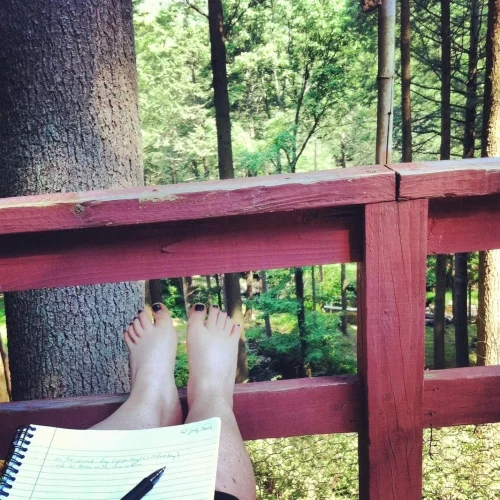
As Alexander Chee recently wrote in a lovely essay for the Morning News, we should all definitely go to writing colonies as much as possible. But not everyone gets to chill at Yaddo with the lit stars. So how can a writer acquire that enviable writing-colony glow if she’s not experienced enough, lucky enough, or possessed of enough free time to chuck it all and head to the woods?
Good news: people, especially those who don’t fit perfectly into the traditional literary establishment (see also: women, genre writers, people of color, people with day jobs), have been writing for centuries without delightful daily lunch baskets waiting for them on the steps of their light-filled studios. People even write without MFAs, or Twitter followings! We write wherever we can, however we can, and we get our life stuff done and manage to keep on writing.
Here are a few suggestions for writers without a (free) room of their own:
1. Weekend Quarantine, otherwise known as “staycation.” We know, your apartment is small and filled with distracting stuff, and your roommate blasts Taylor Swift all night long. You know who has a nice apartment? Someone else. Ask a friend if you can swap places for a weekend. Keep your eyes peeled for housesitter gigs. Basically, try to spend a chunk of time anywhere that is different from the place in which you normally write. NB: Working in a café won’t cut it. You need space and quiet if you’re ever going to replicate that magical “I’m Only Here To Write” feeling.
2. Once you’ve scheduled a Weekend Quarantine (or its younger cousin, the Day-Long Writing Binge), take care of any creature comfortsbeforehand: Stock up on food and coffee, and pre-plan your meals. If you’re really persuasive, maybe you can get an elfin friend to deliver you a lunch basket, but leftover pasta will probably suffice.
3. Go to the library. Have you heard of these places? They’re amazing. They are full of books and electricity and you can get stuff done in there! And they are free.
4. One of the best things about colonies is the interactions you have with other artists while you’re procrastinating — er, processing. To get a hint of creative cross-fertilization, begin a writing session with some non-writing. If you write prose, read a poem; for a different view of the world, peruse a book of photography or paintings for ten minutes. And listen to music. (I prefer music without vocals — my go-to writing albums are Coltrane’s Africa Sessions, Chopin piano pieces, and anything Explosions in the Sky, Dirty Three, or Electrelane.)
5. Log onto your Facebook profile. Go to the little “account menu” arrow in the upper right hand corner (or wherever they’ve moved it lately). Choose the option that says “Account Settings.” Choose “Security.” Click on “Deactivate your account.” There, you've just cleared hours a day off your schedule.
Extra Bonus Pro Tip: Don’t sweat the scene. So you’re not besties with Andrew Sean Greer? So what. Suck it up and write, already.
Image courtesy the author


Everybody loves a good infographic. Need to summarize a complex set of statistics (like, say, alternate band names for Pussy Riot)? Try a pie chart. When scientists have trouble understanding data, they use 3-D imaging to map the invisible patterns of airplane turbulence or visualize how a woman’s hair might rumple if she uses X Brand of shampoo, as illustrated inDiscovery Magazine.
But how do you portray invisible occurrences that are not data-driven? What are my options if I want to visualize the emotional ups and downs of my new favorite song, or understand the subjective history of a public space? Can I get an infographic of some feelings over here?
Here are five artists who are making the invisible easier for us to see.

Music: Andrew Kuo
Andrew Kuo makes infographics based on unreliable information. His minimal, brightly colored graphs chart the unchartable, with a particular focus on music: he might rank the emotions of Kanye West’s “Robo Cop” in comparison to other "great" break-up songs, or plot his reaction to a new 9-minute Joanna Newsom single. If music really is just another kind of math, I want Kuo to be my trigonometry teacher.
Motion: STREB
Choreographer Elizabeth Streb approaches dance like a scientific experiment. In performance and at her Williamsburg "lab," STREB dancers test the invisible laws of motion by throwing their bodies against them. Like, literally. Want to know what gravity looks like? Watch the dancers fly off scaffolding and land hard on their bellies, or balance impossibly on giant spinning hamster wheels. Seeking a spectacle that demonstrates the principle of inertia? Streb's got you covered: dancers run into walls at full speed, duet with lethal projectiles like steel beams, and generally stomp all over the limits of time, space, and muscle.
Cities: Rebecca Solnit
With 13 books under her belt, nonfiction writer Rebecca Solnit has made a career out of exposing subtle truths. (Full disclosure: I once worked for her.) Her 2010 book, Infinite City, visualizes the layered history of San Francisco through maps of seemingly unrelated sites: "Monarchs and Queens" overlays the natural history of the monarch butterfly with queer civil rights history. The result is an atlas of previously unseen connections, a shifting paper record of a living city. A New Orleans version, Unfathomable City, is due out in 2013.

Institutions: Anna Schuleit
There’s the invisible, and then there’s theinvisible — the people pushed beneath the narrative because, as Ralph Ellison’sInvisible Man put it, we refuse to see them. When the Massachusetts Mental Health Center closed in 2003 after 90 years of operation, artist Anna Schuleit was commissioned to create a work memorializing the building. Her stunning installation, BLOOM, filled the decommissioned mental institution with 28,000 living flowers paying tribute to the lives that passed through the space.
Media: Teju Cole’s Twitter feed
There’s invisible, there’s invisible, and then there’s dead. Novelist Teju Cole, author of Open City, tweets about the news — specifically, newspaper notices of death and crime from 1912 New York. He calls the project “Small Fates." Taken as a whole, Cole's timeline is a chorus of funny/sad ghosts. These are the long-forgotten voices of regular folk — criminals, victims, and reporters — a quotidian citizenry of the city, distilled into poetry.
Did I miss any? By all means list your favorite visible/invisible artworks in the comments. Granted, the question of whether what we see is truly "real" is always open to dorm-room-stoner interpretation. But I'm thinking that art has science beat on this one.
Images: BOMB Magazine, Andrew Kuo, Anna Schuleit


Wikipedia, the scourge of teachers who still give writing assignments (as if students still had a chance of becoming literate), cannot rely solely on the blood, sweat, and wikitears of its editors alone. There's simply too much content: as of now, that'd be over four million articles in English alone, plus at least as many in other languages. The English edition, if you printed and bound it, would fill almost nine library shelves. So, according to a recent BBC News Magazine article, the Internet encyclopedia now runs with the help of bots.
Essentially, the bots have to be used because of the logistical massiveness of the encyclopedia. Its contents can be edited by all the people who read it—which means, if you think about it, they should be as tagged, graffed, and marked up as the stalls in your favorite dive bar: FREE ART DEGREES, DREAMERS should be written next to every figurative roll of toilet paper on every page of Wikipedia, right? Somehow, it's not.
The relative cleanliness of Wikipedia is due in large part to the bots—armies of them lurking behind the scenes, looking out for changes to articles that are irrelevant or offensive. Gone are the days when you could squeeze "phuque" into your hometown's demographic chart or kill a lunchbreak by putting dick jokes into Anthony Weiner's page, and gone are the days when you could put the name of your arch nemesis on the list of prominent war criminals. So much for those shitzingigz.
Of course, Wikimedia stresses the fact that the bots are not calling all the shots, and that human editors are necessary to retain the polish—such as it is—of the site. And you might think that that is going to be the case for a while. Except you're probably wrong. Bots are already writing effective articles, covering things that no human would really want to write about. Like little league games.
Once the robowriters start breaking into a more general writing field—I'm guessing that romance and thriller genres will be the first to see commercially viable, algorithmically generated content—the literary landscape will change at an even more rapid pace. You thought eBooks were the end of novels? Wait till a bot compiles a narrative specifically honed on your Amazon buying habits.
In response to this technological marvel, writers will probably become more formally experimental, seeking to convey in ways that escape conventional tropes. (Yay. For. Poetry.) And their audience will probably take renewed pleasure in standing in the same room with them, knowing that the words they savor are the work of a fleshy primate. (Hasta la vista, mass-culture.)
Image: but does it float

In honor of his birthday (June 25), Brainpickings related George Orwell’s top four motivations for writing: egoism, aesthetic enthusiasm, historical impulse, and political purpose. I have often thought that pinning down why I write might give me insight into how I could proceed with new creative work, so I was quick to connect Orwell's motivations with my own. In my twenties I was big on getting things right, creating vivid moments of some sort of true experience, kind of like Orwell's historical impulse. More recently, the sound and impact of words—pure aesthetics—have come to the forefront.
What intrigues me now is Orwell’s attention to early development and inescapable "emotional attitude." This is from his essay "Why I Write":
I do not think one can assess a writer’s motives without knowing something of his early development. His subject matter will be determined by the age he lives in—at least this is true in tumultuous, revolutionary ages like our own—but before he ever begins to write he will have acquired an emotional attitude from which he will never completely escape. It is his job, no doubt, to discipline his temperament and avoid getting stuck at some immature stage, in some perverse mood; but if he escapes from his early influences altogether, he will have killed his impulse to write.
For me, this relates to Ben Marcus’ theory that each writer has one essential story to tell — a story that must be repeated in different ways and can never be resolved. The thought that the compulsion to write can be understood as some kind of unresolvable psychological tic ... tickles me. There is something wrong with writers, and we've made it our business to publicly pick at our scabs.
It’s interesting to compare Orwell’s insistence on early influences with Joan Didion, who has a "Why I Write" of her own. Didion says, “Had I been blessed with even limited access to my own mind there would have been no reason to write. I write entirely to find out what I’m thinking, what I’m looking at, what I see and what it means. What I want and what I fear.”
With Didion, I find the answer to the question of how to proceed. While I very much enjoy thinking about early influences and uncontrollable compulsions—and I love Orwell for saying "Good prose is like a windowpane"—I really don’t have a hold on why I write until after I am writing. The compulsion to write in itself is only really examined, for me, in the process of writing. I don't have any real ideas about what my scabs might look like until the writing itself shows me. It may be my poor memory, but I need the physical presence of words to spark any kind of recognition of that which is real.
In any case, thinking about writing never quite gets any work done. The only thing is to keep writing.
image: bambinipronto.com.au


I've been writing about language usage for the last two weeks, spurred on by Steven Pinker's critique of a New Yorker piece on the divide between prescriptivists and descriptivists. Last week, I argued that patterns of speech are not just abstract tools; they actually constitute part of our bodily identity, which complicates claims about what constitutes good speech. This post looks at how we can still probe language and give it some measure, even if the tools we have are as culturally particular as Samuel Clemens's psuedonym.
How you speak lets the world know who you are. Even if you switch accents as often as this kid, you reveal your origins with the idioms you use. You could be a non-native speaker, a b-school d-bag, a busted urbanite, a grifter whose slithering turns of phrase endear you to anyone with a susceptible ear. However you speak, we have the sense, egalitarian-minded that we are, that it is illiberal to judge you for idiosyncrasies outside your control—your place of birth, your heritage, your parents’ linguistic tics.
This is why language standards are such difficult pancakes.
Yet, there is the problem of taste. Sometimes you have to wonder why certain gestures really hit you in the gut but glance right off other people. There's no single metric of taste, but thankfully there’s something better: understanding the process through which aesthetic judgments are affirmed or disavowed. You can account for taste, even if it involves complex exchange rates.
Here's how it works. Taste is at once an inversion and a strengthening, a way of self-reflectively relating your own appreciation of a thing to that of others—specifically, the peers whose opinion you wish to garner, passively or not. So when you're looking at a piece of art, you gague your own reaction to it and simultaneously measure that feeling against that of the people to whom you'd like to appeal—in both senses: you want your judgment to be appealing to them, and you appeal for their support in having made it. In doing so, you're providing judgments about things that other people use to inform their own tastes. Sort of like dumping a bucket of sand onto the beach on which we're all making mud castles: it's good to have dirty hands.
Once you realize that taste is endlessly being reshaped through the intentional effort of many people, yourself included, you're all set to take on prigs and pedants. Suddenly, their bugbears are mere historical contingencies. "That" and "which," for instance: someone at some point assured us yanks that these were distinct, even though the record of written and spoken American English upholds no distinction. Count it another quixotic case of prickly genteel folk attempting to swim against the linguistic tide.
Speaking of "quixotic," consider a cherished old volume of mine, Fowler's Modern English Usage. The second edition, printed in 1965, calls out people who pronounce Quixote as it would have been pronounced in Spanish for "didacticism." Now, a mere half-century later, people who don’t give a Spanish pronunciation to Cervantes’ character would almost certainly stand out as unschooled.
Other manuals fare poorer. Strunk and White's The Elements of Style wears its convictions on its spine: here is a unified manual of stylistic concerns, rendered in their simplest components. Unfortunately, the book itself is riddled with tips and tics that are just plain wrong.
Garner's Modern American Usage values communication over avoidance, and even helps people know exactly how out of touch their grammatical foibles are. While verging on the pedantic, it has no pretensions about preserving an ahistorical version of language. For words like "enormity,"famously misused (or was it?) by President Obama, Garner’s includes a scale laying out how acceptable the usage error is. You can feel safe indulging your peevological urges if something has low broad acceptance, but once something is as gone as the distinction between nauseous and nauseated, you better let it go.
Usage guides, and the people who love them, have got to take into account the way language evolves. After all, we just want to communicate as clearly and effectively as possible—which means in full awareness of the way language is made on all of our tongues. Hopefully, we can agree on that.

Jay McInerney, writing in the Guardian last month, tried to understand the enduring power of The Great Gatsby. His answer was writerly: it's the prose, stupid. "Without Fitzgerald's poetry," McInerney says, "without the editorial consciousness of Fitzgerald's narrator Nick Carraway, the story can seem threadbare and melodramatic."
Read More
New rules for fulfilling your creative dreams: 1) work when you're tired; 2) work when you're buzzed; 3) forget everything you learned in school.
Read More

 A Black Balloon Publication ©