



A recent Telegraph post about the relationship between poets and their editors starts off with the nervous subhead, “If one poet edits another, whose work is it?” Tensions arise over the prospect of editors having too heavy an influence, the implications of an incestuous landscape. How can we rest assured that our most treasured poetry is "pure"?
Lucky for me, I am completely unperturbed by this notion of purity. I, in fact, adore quite a few exceptionally heavy-handed editors. I’m also still coming off the glory high I got reading Jonah Lehrer’s article in last week’sNew Yorker about brainstorming, in which Lehrer debunks the myth that brainstorming has to be free of criticism in order to be productive. Criticism and debate have been shown to actually improve creativity. Ha! Criticism wins! Editors are helpful!
So, seeing as how some people could use a little push toward criticism-acceptance, I’ve decided to draw up my top five reasons (with a little help from Lehrer, whom I quote liberally below) we shouldn't fear the red pen.
1. Science says that “exposure to unfamiliar perspectives can foster creativity.” Sure, everyone has something to say. If it's useful, steal it. If it's not useful, it can help define what it is you're not looking for.
2. Science also says that “dissent stimulates new ideas because it encourages us to engage more fully with the work of others and to reassess our viewpoints.” Dissent! Know thine enemy! How better can you position yourself to be the champion? Would you even know about being a "champion" if it weren't for the presence of critics?
3. For the most part, no one is paying any attention. If they are paying attention, they will forget everything you’ve done in less than thirty seconds. There is only so much time you have to engage and really have an effect on someone else, so you might as well try to make it count. Good criticism can help push you toward that effect.
4. For the most part, we are not paying attention. Do you know how many unconscious actions I’ve committed, for years, without knowing? I couldn’t be the first to end a telephone conversation until I was 24 years old—and I had no idea. Or with my writing: how many times in a paragraph do I have to mention a hand touching something before someone shoots me? We all need someone else to tell us what it is we are doing.
5. No one wants to hear you whine. What are you, a baby? Whether it’s the undergraduate with the rambling justification or the man-child distraught because not everybody likes him, whiners are usually too busy suckling on the self-absorption tit to get any work done. Don’t be one of them.
Good criticism can save you from the enormous embarrassment your actions alone will undoubtedly lead you to. So what's the difference between shitty criticism and good criticism? Honest, deep concern for the creative object at hand. As long as the critics you listen to are truly engaged with what it is you’re trying to accomplish—and not just smarmy ass-clowns with ulterior motives—they deserve a good listen. Even the act of turning away can lead to something better.
Image: curmudgeonloner.wordpress.com


"Every once in a while you get the truth from a movie."
—Warren Beatty, 2012 Academy Awards
The Lifespan of a Fact, the new book by essayist John D’Agata and his fact-checker Jim Fingal, has caused a lot of ruckus. The book lays out an essay by D’Agata accompanied by the annotations of Fingal and their correspondence over seven years of working on the project. Fingal is intensely scrupulous when it comes to accuracy and facts, while D’Agata bristles under the procedures of nonfiction—he’s trying to accomplish something else. There's a lot at stake concerning fidelity to the facts,journalistic integrity, the expectations we have toward different forms of art...basically, the nature of truth itself.
Black Balloon’s forthcoming book, Louise: Amended, is a memoir that includes fictional interludes. In these interludes, author Louise Krug assumes the third-person POV and imagines the thoughts and emotions of her family members. This technique bucks the expected boundaries of the memoir form, but by including these other perspectives, Krug has arguably expanded the depth and scope of the memoir’s experience to include a truth larger than the narrator’s alone.
I think the debate concerning nonfiction’s relationship to truth could benefit greatly from the inclusion of texts written about truth and photography. Susan Sontag, Roland Barthes, John Berger and countless others (most recently, Errol Morris) have written about the nature of photography: its relationship to reality and time, the intricacies of what exists just beyond the frame, etc. If great artists and thinkers are still grappling with photography’s depiction of reality, isn’t it fair to assume that investigation into the nature of nonfiction’s depiction of reality is worthwhile?
One of the reasons I believe art to be so profoundly necessary is because it functions as a context in which the truth is possible. Or at least provides a context in which the truth is painstakingly sought after, if not quite achieved.
Truth is not always acquired by means of unveiling what already exists in the world. Sometimes, truth is achieved by sheer creation, brought about by something entirely new. I believe both truths—unveiled and created—to be absolutely necessary, and I would strongly oppose any restrictions or impediments to the exercise of either. If D’Agata is playing with a new context (or simply a context that has gone out of style) in which truth might be created, we might just want to pay attention.
image: grokzone.com


I remember when the High Line opened in 2009: amid the reports of overcrowding, I heard people gushing about the greenery, the views and, of course, the famously non-reflective windows of the Standard Hotel. Everybody in New York thought it was the new Central Park.
But now it’s late winter, and everybody’s long since moved on to other novelties (fake snow in Union Square, anybody? How about an indoor park?). The weather’s been unnaturally nice in the city, so I decided to go for a walk on the High Line. To do that, of course, I had to take the subway. Only in New York: going underground to go aboveground.
There were the usual groups of tourists, and occasional couples wandering up and down the pathways. But the plants were pretty sparse, and as I looked up at the Standard, I had to shield my eyes. So I was surprised to feel more relaxed, at a remove from the city, even though I could see skyscrapers in the distance.
Why was anybody here, really? What do parks have to offer in the winter? Are New Yorkers so starved for nature that they have to make pilgrimages to these carefully tended gardens to get their green fix?
If this is a problem New Yorkers face, they’re not alone. My friend Daniel works in Paris, and decided to make a day trip in July out to Giverny, about an hour away (less if you go 150 km/hr, of course). He dragged along three more people in his rental car, and they couldn’t stop remarking on how relaxed they felt after a trip to Monet’s gardens. It was a way of escaping, yes, but the greenery itself had a way of settling their souls after so much time in the steel and glass and concrete of the city.
I came back from the High Line and pulled out my copy of Wordsworth’s poems. It fell open, as it usually did during my Romantic Poetry class in college, to Tintern Abbey. As the rhythms rolled over me, my eyes caught on the stunningly contemporary lines:
These beauteous forms,
Through a long absence, have not been to me
As is a landscape to a blind man's eye:
But oft, in lonely rooms, and 'mid the din
Of towns and cities, I have owed to them
In hours of weariness, sensations sweet,
Felt in the blood, and felt along the heart . . .
By the end of the poem, Wordsworth has found himself revitalized by the mere memory of nature. A romantic sentiment, certainly, but one that makes some sense of the High Line’s popularity in winter. If Eliot is right to declare that “humankind cannot bear very much reality,” then the High Line is a way of escaping that reality, for a moment, in order to recall feelings far more real.
image credit: nycgovparks.org
I wasn't born of a shut-in mother, and I've never been married to a cheating man. I haven't experienced the onset of dementia. I am not a recovering drug addict. And yet the main characters of my undergrad thesis were all of these and more. As one who eschews the "write what you know" cliché, I'm not alone—or that's what I gather from a recent Times article...
Read More

Our bloggers got to thinking about parent-child writing teams with the death of Nabokov’s son, Dmitri.
Perhaps he'll go on to inspire a legendary book charcter, much like the man behind Roald Dahl's BFG.
Though, the man behind legendary spammer, horse_ebooks, could also make for good story fodder.
He'd probably have some strange insights for the computer model of the brian scientists are working on.
But don't fear the rise of the robots. That is, unless fear helps get your writing gears churning.
Perhaps it will even help you write those legendary love letters you always knew you had inside of you.
Though some people prefer to use their brains for other sports, such as hacking the Whitney Biennial.
But whatever you end up doing, make sure to get your facts straight, or the fact-checkers will be on to you.

Dmitri Nabokov, who died last week, was more notable as an opera singer and a racecar driver than a writer, according to his Times obituary. But he was best known as the executor of his father Vladimir's estate, and as the translator of many of his Russian novels. Without Dmitri, anglophone readers might never have read Invitation to a Beheading or The Gift. And he’s given us Nabokov’s drafts for The Original of Laura, insisting as an honest executor on highlighting its incompleteness.
In honor of Dmitri, I’ve decided to round up more literary parent-child pairings—some canonical, some obscure—that have made our bookshelves fuller.
1. Kingsley Amis and Martin Amis
This duo has been unstoppable: the father was a renowned comedic novelist—Lucky Jim includes such gems as, “There was no end to the ways in which nice things are nicer than nasty ones”—while the son has been an international heavyweight from his first novel The Rachel Papers (“Erections, as we all know, come to the teenager on a plate”) to the forthcoming Lionel Asbo.
2. Samuel Taylor Coleridge and Hartley Coleridge
Admittedly, the son was very much overshadowed by his father, the great Romantic poet and compatriot of Wordsworth, but Anne Fadiman’sthorough and thoughtful essay, “The Oakling and the Oak,” makes for a fantastic and poignant read. “I have long been interested in what makes some oaklings thrive and others wither because, in a minor way, I’m an oakling myself,” the author writes, acknowledging her own filial relationship to the public intellectual Clifton Fadiman, before turning her eye back to the son who wrote sonnets and disappeared into relative obscurity.
3. Frank Herbert and Brian Herbert
Much like Nabokov and his son, Brian Herbert has followed in his father’s footsteps, writing a few science-fiction novels of his own before penning prequels and sequels to Frank Herbert’s Dune series. The desert planetArrakis, with its reserves of an extraordinarily rare spice called melange, was already well known to sci-fi enthusiasts upon Frank Herbert’s death, but his son has kept the saga alive (unlike the then young and hapless David Lynch).
4. Floyd Skloot and Rebecca Skloot
Two of America’s most brilliant nonfiction writers have taken fascinating trajectories: the father, Floyd Skloot, became an acclaimed writer of nonfiction even before suffering brain damage, and writing a memoir that articulates the experience. Meanwhile, his daughter, Rebecca Skloot, has written the runaway bestseller about “immortal” human cells, The Immortal Life of Henrietta Lacks. So, of course, the pair have co-edited the delightfully readable Best American Science Writing 2011.
5. Mary Wollstonecraft and Mary Shelley
Fathers and sons, fathers and daughters...no such list would be complete without the famous mother-daughter pair of Mary Wollstonecraft and Mary Shelley. The elder was an outspoken feminist—the author, in fact, of A Vindication of the Rights of Women—who died in childbirth. After marrying Percy Bysshe Shelley, the daughter, herself an outspokenly feminist, wrote the seminal horror novel, Frankenstein, about a man’s monstrous attempt to give birth to a living thing. Mary Shelley’s son, unsurprisingly, bore no children of his own.
Philip Larkin memorably declared, “They fuck you up, your mum and dad, / They may not mean to, but they do.” True enough, but imagine a world without Marys, Martins and Dmitris. I can only feel relief and gratitude when I reflect that the elder halves of these pairs did not follow the childless Larkin's final exhortation: "Don't have any kids yourself."
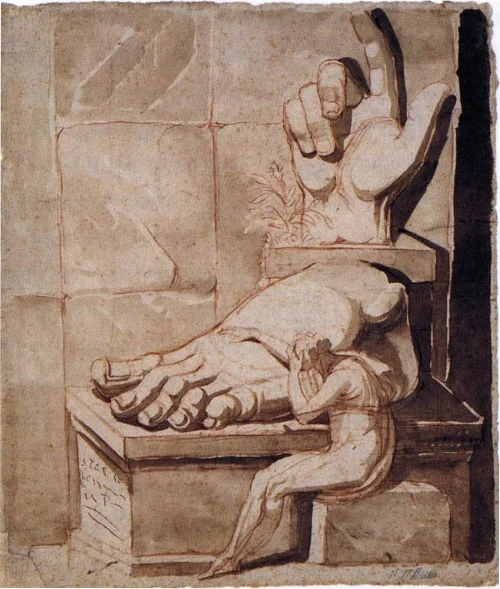
Image: Henry Fuseli, Artist Moved by the Grandeur of Ancient Ruins (1778-9). Credit: englishare.net

A most troubling announcement from Syracuse chamber-pop band Ra Ra Riot passed through my Facebook feed. It read, in all lowercase, "sad to say, allie is leaving the band…" There, beneath an oversaturated Polaroid, was cellist/backing vocalist Alexandra Lawn's amicable message: "not a 'goodbye.'"
Bands change members all the time; I get this. As a critic and music lover, I wonder about the shifting sound and dynamics, the old songs versus the new, unwritten ones. Particularly when that sound has intrinsic melody, like Lawn's cello, stitched into it.
Take NYC math-rockers Battles. Their instrumental avant-jams didn't really combust the hipster populace's trainers until Warp Records LP Mirrored—and specifically the single "Atlas," with Tyondai Braxton's helium-treated croon. Yet when Braxton left the band in summer of 2010, Battles' machinelike precision and groove-inducing stage presence only grew.
Cali art-rock provocateurs Xiu Xiu were a rotating cast around tortured soul Jamie Stewart for years. But multi-instrumentalist Caralee McElroy's entry in 2004 was a balm to Stewart's harsh delivery (witness the sweet, McElroy-sung track "Hello From Eau Claire"). Her departure after five years left me bewildered, beginning with "who is going to play all her gear?!" Enter Angela Seo, plugging into the crackling synths of New Wave horrorfestDear God, I Hate Myself (replete with a notorious, vomitious video). I'm relieved to say that Xiu Xiu are heavy as ever, if pounding new track "Hi" is any indication.
East Coast synth-vampires Cold Cave may have originated as "just" a solo effort by dark god Wesley Eisold, but by debut Love Came Close he'd added noisician Dominick "Prurient" Fernow and McElroy—plus created a scorching live act. Though McElroy left before second LP, Cherish the Light Years (taking the sweeter pop sounds with her), the addition of Alex Garcia-Rivera (who drummed with Eisold in Boston hardcore group Give Up the Ghost) kept Cold Cave's live sound at a bracing, post-apocalyptic froth.
But what if the change doesn't groove well? Or, more complicatedly, it alters my feelings as a fan? I'll come clean: I credit my initial openness to Ra Ra Riot to Lawn. Usually she played honeyed counterpoint to Wes Miles' bright tenor. But she sang lead on the jazz-inflected torchsong "You And I Know," sounding like she just took a slug of scotch and a three-second cigarette drag. So as I await and listen for Ra Ra Riot this year, I'm crossing my fingers for a future Alexandra Lawn solo.
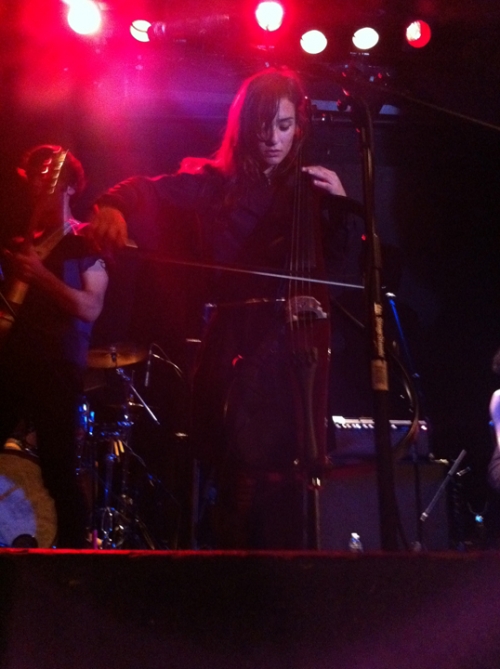
Image: Alexandra Lawn (and Ra Ra Riot) at Bowery Ballroom, September 22, 2010. Courtesy the author.


Perfume Genius's second record, Put Your Back N 2 It, was released last week after some controversy surrounding the video advertisement, excerpted from the video for "Hood." YouTube and Google claimed was not “family-safe,” explaining that the two shirtless men hugging (Mike Hadreas a.k.a. Perfume Genius & porn star Arpad Miklos) gave an “overall feeling…of a more adult nature.” More than what? Nature becomes more adult. We learn that existence is to differ. Love is dark. We have 2 put our bax n2 it.
“The hands of God were bigger than Grandpa’s eyes / But still you broke the elastic on your waist […] The love you feel is strong / The love you feel is stronger / I will take the dark part / of your heart into my heart / I will take the dark part / of your heart into my heart”
—Perfume Genius “Dark Parts,” from new record, Put Your Back N 2 It, released last Tuesday on Matador
“The magical (such as it can really be called without lexical muse) ascendancy of night and of the dark, the fear of darkness also probably derive from the threat they pose to the organism/environment…darkness is not the mere absence of light; it has some positive quality. Whereas bright space disappears, giving way to the material concreteness of objects, darkness is ‘thick’; it directly touches a person, enfolds, penetrates, and even passes through him.”
—Roger Caillois, “Mimicry and Legendary Psychaesthenia,” 1937 (collected in The Edge of Surrealism)
“To exist is to differ…identity is a minimum and, hence, a type of difference, a very rare type at that, in the same way as rest is a type of movement and the circle is a type of ellipse. To begin with some primordial identity implies at the origin a prodigiously unlikely singularity, or else the obscure mystery of one simple being then dividing for no special reason.”
—Gabriel Tarde, Monadology and Sociology, 1895
"Dark Parts" Studio Recording
Interview with Perfume Genius and "Dark Parts" live performance
Let Me Recite What History Teaches (LMRWHT) is a weekly column that flashes the lavalamp, gaslight, candlelight, campfire, torch, sometimes even the starlight of the past on something that is happening now. The form of the column strives to recover what might be best about the “wide-eyed presentation of mere facts.” Each week you will find here some citational constellation, offered with astonishment and without comment, that can serve as an end in itself, dinner party fodder, or an occasion for further thought or writing. The title is taken from the last line of Stein’s poem “If I Told Him (A Completed Portrait of Picasso)."
Image (Silver Laced Polish Chicken): 4chan.


Cormac McCarthy, one of the most extraordinary prose writers of our time, spends his days in an office at the Santa Fe Institute, where he types his novels on an Olivetti. As The Chronicle of Higher Education reports, his involvement at the scientific research institute has deepened: McCarthy copy-edited one of his colleagues’ books. “He made me promise he could excise all exclamation points and semicolons, both of which he said have no place in literature,” says Lawrence M. Krauss, whose 2011 book Quantum Man, a biography of Richard Feynman, got the McCarthy treatment.
I started thinking about the equally extraordinary Richard Feynman and his memoir, Surely You’re Joking, Mr. Feynman!, whose title would suffer at least one obvious chop if McCarthy got his hands on it. McCarthy loves dialogue without much attribution or explanation, and his furious-yet-controlled prose—"He was sat before the fire naked save for his breeches and his hands rested palm down upon his knees"—as well as his propensity for extraordinary violence are a far cry from Feynman's excitable, jocular tone: "He didn't know I didn't know, and I didn't know what he said, and he didn't know what I said. But it was OK! It was great! It works!"
But how would the author of Blood Meridian, No Country for Old Men, and The Road have edited Mr. Feynman’s book? We offer a suggestion below.
ALL THE PRETTY DISBELIEVERS
OR THE EVENING MERRIMENT IN MR. FEYNMAN'S QUARTERS
1. The Child Fixes Radios by Thinking.
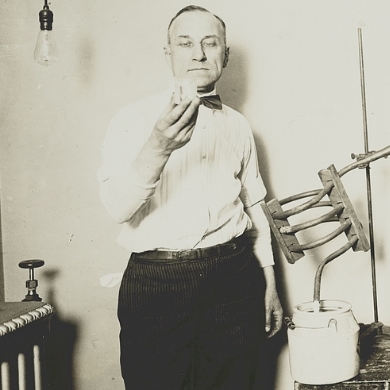
See the child. He is eleven or twelve, he sets up a lab in the house. It is nothing more than a wooden packing box into which he has set shelves, and he has a heater wherein he stokes hogfat and cooks french-fried potatoes day upon day. He also possesses a storage battery and a lamp bank.
The lamp bank he builds with sockets he screws down to a wooden base. When the bulbs were in series, all half-lit, they would glow. Sublime, splendid.
He lights up the bulbs and drives burnished iridescent daggers into the naysayers who come upon his lamp bank. The dead lie by the lamp bank in a great pool of their communal blood. It has set up into a sort of pudding crisscrossed with wires from the storage battery. It has seeped into the floorboards and in between the grooves of the child’s boots. The child surveys the blood and the room and the long slow land around him.
This is great, says the child, and it’s a seller’s market and those lamp banks are only the beginning. Now it’s time to try my hand at radios. He sheathes his dagger bloodred and silvery and walks into the world and is black in the low-set sun, the shadow of evil stretching ever onward behind him.
It was okay, he foams. It was great. It works.
Image: wwnorton.com (sepia effect added)

While I’m not so good at being aware of what’s going on in popular culture, somehow I'm still stubborn and adamant in my judgment of popular culture. This becomes horribly evident every year when it comes time for the Academy Awards and I haven’t seen any of the films nominated for anything, yet I insist on filling out the NYTimes Oscar Ballot along with my family and friends.
The only 2012 nominee I saw was Drive (here's me raving about its soundtrack a few months ago), which was only nominated in the category of sound editing. It did not win. My sister-in-law informed me that Glenn Close was in this film Albert Nobbs about a woman dressing as a man in the 1920s, and I proceeded to pick that film as my winner for every category for which it was nominated.
My brother found my ignorance amusing enough to actually record some of it. In his words, "Watching the 'scars with my sister is the most hilarious thing in the world. She is almost criminally ignorant of movies and popular culture in general." What follows is his edited transcript.
"The Descendants, that stupid movie about the beach?"
"The Artist...it’s fucking silent, it’s not gonna win. Well, at least it’s prestigious."
"The Help... Javier Bardem and Penelope Cruz are married?"
On The Iron Lady: "What's that, a movie about the First Lady?"
[Insert unrelated heated exchange between the Blatchley siblings:]
Kayla: "Why does everyone love Sandra Bullock? I mean, why is she even on TV?"
Response: "Well, she won the Academy Award last year."
Kayla: "What?!?! That stupid bitch won an academy award? For WHAT?"
Response: "Blindside."
Kayla: "What?! That movie about a prissy white woman who lets a black kid stay with her won an Academy Award? They don't even have sex!"
My impeccable strategy of seeing as few movies as possible landed me 4 our of a possible 24 on my NYTimes Oscar ballot. My Oscar picks are apparently not Oscar’s picks. But who is the real winner? I somehow suspect it’s me.
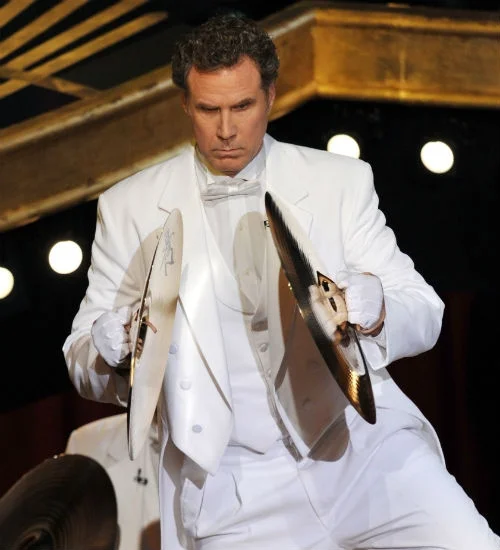
Image: Getty images via blog.zap2it.com

 A Black Balloon Publication ©