



Reading an interview with George Saunders in Blip magazine and a run-down of some of the best notes from Susan Sontag's diary up at Brainpickings makes for some pretty hefty writers-on-writing thoughts. Reading each separately can result in joy, inspiration, and serious reflection. But what happens when we force these two writers' thoughts together in fake conversation?
Imagine, if you will, a set not unlike Between Two Ferns. George Saunders waits patiently with his legs crossed, but instead of Susan Sontag joining him (as she obviously cannot), Zach Galifianakis comes out with a copy of Sontag's dairy. He sits, nervously eyeing the ceiling for wasps.
Zach Galifianakis as Susan Sontag: I think I am ready to learn how to write. Think with words, not with ideas ... The function of writing is to explode one’s subject—transform it into something else.
George Saunders: I think what a reader wants is genuine engagement from a writer: that is, he wants the writer to tell the truth as she sees it, and for the form of the telling to somehow be authentic to that which is being told. The reader wants the writer to be brave enough to step away from pre-digested forms or modes, as necessary, in pursuit of beauty.
ZG/SS [looking at his/her nails]: In "life," I don’t want to be reduced to my work. In "work," I don’t want to be reduced to my life. My work is too austere. My life is a brutal anecdote.
GS [frowning, then opening and closing his mouth twice before beginning to speak.]: I think truth, for artistic purposes, is that set of things that we feel deeply, or have felt deeply, but can’t quite articulate, and can’t quite “prove,” and, the direct statement of which feels deficient.
ZG/SS: Ordinary language is an accretion of lies. The language of literature must be, therefore, the language of transgression, a rupture of individual systems, a shattering of psychic oppression. The only function of literature lies in the uncovering of the self in history.
[A crow flies low overhead across the stage. Saunders ducks, covering his head with his arms. Zach/Susan simply glares at the bird's flight, makes to leave his/her chair and follow the bird, then sits down again, shaking head.]
GS [clearing his throat]: Art is ... paying hyper-attention to the things that make reality what it is, resisting reduction, trusting that the truest (and most beautiful) thing that can be said has something to do with the accretion of those small instants.
ZG/SS [with a sudden flailing of arms]: What’s wrong with direct experience? Why would one ever want to flee it, by transforming it—into a brick?
GS: So art—I think one reason we value art so highly is because it really is, and has to remain mysterious—in its intentions and procedures, everything.
ZG/SS: If only I could feel about sex as I do about writing! [ZG/SS stares at GS, breathing noisily through his/her nose. Keeps staring.] That I’m the vehicle, the medium, the instrument of some force beyond myself.
GS [clears throat]: In a larger sense, I think people write better when they’re happy. (Allowing for a broad definition of “happy.”) Maybe “feeling exultant” would be a better way of saying it.
ZG/SS: By refusing to be as unhappy as I truly am, I deprive myself of subjects. I’ve nothing to write about. Every topic burns.
[Saunders coughs and looks anxiously about the room. In doing so, he comes across a beer placed on the table between the chairs. He takes a long pull from it, guzzling, actually, nodding in a certain way while continuing to pull mightily from his beverage. He belches softly. Then swallows hard.]
GS: Writing dictums are the equivalent of replacing the tightwire with a wide plank: a lazy man’s approach. Safer, but less thrilling. There will never be a definition of beauty that helps anybody make some.
[The studio lights start to dim, but not before we catch a scathing look from ZG/SS in George's direction, and George looking about the room in search of a swift exit.]
Image: Caitlin Saunders c/o studio360.org
all quotes ruthlessly stolen from Blip Magazine (George Saunders) and Brainpickings.org
Apologies to Zach Galifianakis


The Morning News has decided to play Reading Roulette with six Russian authors, shooting a new one into the American blogosphere each month. And because I can't get enough of translation, I’ll be writing about this year's selections—and linking to each story so you can read it yourself. First off is Anna Starobinets's pungent phantasmagoria, "I'm Waiting."
It's no secret that Russia is a cold country, or that the name of their national drink is a diminutive of their word for water, voda. The burgeoning population, spread thinly from Kaliningrad to the farthest edge ofKamchatka Krai, has huddled in bars and in front of fires over the centuries, telling stories to while away the endless nights. Anna Starobinets is the latest in a long line of storytellers, but unlike so many of her forebears, she deliberately resists the mythic.
In "I'm Waiting," a modern-day narrator leaves some of her mother's soup in a saucepan until it becomes putrid, and then outright dangerous. How dangerous? Without giving too much away, the saucepan breeds a ghost. Then things get really weird.
We humans have a visceral response to mold and stench. We're evolutionarily conditioned to seek out perfect, unblemished food. If we eat something that makes us sick, just once, our bodies can exhibit aversion to it every single time thereafter. An attraction to spoilage isn't just strange; it's deeply abnormal. And a first-person story about this sort of attraction is even more revolting: I can almost imagine myself become this woman.
So why this obsession with her mother's soup? I grew up with Eastern European food from the countries circling Mother Russia. I love going toVeselka at two in the morning for pierogies, and insisting on stuffed cabbage with my friends. There's something deeply familiar about the food a mother makes.
But let's think about this a different way. My father was once a nuclear engineer. It wasn't until high school, when I learned about nuclear power in Chemistry class and read John Hersey's Hiroshima, that I realized the research in nuclear fusion my father had done was tangentially connected to the nuclear reactors' fission that, in Russia, had resulted in a scab of earth that humans can't go near for, give or take, twenty thousand years.
If mother's soup goes bad and ends up contaminating a pot, then a refrigerator, then an entire apartment, until outside forces have to come in with gas masks and chemicals to destroy it, it's a strangely appropriate metaphor for . . . well, lots of things.
A nuclear disaster from something homegrown? The idea turns my stomach.
Anna Starobinets has hit the nail on the head. She doesn't even have to delve into myth; the world we actually live in is terrifying enough.
Image: telegraph.co.uk


Reading Padgett Powell’s new book, You & Me, felt a lot like sitting on a lawn chair, slightly drunk, quietly listening to two old and charming men, also slightly drunk, pontificate on life. I imagine Powell, author of Edistoand The Interrogative Mood: A Novel?, reclining in Gainesville, getting down to the true business of what it means to repose.
Fashioned after Waiting for Godot, the book features two unidentified speakers, indistinguishable from one another, who simply speak together. Unlike Didi and Gogo, they aren’t really waiting for anything—except maybe death, a little. Or rather, a state of readiness for death, but only as much as they are waiting for a woman to stop by. The book offers no plot, and yet I felt compelled forward by some strange momentum, and I have some suspicions as to what these mysterious gadgets of momentum might be.
Gadget #1: Charm
I kind of fell in love with them a little bit. I, admittedly, have a weakness for old men, especially if they are tender toward some loss, but the dialogue here is not only funny and intelligent, but graceful and full of the humility of a felt humanity.
You have a wife?
I had a wife.
Oh. Of course. We all had a wife. Wife is a synonym for "past."
Are you in love with them? I am in love with them. I want to bring them blankets and whiskey and perhaps offer snacks later, because they probably aren’t eating enough. Which brings me to...
Gadget #2: Comfort
The interchange here is tender: it is tender between the two men and they are tender towards themselves. They are tender even in their disappointment of people and what life has ended up being.
What about with the exposed Wizard in the basket at the end?
Dorothy never gets in the basket. That’s what wakes her up.
We never got in the basket either, my friend, and that is what has us all woke up. We are looking up at the basket.
We is all woke up and nowhere to go.
It is comforting to listen in on their exchange. Their words are comforting, their philosophy is comforting, their relationship is comforting. This makes for easy reading, but it also helps to propel things along, in that we want to seek out further comfort. Further comfort and simply more words from those who would comfort us.
Gadget #3: Intimacy Over Time
There are various characters and objects introduced over the course of the conversations, such as the imagined character Studio Becalmed, who take on a kind of fullness. But after reading the whole book, I’m pretty convinced that what really kept me reading, excitedly and with pleasure, was simply the desire to spend enough time here, in their conversation, to feel as though I knew them fully enough, and that I was given the gist of all they had to say.
This is why we do not know, have a clue, really, how to live today as if it's the last day of our lives. We think we have the score because we can see that fifty years ago we did not have the score, bolting from the playhouse, but the fact is we are bolting from another playhouse today. We do not even recognize it as a playhouse.
It wouldn’t do to cut these men short. And I don’t think the full pleasure of the encounter would be the same if the story were told in any other way.
image: startribune.com


Move over, Cool Britannia, the Olympics have taken London by storm. And when something this crazy happens, everybody's got some thoughts. Including Banksy. Especially Banksy, the world's most famous graffiti artist. Here's the latest swiped from his site (just in case the IOC scrubs away his graffiti), and annotated by the Black Balloon commentariat:
1. [Javelin Thrower with Fully Functional Rocket]

Note the poor form, likely inspired by Hellenistic Greek sculptures rather than contemporary photography of javelin throwers, which wouldn't get the rocket (or javelin) very far. Consider the jersey number, which likely may refer to the gold medalist for the 2004 Olympics women's javelin competition, Osleidys Menendez from Cuba. What can we make of the fact that this winner has been depicted as a white male? Is this an incitement to the athletes to make war, not peace? Or is this a reference to the militarization of Britain, and the sudden arrival of military troops to provide overly thorough security for this event?
2. [Pole Vaulter Over Barbed-Wire fence, with Old Mattress]
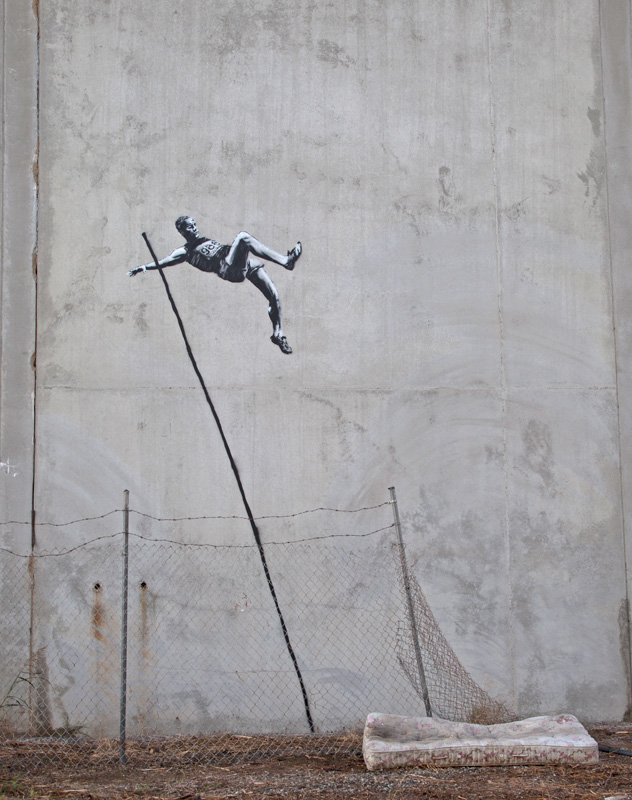
Again, the form is terrible: the body should go straight as it lets go of the pole, as this video shows. Even more unnervingly, the vaulter seems to have dramatically overshot the height of the barbed-wire fence, instead of barely surpassing it. Is this England trying too hard to make a spectacle of itself? Is this the organizers grossly overstepping their bounds? The mattress, at least, makes sense: once the Olympics are over, what will remain? Plenty of trash, that's for sure. But hey, I like the creative use of found materials. Nothing says austerity measures like using a dirty mattress.
3. [Sweatshop Worker Making British Flags]

If this is an allegory, we had better pay close attention: who are the sweatshop workers here? Are they as young, and as naive, as the child here? One of my friends sent me this video of Olympic diver Tom Daleybeing doused in glycerin for a photo shoot—and he's barely eighteen. Does the United Kingdom depend entirely on the young, the fresh, and the novel to establish itself? What's happened to history, to everything that makes London different from any other city that has hosted the Olympics?
I'm sure this isn't the last of it. I'll be watching the Olympic competitions all this week, and I'll keep my eyes peeled for more of Banksy's biting commentary. May the best man win.

Book sales are running rampart this week if you're looking for a good deal.
After all, you want to support your fellow artists, considering that money apparently feeds inspiration.
We've even got history to back that claim up, so start reaching into those wallets.
Who knows? We might even have the next Stephen King on our hands.
He or she might even pop up among the hordes of self-publishing writers out there.
Let's just hope there's no self-published mommy porn involved this time.

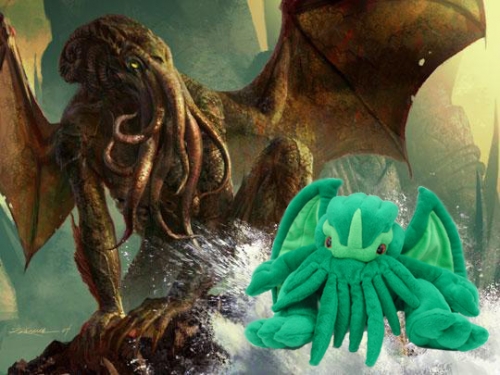
I owe my childhood fear of clowns and feral felines to Stephen King. His brick-sized bestsellers dominated my bedroom bookshelves, although I supplemented historical horror with a leatherbound volume of Edgar Allan Poe. I remember wondering who bridged Poe's masterful 19th-century macabre and King's contemporary terror. Today, King's ubiquity remains unchallenged—New York has ranked his entire published oeuvre, and he's got two novels planned for 2013—but contemporary horror trends contain an undercurrent of something unspeakably scarier, originating from the cosmos-chilled, slime-soaked legacy of the writer who not only greatly influenced King, but has his own sub-genre. I give you H.P. Lovecraft.
King himself acknowledges the genre's debt to Lovecraft in his book Danse Macabre: “The reader would do well to remember that it is Lovecraft's shadow, so long and gaunt, and his eyes, so dark and puritanical, which overlie almost all of the important horror fiction that has come since.” With that in mind, I offer this brief primer to help you navigate the Lovecraftian goo.
The Necronomicon
A purely fictional book of the dead that figures greatly into Lovecraft's work. Consider The Case of Charles Dexter Ward and its central tale “The Dunwich Horror.” A librarian senses “a hellish advance in the black dominion of the ancient and once passive nightmare” upon opening the cursed tome. In Sam Raimi's film The Evil Dead, the titular antagonists are (un)wakened by the Necronomicon, while HR Giger's debut monograph(and painting Necronom IV, which inspired Alien's iconic xenomorph) shares the name. Unfortunately, The Dunwich Horror is also a ridiculous B-movie starring Sandra “Gidget” Dee. Tread carefully with “direct” Lovecraft film adaptations.
A fictional Massachusetts town (like King's Castle Rock, Maine) and the setting for Lovecraft's Cthulhu Mythos. Meet “Herbert West—Reanimator,” who proved “rational life can be restored scientifically," and proceed to the decent '85 bloodbath Re-Animator, but I advise eschewing the slasher atrocity The Unnamable, based on Lovecraft's 1923 story. “The Thing on the Doorstep” revolves around Arkham's sanitarium, preceding Arkham Asylumand its gallery of Batman villains, and its personality-shifting plot is a bit Lost Highway. Just think: Lovecraftian and Lynchian!
Indescribable terror
“The Call of Cthulhu” birthed Lovecraft's famous extradimensional, malevolent entity, yet it simultaneously underscored the crippling bafflement of fear. Here's Cthulhu's setup, after a very late reveal: “the Thing cannot be described—there is no language for such abysms of shrieking and immemorial lunacy, such eldritch contradictions of all matter, force, and cosmic order.” Frank Darabont's 2007 film The Mist, based on King's 1980 novella, keeps its besieging, otherworldly fauna masked by the enveloping haze. Jorge Luis Borges, preeminent engineer of enigmas, dedicated The Book of Sand's “There Are More Things” to Lovecraft. The narrator's abstracted inability to describe a house's monstrous inhabitant recalls Lovecraft's scientific barrage of the frozen...things in his singular novella At the Mountains of Madness: in either case, we are no closer to understanding the horror in front of us.
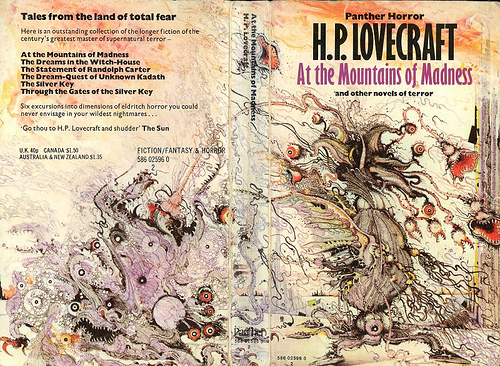
This brings me to Guillermo del Toro's much-delayed dream-project: translating At the Mountains of Madness to cinema. Despite the aforementioned Lovecraft-flavored films, there's little out there that successfully combines “proper Lovecraft adaptation” with “quality viewing” besides 1992's The Resurrected, which didn't even have a proper theatrical run. Del Toro aimed to change this, but after Universal's balking at the blockbuster price tag and Del Toro fearing similarities between ATMOMand Ridley Scott's Prometheus—which draws tellingly from Lovecraft's “Promethean trespass”—its fate is in limbo.
I'm not ready to close this chapter just yet. If Michael Bay gets the OK to helm yet another schlock-and-awe Transformers sequel—whether or not it stars Rosie Huntington-Whiteley—then I say we need a philosophical sci-fi horror film of ATMOM's stature more than ever. In Lovecraft's words from “The Nameless City”:
That is not dead which can eternal lie,
And with strange aeons even death may die.
Main image: H. P. Lovecraft Wiki + ToyVault, photo-chopped by the author; At the Mountains of Madness via The Furnace


In the wake of the shootings in Aurora, Colorado, discussion of firmer gun control measures has been whisper quiet, if not completely nonexistent. Evan Selinger contemplates the philosophical defensibility of the neutral weapon fallacy, Hegel mourns the ruthless efficiency of the guillotine, and Marshall McLuhan calls out a Reserve Brigadier General, who also happened to be a telecommunications mogul, on voicing the “Narcissus style of one hypnotized by the amputation and extension of his own being in a new technical form.”
1.
“Like many other technologies, Ihde argues, guns mediate the human relation to the world through a dialectic in which aspects of experience are both 'amplified' and 'reduced.' In this case, there is a reduction in the amount and intensity of environmental features that are perceived as dangerous, and a concomitant amplification in the amount and intensity of environmental features that are perceived as calling for the subject to respond with violence.”
—Evan Selinger, “The Philosophy of the Technology of the Gun,” 23 July, 2012.
2.
“The sole work and deed of universal freedom is therefore death, a death too which has no inner significance or filling, for what is negated is the empty point of the absolutely free self. It is thus the coldest and meanest of all deaths, with no more significance than cutting off the head of a cabbage or swallowing a mouthful of water.”
—G.W.F. Hegel, Phenomenology of Spirit, trans. A.V. Miller, 1807.
3.
“… General David Sarnoff made this statement: ‘We are too prone to make technological instruments the scapegoats for the sins of those who wield them. The products of modern science are not in themselves good or bad; it is the way they are used that determines their value.’ That is the voice of the current somnambulism. Suppose we were to say… ‘Firearms are in themselves neither good nor bad; it is the way they are used that determines their value.’ That is, if the slugs reach the right people firearms are good…There is simply nothing in the Sarnoff statement that will bear scrutiny, for it ignores the nature of the medium, of any and all media, in the true Narcissus style of one hypnotized by the amputation and extension of his own being in a new technical form.”
—Marshall McLuhan, Understanding Media: The Extensions of Man, 1964.
Let Me Recite What History Teaches (LMRWHT) is a weekly column that flashes the gaslight, candlelight, torch, or starlight of the past on something that is happening now. The citational constellations work to recover what might be best about the “wide-eyed presentation of mere facts.” They are offered with astonishment and largely without comment. The title is taken from the last line of Stein’s poem “If I Told Him (A Completed Portrait of Picasso)."
Image: mankindunplugged.com


Sorry Please Thank You, a new collection of stories by How to Live Safely in a Science Fictional Universe author Charles Yu, serves up lonesome tales in both science- and meta-fictional landscapes. Whether taken as projections of where we're headed, reflections on how things are, or simply the settings and structures Yu is most drawn to, the worlds we encounter are far from bright. I don't see these stories as warnings—they're more like compassionate takes on human longing and insecurity, regardless of where they fall on the space-time continuum—but I thought it'd be fun to pick out the suckiest aspects of Yu's alternate realities. Things we just might have to look forward to.
Low Wages
In exchange for feeling the worst kinds of pain, pain that people would rather pay someone else to feel for them, the hero of "Standard Loneliness Package" makes twelve dollars an hour. Twelve dollars an hour! Counting for inflation, by the time technology has figured out how to transfer emotion from one brain to the other, there's just no way twelve dollars an hour would be a liveable wage. But of course the corporation still makes millions. Ouch.
Inadequate Flirting
For both the employee of WorldMart and the zombie that waltzes through gussying up for a date in "First Person Shooter," having a little confidence seems to be a big problem. Not the megabox store the size of three city blocks, not that they work the graveyard shift or that they are a zombie (or that there is a zombie), but that they're both terrified of rejection.
Jobs Where You're Basically Signing Up to Die
If twelve dollars an hour to experience other people's anguish wasn't depressing enough, the story "Yoeman" invites us to imagine space jobs wherein promotion leads to inevitable and needless death. As soon as our hero "makes it" enough to take care of his expectant wife and soon-to-be child, he gets to be the one who's killed for no good reason. Or rather, killed because it's nice to have something noteworthy in the Captain's log. We all know how important logs are.
Angsty Avatars
Have you ever wished you could live in a video game? Because it's so straight-forward and has lots of interesting graphics? Think again. In "Hero Absorbs Major Damage," the actual characters of video games question their right to be there and their readiness for the mission. No matter how good Jeff Bridges looks in the original Tron, you're kidding yourself if you think you get to leave your self-doubt in the real world.
Intergalactic Loneliness
Probably the saddest thing is that when we reach the end of the universe, and we've explored it countless times and the excitement has kind of worn off the old "discovery" thrill, there still won't be other people for everyone. Not everyone gets to love. Some people only get some goo they can dry-hump for all eternity, like our poor Captain from "Yoeman." Probably really quality goo though, on the outskirts.
To experience Yu's imaginings in action, check out this samplefrom Lightspeed. It might just make you appreciate the present.
image: io9.com

If it looks like her moods are swinging faster than a speeding lithium, look closer. Better yet, see the whole video when you download theLouise: Amended evolving book app to your iPad. Better still, act fast and you can get the app for free and even bag a $100 gift card to Powell's Books!
Read More
 A Black Balloon Publication ©