


Like brains but not a zombie? Check out this beauiful, eloquent essay by Black Balloon's founder on the science of brains and writing.
After all, even the military is using neoroscience, so you better start brushing up on it.
Besides, what would Encyclopedia Brown have been without his all-knowing noggin helping him on the case?
It would also be intriguing to visit the brains of Jay-Z and Mary Karr, two artist deliving into artforms they're not known for.
But while you're focusing on your brian, keep an eye on your money, lest you end up like Mavis Gallant and her sketchy lit agent.
As if it wasn't bad enough that writing literary fiction isn't known for bringing home the big bucks.
So in the mean time, just lock yourself up in a room at the Paris Ritz and start pecking away at that novel.
Image source: Evan "Doc" Shaner


1.
The line might be three people long or thirty. On a ninety-degree afternoon, we waited 45 minutes for second-row seats.
2.
"It's a film made up of clips from other movies," the line attendant told us. "Every clip has a clock, or refers to time, or implies time, and every clip happens at the same moment as the time it is outside. If you look at your watch and it says 2:15, a clip that takes place at 2:15 will be up on the screen. It's connected to a computer program to make sure that the film's always synchronized with the real-world time."
3.
Just before 5:00pm, Steve Martin pantomimed to his business partner that he had to leave for a 6:00 flight. At six, we saw him make it to the gate only to find the flight delayed. What Steve Martin was doing for that hour in between, as we watched clips from the 1960 version of The Time Machineas well as Casablanca and others—well, it’s not hard to guess.
4.
We couldn’t believe how much happened on the screen in ten minutes. How many people sighed, how many people answered phones, how many people watched clocks ticking.
5.
I meant to stay for an hour. The people in the couch next to mine got up and left. A woman sat down there and soon moved to the far end of her couch—a comfortably retired actress, I realized. Was she waiting for her cameo?
6.
We saw actors in different films throughout their careers. Glenn Close has changed. Robert Redford has changed. Meryl Streep has changed. Jimmy Stewart has not changed.
7.
I am a product of the eighties. I recognized the clips from The Matrix andNapoleon Dynamite. If there was any Orson Welles, it was lost on me. I nodded at a two-second clip from Sixteen Candles and a fifteen-second clip from Adventures in Babysitting. My parents are products of the fifties, as well as the decades after. Would they have been even more enthralled than I was?
8.
“Marclay manages to deliver connections at once so lovely and so unlikely that you can’t really see how they were managed: you have to chalk it up to blessed serendipity. Guns in one film meet guns in another, and kisses, kisses; drivers in color wave through drivers in black-and-white so they might overtake them.”
—Zadie Smith, “Killing Orson Welles at Midnight”
9.
The difference between good editing and great editing is a matter of discipline. Of course there are "good enough" transitions, but insisting on the perfect juxtaposition, just like le mot juste, makes a world of difference when attempted on such a massive scale. There is suspense embedded in the film clips, but Marclay's prowess is evident in the perpetual suspense of the cuts between them.
10.
“At Marclay’s request, White Cube posted a 'Help Wanted' sign at Today is Boring, a cinéaste redoubt on Kingsland Road. Six young people were hired to watch DVDs and rip digital copies of any scene showing a clock or alluding to the time . . . At first, he was merely collecting scattered files, but eventually he had enough to forge 'hinges' between them. The more hinges he came up with, the more inventive they got.”
—Daniel Zalewski, “The Hours”
11.
People punch the clock, hit the alarm clock, wind up the grandfather clock, open their pocket watch, move the minute hand forward and forward and forward. Robert Redford hits a baseball through a clock—although, in The Clock, the shards don’t fall in slow motion. It all happens in real time.
12.
“There was not actually such a thing as a second [in the film L'Avventurawhen a twentysomething Geoff Dyer saw it in Paris] . . . A minute was the minimum increment of temporal measurement. Every second lasted a minute, every minute lasted an hour, an hour a year, and so on. Trade time for a bigger unit of time. When I finally emerged into the Parisian twilight I was in my early thirties.”
—Geoff Dyer, Zona
13.
I emerged into the New York twilight three hours after entering, having walked past sleeping hipsters and snacking gallerinas toward the fading sunlight. I took the bus back to my apartment, and saw a row of clocksalong Fifty-Seventh Street, each one set to a different time zone. In my head, I could still hear the ticking.
image credit: flickr.com/billindc


Scientists in Toronto have begun to understand a sleep disorder in which the muscles of the body fail to paralyze themselves during REM sleep, causing the sleeper to act out her dreams in various degrees of embodiment. During her fieldwork in the 1930s, Zora Neale Hurston contemplates the body called back to life, and Junot Diaz ferries us back to Haiti for the apocalypse.
1.
“What we call ‘sleep’ involves transitions between three different states….REM sleep is also characterized by temporary muscle paralysis. In some sleep disorders such as narcolepsy and parasomnias, like REM behavior disorder, the distinctions between these different states breaks down; characteristics of one state carry over or ‘invade’ the others. Sleep researchers believe that neurological "barriers" that separate the states don't function properly, though the cause of such occurrences is not entirely understood….[M]ost people, even when they are having vivid dreams in which they imagine they are active, their bodies are still. But, persons with RBD lack this muscle paralysis, which permits them to act out dramatic and/or violent dreams during the REM stage of sleep.”
—The National Sleep Foundation on the condition known as REM Behavior Disorder, undated.
2.
“Here in the shadow of the Empire State building, death and the graveyard are final. It is such a positive end that we use it as a measure of nothingness and eternity. We have the quick and the dead. But in Haiti there is the quick, the dead, and then there are Zombies. This is the way Zombies are spoken of: They are bodies without souls. The living dead. Once they were dead, and after that, they were called back to life again.
—Zora Neale Hurston, Tell My Horse: Voodoo and Life in Haiti and Jamaica, 1938.
3.
“For six, seven months it was just a horrible Haitian disease—who fucking cared, right? A couple of hundred new infections each month in the camps around Port-au-Prince, pocket change, really, nowhere near what KRIMEA was doing to the Russian hinterlands. For a while it was nothing, nothing at all…and then some real eerie plep started happening. Doctors began reporting a curious change in the behavior of the infected patients: they wanted to be together, in close proximity, all the time.”
—Junot Diaz, “Monstro,” The New Yorker, June 4 & 11, 2012.
Let Me Recite What History Teaches (LMRWHT) is a weekly column that flashes the gaslight, candlelight, torch, or starlight of the past on something that is happening now. The citational constellations work to recover what might be best about the “wide-eyed presentation of mere facts.” They are offered with astonishment and largely without comment. The title is taken from the last line of Stein’s poem “If I Told Him (A Completed Portrait of Picasso)."
Image: Felicia Felix-Mentor, photographed by Zora Neale Hurston


I am color deficient: red, green, brown and sometimes gray blur into a muddle in my sight.1 Probably because of my troubles with color, I've been fascinated by culture's approach to divvying up the visual spectrum. Which is what makes "The Crayola-fication of the World" so interesting to me. In this super-viral two-part article, Aatish Bhatia describes how Japanese people call green traffic lights blue, even though they have the physical capacity to distinguish the two shades. Still, because of the history of the cultural practice of naming colors in Japan, the green "go" light is labeled blue. Awesome, and strange, eh? It gets better.
It seems that the development of color words follows a predictable path: you start with two, which in English we might feel as analogous to white and black, and from there you progress to three, which would be analogous to our red (well, yours anyway), and which further progresses until you get to the infinitesimal division of the rainbow.
Looking at the history of colors entering languages, you might feel like it's only a matter of time before English speakers employ a color vocab that makes the big box of Crayolas look puny. Well, rein in that pride: there are limits to your eyeballs, and human perception of color, even that of the freak ladies2 with four color receptors on its outlying limits, is drab compared to that of other creatures. Like the mantis shrimp. Of course, crustaceans don't speak, which means all that vibrant visual acuity is mute.
But I wonder about the forms of metaphor in languages that lack the barrier between colors we know. Would a phrase like this one I dreamt up, the sky, lime-like in midday under a yolky sun, be sensible to a culture that didn't distinguish between blue and green? I'm inclined to think not, because even if we used the same word to describe the color of blue and green things, the sky certainly isn't similarly hued to a lime—it's not like we're calling it plum-like. Which would make it a bad, bad metaphor.
Then again, no one knows what to make of Homer's epically confusing "wine-dark sea."
________________________
1. It might interest you full-spectrum types to learn that total color blindness, the inability to distinguish any color from another, is exceptionally rare; and that we who have trouble with specific color pairs or ranges are overwhelmingly male. Blame it, as I do, on the Y-chromosome.
2. There are a select few women who have an extra color receptor, or cone, in their eyes, which allows them to see further into the ultraviolet spectrum than most of us. Lucky them. Maybe they should paint.
Image: flickr user bortwein75
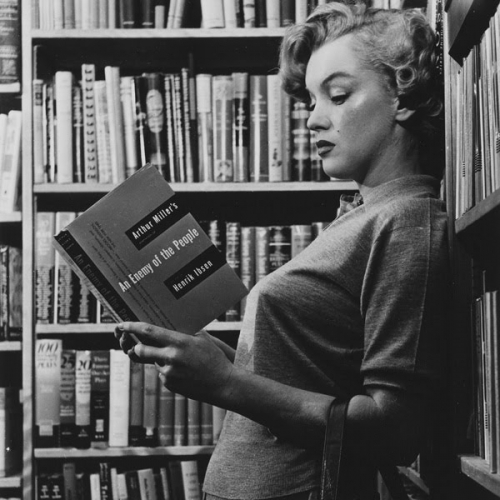
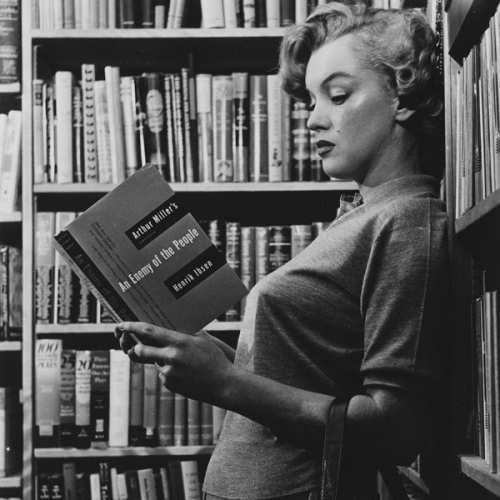
“I don’t want to read a book in translation,” my friend declared. “It’s not as good as reading the original.”
I put down my beer with a thud. I couldn’t even reply. The comment seemed to confirm a depressing statistic I had read in The Economist: “When it comes to international literature, English readers are the worst-served in the Western world. Only 3% of the books published annually in America and Britain are translated from another language; fiction’s slice is less than 1%.”
I wanted to pull out a copy of Anna Karenina—sorry, Анна Каренина—and show my friend the Cyrillic text. I ought to have said, “You mean reading a book you can’t understand is better than reading one you can?” Or, “I can barely correct my brother’s Spanish grammar, and I sure can’t read New Finnish Grammar unless it’s in English.”
Fortunately (or not), I had the self-restraint to change the subject.
America, go to our bookstores and look at the “Classics” sections. Homer,Cervantes, Dante, Flaubert, Borges. We owe our literary history to these authors and the intermediaries—Robert Fagles, Edith Grossman, Allen Mandelbaum, Lydia Davis, Andrew Hurley—who have carried the texts to our Anglophone shores.
It doesn’t matter how many MFA programs we have. It doesn’t matter how brilliant our living writers might be. Our own literature would still be barren without those foreign incursions. Even our earliest English classic isBeowulf, and I read it in Seamus Heaney’s resounding, earthy translation. Ask a budding writer if they’ve read Bolaño, and they’ll most likely nod enthusiastically, half-aware that Natasha Wimmer made possible their enjoyment of The Savage Detectives and 2666.
Among the alarmingly low number of publishers who will do books from other countries, we have Open Letter, Europa, Other Press, and a new player: Peirene Press. The wonderful thing about Peirene is that, although it publishes exclusively literature in translation, it focuses first and foremost on sharing a great story with each book. Their novellas take as little time to read as it does to watch a film, and the publisher holds events to discuss each book. She's a salonniere, and she's a success. She’s actually getting people to read something they might avoid if they knew it was “foreign.”
America, there’s a new direction for us. We don’t need relatable authors; we need strange and wonderful and new stories. I’d rather talk about good books than nice authors any day. Let’s skip the usual crop of MFA workshop pieces about the Brooklyn Promenade.
America, let’s publish Icelandic writers (Steinar Bragi!) and Argentinian writers (Pola Oloixarac!) and Mauritanian writers (Ananda Devi!) and make them worth reading. I wouldn’t know where on the map Iran is, or why I’d want to visit, unless I’d read Censoring an Iranian Love Story. I want to read something nobody in America would risk writing. America, let’s open our eyes to the rest of the world.
America, let’s make foreign literature sexy.
image credit: redsurproducciones.blogspot.com


I willingly do not own a television, but when I visit my family I tend to gorge myself on it. Last Thanksgiving, I watched eight episodes from Season 6 ofKeeping Up with the Kardashians, and somewhere in that miasma of SoCal socialite bliss—episode 3's synopsis: “Kim takes action to prove that her butt is real”—I got to know Kardashian half-sisters Kendall and Kylie Jenner. Beyond their reality TV stint, they've modeled, hosted red carpet events, designed nail lacquers, and contributed to Seventeen. Now E! News has revealed the next logical step: the Jenner sibs are writing a young-adult sci-fi novel set 200 years in the future. As you do.
Khloé, Kim, and Kourtney already penned a novel, Dollhouse, but you couldn't get me to “read” it if you hooked me to a single-malt intravenous and had Gary Oldman perched over my shoulder, reciting their prose dramatically (or Gilbert Gottfried, for that matter). But my inner-dork is intrigued by the Jenner sisters' premise. According to their publisher, who also put out Kris Jenner's ...And All Things Kardashian, “the story will take place in a world none of us have ever seen and it will follow two sisters on a journey filled with terror, mystery, drama and love.”
Just think of the century-specific technology envisioned by these young minds! I'm secretly hoping they take inspiration from Luc Besson's The Fifth Element (also set in the 23rd Century) and feature flying Range Rovers.
But seriously now. The publishers call it “dystopian,” which pretty much screams "Hunger Games ripoff"—a charge leveled at young author Veronica Roth's Divergent. Those questioning how the Jenners could fathom a concept like “dystopia” need only watch the harrowingKardashians episode “The Have and Have Nots,” where Dad makes Kendall and Kylie visit a downtown LA children's shelter. Severely limited "real life experience," true, but maybe they can build on it in their novel. OK, I'm taking a huge leap of faith here.
And they're still teenagers! Their project comes with a cowriter, Maya Sloan (whose own debut YA novel High Before Homeroom has its own book trailer!), but trust in Kris to pull the Overbearing Mom routine to ensure her daughters' voices come through clearly. Plus, their “Fashion Journal” column debuted in the June/July issue of Seventeen. It's a collage ofphotos and quotes, but if the girls can concentrate percolating ideas into chapters (cue cowriter Sloan), they just might create something memorable—and atypically Kardashian.
Image: Kendall and Kylie Jenner via JustJaredJr. + Blade Runner scene viainCrysis, photo-chopped by the author

While you were looking for loose change in your couch cushions, the Fifty Shades author was busy raking in a cool $1 Million.
Perhaps you should become a justice-seeking vigilante in your spare time to gain a similar amount of fame.
Just don't give up on the book business too soon. Even the tastemakers over at Pitchfork are dipping their toes in.
You'll be in good kompany, konsidering the youngest Kardashian sisters are also taking up the pen.
While you're at it, make sure to throw the English readers a bone -- apparently they're the worst served in the Western world.
Maybe these upcoming European books will shed some light on the situation.
Though the short story business could use more support, considering that their awards are dropping like flies.
Image source: Getty


Flavorwire posted a list of ten of the best books set in the Midwest, and since I’m currently reading Sherwood Anderson’s Winesburg, Ohio (#1 their list) and residing in our nation’s heartland (right around where much of Freedom is set), I figured I could help those of you who are unfamiliar with this vast terrain. Here are five things that make the Midwest such fertile ground when it comes to novels.
1. The illusion of safety
Sure, there’s probably less crime (there are, after all, fewer people), but the Midwest is also full of folks less likely to report certain behaviors as criminal. If you have a character who needs to get away with some things, there are a whole bunch of Midwesterners more than happy to look away and tend to their own business, or the neighbors are so far away they’d hardly notice anything awry. This doesn’t mean privacy, exactly; it just means there is more space for those wanting to be left alone. Midwesterners gossip, but we usually don't ask questions.
2. Everybody knows your name
Everyone is in everybody’s shit all the time 'cause they all know each other and there isn’t much more excitement than other people’s shit. If you don’t share with everybody, everybody will talk shit about you. They’re all paying attention. Newcomers and committed outsiders are easy protagonists because it is easy here to rub against the grain.
3. Nature will scare the shit out of you
In the Midwest, nature isn’t just something pretty to describe; it's a force that no one can control and that affects everyone’s day-to-day life. Just askAnder Monson. Nature can be a legitimized mood swing or full-on devastation of life and home. Looking for a villain but don’t want to look too hard? Set your novel in the Midwest and look up. Or down. Take cover and build your ass a canoe.
4. Desire for days
A person cannot help but want something bigger, brighter, and more fantastic if they happen to be confined to the Midwest. Desire will not likely be satisfied here. There will be compromise. The Thai food will not fulfill even your lowered expectations (though if you try really hard you can get great Indian in Ohio and the Cambodian in St. Paul is phenomenal). There is always something better, on either coast, in any big city. All characters must want something, and if your characters reside in the Midwest, they inherently want more. And most of them want out.
5. Space and time (way too much of them)
This is how John Jeremiah Sullivan describes his home state: "when I say "Indiana"…blue screen, no?" There is little to blame frustrations on other than yourself, and yet there is also little to be distracted by, so you’re constantly aware of your own failure/discontent/alcoholism. What’s wrong is your soul: your natural, uncomplicated, and unfettered soul. In a true Midwestern novel, it’s not society that’s fucked; it’s people. I like to think of this as clarity, and it’s great for fiction that strips off the superficial nonsense and cuts right to the bone.
Image: foxnews.com


Last week, just days before his first solo album was released, writer, singer, and Odd Future member Frank Ocean posted an arresting statement on his tumblr, describing his first love: a young man who couldn’t love him back. Some called it a coming out…others called it an amazing piece of writing. For his first televised performance, on Jimmy Fallon, he performed the song “Bad Religion,” a meditation on longing in the tradition of An Excellent Song, Which Was Solomon’s, and Mirza Ghalib’s Urdu poetry.
1.
Taxi Driver
be my shrink for the hour
Leave the meter
runnin
It's rush hour
so take the streets if you
wanna
Just outrun the demons
could you.
And he said Allah ho Akbar
I told him don't curse me
Well boy you need prayer
I guess it couldn't hurt me
If it brings me to my knees
It's a bad religion…
—Frank Ocean “Bad Religion,” 2012
2.
1 In my bed by night I sought him that my soule loved: I soght him, but I founde him not. 2 I wil rise, therefore now, and go about in the citie, by the streets & by the open places & wil seke him that my soule loveth: i soght him but I founde him not. 3 The watchemen that went about the citie, founde me: to whom i said, Have you sene him who my soul loveth?
—Geneva Bible, Song of Solomon, 1560.
3.
...What appears as confirmation of the Ocean's actuality
It is merely a sum total of wave, drop, phosphorescence
Reticence is a form of pride, even with oneself
No matter how unveiled you are within your many veils
The embellishment of the ravishing is never to be done
Inside the seclusion of the veil, the mirror lives constantly
The deep decorum of the hidden is misread as revelation
The clairvoyant lost in dream, dreams he is awake…
—Mirza Ghalib, “Why parsimony today in the promise of tomorrow’s imbibing,” 1841, trans. Sara Suleri & Azra Raza
Let Me Recite What History Teaches (LMRWHT) is a weekly column that flashes the gaslight, candlelight, torch, or starlight of the past on something that is happening now. The citational constellations work to recover what might be best about the “wide-eyed presentation of mere facts.” They are offered with astonishment and largely without comment. The title is taken from the last line of Stein’s poem “If I Told Him (A Completed Portrait of Picasso)."
Image: Still from Frank Ocean, "Swim Good"

I haven’t been a lifeguard for years. But when I walk past the freshly reopened McCarren Park Pool and get a whiff of chlorine, I realize there are some things I haven’t really forgotten. The positions for performing CPR. The office cubbyholes where we stashed our keys while on duty. The way the light on the water changes from six o’clock, when the sun starts setting, until the pool closes at eight.
To the children in the water, we are like the gargoyles on an old cathedral: instantly recognized, immediately forgotten. If we are gargoyles, they are wide-eyed pilgrims, in love with water. They swim with inflatable wings, water noodles, kickboards, flippers. They swim in the shallow areas, then they go deeper, then they learn how to dive. We watch them come back over days, months, years.
We perform the same rituals day after day. We unlock the bathhouse doors. We hand each other our foam rescue tubes as we climb up and down the lifeguard stands. We loosen the lane ropes, turning six-foot-tall wheels, until they have been coiled up on a reel aboveground, only to unroll them again later in the day.
The water circulates through the filters and the pumps, always the same water.
• • • •
One winter, I went to the Whitney, and saw a series of photographs by Roni Horn of the River Thames. As I looked more closely, I realized that the pictures had been superimposed with tiny numbers. Below the photographs were numbered footnotes.
61. Is water sexy?
62. Water is sexy.
63. Water is sexy. It’s the purity of it, the transparency, the passivity, the aggression of it.
64. Water is sexy; the sensuality of it teases me when I’m near it.
65. Water is sexy. (I want to touch it, to hold it, to drink it, to go into it, to be surrounded by it.)
66. Water is sexy. (I want to be near it, to be in it, to move through it, to be under it. I want it in me.)
I smiled. Not long after, I forgot about the photos and their captions, just as I stopped thinking about about my time as a lifeguard. Even when McCarren Pool opened last month, I didn't think about the water as anything more than an afternoon's diversion.
• • • •
Back when I was a lifeguard, I had always kept an eye on the evening swim teams practicing. After a shift, I sometimes jumped straight from my chair into the water and started swimming laps beside them. I swam to shake off the heat and restlessness of the long day, to bring my mind back to the real world I would face upon exiting the water. Watching those swimmers, I wondered what they thought about as they went from one end of the pool to the other. And then I read Leanne Shapton’s Swimming Studies.
I know their hours of swimming are no less repetitive than a lifeguard’s on his chair. Instead of focusing on everyone but themselves, however, swimmers focus on nobody but themselves. Leanne Shapton distills this to a state of mind.*
I swim a few laps, then decide to do a hundred. This is my default workout, one hundred reps of whatever. One hundred is actually not much, but it sounds nice, like “an hour,” even though swimming a hundred laps of this short a pool does not take an hour, it takes about twenty minutes ... As I swim, my mind wanders. I talk to myself. What I can see through my goggles is boring and foggy, the same view lap by lap. Mundane, unrelated memories flash up vividly and randomly, a slide show of shuffling thoughts.
Leanne had been training for the Olympics. She nearly qualified, but didn’t. I wasn’t interested in reading about this, nor she in writing about this. Instead, I read about the small, quotidian details of a swimmer's life. Her drives with her parents to and from the pool. The effects chlorine has on swimmers’ swimsuits, on swimmers’ hair. And then there are her watercolors. She continually detailed the contours of the different pools she had gone to—a silly thing to mention, I thought, until I came much later in the book to watercolors of all the swimming pools she remembered, and I suddenly recognized the details she had described.
Leanne stopped seriously competing after those Olympic trials, channeling her energy into art. The result, in Swimming Studies, is a collage of prose texts and pieces of art that cumulatively feel well, watery. Aqueous. The quality of her diction, as well as the similarity of the many scenes she depicts, makes reading the book feel very much like swimming laps with someone who knows the pool, the water, and her own body, extraordinarily well.
• • • •
I was a lifeguard. And Leanne, the one in the water, was just as obsessed with its surface. She went through rubber swimming caps, through championships, through boyfriends and houses and cities, and still relished each moment she made the first dive into the sickly-blue water. I looked through the footnotes about her swimsuits, and was reminded again of Roni Horn’s pictures.
Sure enough, those photographs had been made into a book: Another Water (The River Thames, for Example). Roni's footnotes were still as idiosyncratic and meditative as back at the Whitney.
411. Water shines. Water shimmers. Water glows. Water glimmers. Water glitters. Water gleams. Water glistens. Water glints. Water twinkles. Water sparkles. Water blinks. Water winks. Water waves.
412. Under the cover of harsh, elusive colors, black is constant. These useless, hopeless colors gather around this black place.
413. The Thames is a tunnel.
414. The river is a tunnel, it’s civic infrastructure.
415. The river is a tunnel with an uncountable number of entrances.
416. When you go into the river you discover a new entrance—and in yourself you uncover an exit, an unseen exit, your exit. (You brought it with you.)
There are many waters, but our experiences with them were deeply similar, deeply meditative. I looked up from each to realize that I did not smell chlorine. I was not in a lifeguard chair in the Midwest or in Brooklyn but on a couch in my apartment. These books had so perfectly recreated in my mind the experience of sitting at the edge of water that those faraway summers had come back and, doing flip turns, splashed me awake.
* Buzz Poole, who also works at Black Balloon and was once a competitive swimmer, has a wholly different and very enjoyable perspective on Shapton's book at The Millions.
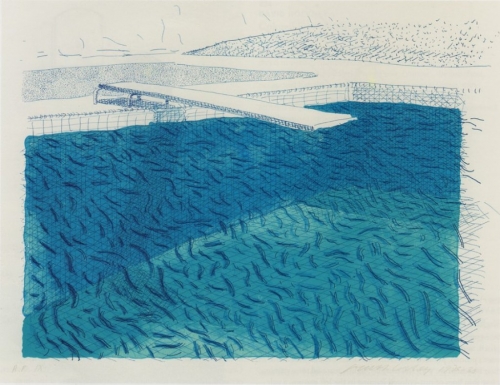
Image credit: David Hockney, Swimming Pool Lithograph,ahholeahhole.blogspot.com

 A Black Balloon Publication ©