



Every so often, people will ask me why I read so many novels. They sneer: Why don’t I want to know about real life?
Marilynne Robinson, the Pulitzer Prize-winning author of When I Was a Child I Read Books, writes that she read “to experience that much underrated thing called deracination, the meditative, free appreciation of what ever comes under one’s eye.” Even more fundamentally, she read because she wanted to.
But to fiction skeptics, “Because I want to" usually doesn't cut it. I like nonfiction, sure. James Gleick’s The Information: A History, A Theory, A Flood caused me to miss a subway stop. But I don’t care about politics, at least not as much as I should. Or about the biographies of great men and women. Honestly, the Times is all the “real life” I need most days.
Sometimes I read fiction for the sheer beauty of other people’s words. Over winter vacation, I brought along Alan Hollinghurst’s The Line of Beauty. I came across these lines—
"Far from it," said Nick. "No, no—he spoke, as to cheek and chin, of the joy of the matutinal steel." They all laughed contentedly. It was one of Nick’s routines to slip these plums of periphrasis from Henry James’s late works into unsuitable parts of his conversation, and the boys marvelled at them and tried feebly to remember them—really they just wanted Nick to say them, in his brisk but weighty way.
—and quite suddenly, because Hollinghurst’s writing is so baroque and perfectly rendered, I found myself thinking and speaking with those “plums of periphrasis” for the next week. Other people can’t change my tone like that. The world around me can’t change my thoughts like that.
But the best, the most important reason that I bother with the figments of an author’s imagination is to understand other people. Annie Murphy Paul explains that when we read, we interact with the characters as if they were real. “The brain...does not make much of a distinction between reading about an experience and encountering it in real life,” she explains; “in one respect novels go beyond simulating reality to give readers an experience unavailable off the page: the opportunity to enter fully into other people’s thoughts and feelings.”
It’s true: I tend to imagine the characters I’m reading a little too well. I had to stop reading Watchmen when Dr. Osterman was destroyed in an Intrinsic Field Subtractor. And when I read Teju Cole’s Open City, I found myself unable to separate Julius’s view of New York from my own. I never had an invisible friend as a child; it looks like books took care of that for me.
Hence my answer: I can read nonfiction to understand how the world works, but I’d rather read fiction to understand how people work. What about you?
image credit: litfestalberta.org


Taking a cue from Buzzfeed's recent list of internet terms, I decided to take a break from deleting my "turklebaum" and think up some new terms to help describe the current literary atmosphere.
Aspbooker n. an obsessive reader. She was such an aspbooker about Harry Potter, it was embarrassing.
Canned adj. a term used to describe books that are popular with or come out of hispter/DIY culture. The second Werner Herzog read Go The Fuck To Sleep it became like uber-canned.
Chicortle v. the gag reflex resulting from an excess of chick lit. I'll totally chicortle if you recommend Jennifer Weiner one more time.
Libro Luddito, El n. any book or magazine being read in paper form; "Un Luddito" is a person who exclusively reads paper. Can you grab el libro luddito before it falls off the couch? My iPad died.
Movel n. a novel one's mom might recommend. Do you want this movel or should I just donate it?
Polybiblymous n. a person who reads using multiple formats. Look at that polybiblymous checking his messages. We could totally mug him.
Straight Veg n. any novel that is or will be considered a classic and that is actually awesome. Anna Karenina is straight veg, but I just don't have the patience for War and Peace (cf. "War'n'Rainbows") .
War'n'Rainbows adj. a person or book trying too hard to impress others. War'n'rainbows also suggests intellectual weariness. That Adam Levin book The Instructions was just too war'n'rainbows for me, and it gave me scoliosis.
What other new phrases might be useful? What should we call housewives who read porn in plain sight? Or the book that isn't out yet but you've already heard so much about you're no longer interested? Feel free to offer your suggestions below. Or just threadjack the comments.
image: wikiality.eikia.com


Will you participate in the March Madness that is the Tournament of Books?
You could even ask your best brogrammers to help you trick out your bracket.
Just don't underestimate the power of erotic housewife novels, especially if they're Twilight-centric.
Then again, erotic sci-fi is also giving it a run for its money.
Whatever erotica strikes your fancy, you can bet that the Brooklyn Public library will print it out on demand.
But make sure you're reading those books at the same rate you're churning them out.
And if you're writing rather than reading, make sure you're citing your Tweets in MLA format.
In fact, make sure your entire online curatorial style is completely up to date.
Then test it out by trying to spot all the references in this insanely intricate Cartier commerical.


Right now, I am typing in Dvorak, a keyboard layout that places all the vowels in the home row and purports to be more ergonomically friendly. I have been typing this way for a week, but my computer keyboard still feels foreign to me. I cannot believe my fingers are still not dancing across the keys.
I decided to start typing in Dvorak because I wanted to see if anything would change. So what did change?
First was my brain: I could feel the ache immediately. Norman Doidge describes competitive plasticity as a gerrymandering of cerebral territory, which perfectly explains why training my fingers to tap different keys for the same letters would run so palpably contrary to my brain’s heavily automated routines. In his book The Information: A History, A Theory, A Flood, James Gleick discusses how breaking words down into letters "forces the reader to detach information from meaning; to treat words strictly as character strings; to focus abstractly on the configuration of the word." I didn't have to be told twice. I struggled through the first half-hour of typing, and then stopped. My head felt like it might divide in two.
But an hour later, I came back and found myself distinctly remembering where the different letters went. Astonishing. My brain—I could feel my brain mastering this.
Then it was my writing: I had to simplify every part of it. If I was patient and tough, I might break ten words a minute. Gone were all the fillers—eh, nah, well—I’d typed during my Qwerty days. Gone were my slow-spooling, oft-Proustian digressions. Like Beckett switching from English to French, my sentences became plain. The words I chose changed, too. As a recent study has found that QWERTY typists prefer words typed with their right hand. I do prefer words that are easier to type; as David Mitchell mastered vocabularies to work around his stammering, so I found myself similarly picking words to suit my fingers and my mind.
“Our writing equipment takes part in the forming of our thoughts,” declared Nietzsche in 1882, having learned to use a typewriter. I have moved in the opposite direction from Henry James, whose novels swelled in length and obliqueness once he started dictating to his secretary. He was able to postpone the work of editing; I, in my turn, must begin editing before I get a single word down.
I feel like I am writing more clearly now, more carefully and precisely. Typing in Dvorak has made my words strange to me, and so I look at each one closely like a small gemstone before setting it into my text. I won’t pretend that I’m a happier person for having learned to type at a rate far slower than my thoughts, but I know my words have become more exact and honest. My brain has actually been rewired.
Image credit: flickr.com/photos/julianrod
At an AWP panel last year, I heard a prominent writer, hidden in an audience of non-prominents, ask an editor on the panel how many literary fiction writers were able to make a living off their craft. The editor thought for a second before giving a figure so depressingly low, with such chilling authority, that it elicited a collective groan-sigh from the audience.
Read More

A recent Telegraph post about the relationship between poets and their editors starts off with the nervous subhead, “If one poet edits another, whose work is it?” Tensions arise over the prospect of editors having too heavy an influence, the implications of an incestuous landscape. How can we rest assured that our most treasured poetry is "pure"?
Lucky for me, I am completely unperturbed by this notion of purity. I, in fact, adore quite a few exceptionally heavy-handed editors. I’m also still coming off the glory high I got reading Jonah Lehrer’s article in last week’sNew Yorker about brainstorming, in which Lehrer debunks the myth that brainstorming has to be free of criticism in order to be productive. Criticism and debate have been shown to actually improve creativity. Ha! Criticism wins! Editors are helpful!
So, seeing as how some people could use a little push toward criticism-acceptance, I’ve decided to draw up my top five reasons (with a little help from Lehrer, whom I quote liberally below) we shouldn't fear the red pen.
1. Science says that “exposure to unfamiliar perspectives can foster creativity.” Sure, everyone has something to say. If it's useful, steal it. If it's not useful, it can help define what it is you're not looking for.
2. Science also says that “dissent stimulates new ideas because it encourages us to engage more fully with the work of others and to reassess our viewpoints.” Dissent! Know thine enemy! How better can you position yourself to be the champion? Would you even know about being a "champion" if it weren't for the presence of critics?
3. For the most part, no one is paying any attention. If they are paying attention, they will forget everything you’ve done in less than thirty seconds. There is only so much time you have to engage and really have an effect on someone else, so you might as well try to make it count. Good criticism can help push you toward that effect.
4. For the most part, we are not paying attention. Do you know how many unconscious actions I’ve committed, for years, without knowing? I couldn’t be the first to end a telephone conversation until I was 24 years old—and I had no idea. Or with my writing: how many times in a paragraph do I have to mention a hand touching something before someone shoots me? We all need someone else to tell us what it is we are doing.
5. No one wants to hear you whine. What are you, a baby? Whether it’s the undergraduate with the rambling justification or the man-child distraught because not everybody likes him, whiners are usually too busy suckling on the self-absorption tit to get any work done. Don’t be one of them.
Good criticism can save you from the enormous embarrassment your actions alone will undoubtedly lead you to. So what's the difference between shitty criticism and good criticism? Honest, deep concern for the creative object at hand. As long as the critics you listen to are truly engaged with what it is you’re trying to accomplish—and not just smarmy ass-clowns with ulterior motives—they deserve a good listen. Even the act of turning away can lead to something better.
Image: curmudgeonloner.wordpress.com

Dmitri Nabokov, who died last week, was more notable as an opera singer and a racecar driver than a writer, according to his Times obituary. But he was best known as the executor of his father Vladimir's estate, and as the translator of many of his Russian novels. Without Dmitri, anglophone readers might never have read Invitation to a Beheading or The Gift. And he’s given us Nabokov’s drafts for The Original of Laura, insisting as an honest executor on highlighting its incompleteness.
In honor of Dmitri, I’ve decided to round up more literary parent-child pairings—some canonical, some obscure—that have made our bookshelves fuller.
1. Kingsley Amis and Martin Amis
This duo has been unstoppable: the father was a renowned comedic novelist—Lucky Jim includes such gems as, “There was no end to the ways in which nice things are nicer than nasty ones”—while the son has been an international heavyweight from his first novel The Rachel Papers (“Erections, as we all know, come to the teenager on a plate”) to the forthcoming Lionel Asbo.
2. Samuel Taylor Coleridge and Hartley Coleridge
Admittedly, the son was very much overshadowed by his father, the great Romantic poet and compatriot of Wordsworth, but Anne Fadiman’sthorough and thoughtful essay, “The Oakling and the Oak,” makes for a fantastic and poignant read. “I have long been interested in what makes some oaklings thrive and others wither because, in a minor way, I’m an oakling myself,” the author writes, acknowledging her own filial relationship to the public intellectual Clifton Fadiman, before turning her eye back to the son who wrote sonnets and disappeared into relative obscurity.
3. Frank Herbert and Brian Herbert
Much like Nabokov and his son, Brian Herbert has followed in his father’s footsteps, writing a few science-fiction novels of his own before penning prequels and sequels to Frank Herbert’s Dune series. The desert planetArrakis, with its reserves of an extraordinarily rare spice called melange, was already well known to sci-fi enthusiasts upon Frank Herbert’s death, but his son has kept the saga alive (unlike the then young and hapless David Lynch).
4. Floyd Skloot and Rebecca Skloot
Two of America’s most brilliant nonfiction writers have taken fascinating trajectories: the father, Floyd Skloot, became an acclaimed writer of nonfiction even before suffering brain damage, and writing a memoir that articulates the experience. Meanwhile, his daughter, Rebecca Skloot, has written the runaway bestseller about “immortal” human cells, The Immortal Life of Henrietta Lacks. So, of course, the pair have co-edited the delightfully readable Best American Science Writing 2011.
5. Mary Wollstonecraft and Mary Shelley
Fathers and sons, fathers and daughters...no such list would be complete without the famous mother-daughter pair of Mary Wollstonecraft and Mary Shelley. The elder was an outspoken feminist—the author, in fact, of A Vindication of the Rights of Women—who died in childbirth. After marrying Percy Bysshe Shelley, the daughter, herself an outspokenly feminist, wrote the seminal horror novel, Frankenstein, about a man’s monstrous attempt to give birth to a living thing. Mary Shelley’s son, unsurprisingly, bore no children of his own.
Philip Larkin memorably declared, “They fuck you up, your mum and dad, / They may not mean to, but they do.” True enough, but imagine a world without Marys, Martins and Dmitris. I can only feel relief and gratitude when I reflect that the elder halves of these pairs did not follow the childless Larkin's final exhortation: "Don't have any kids yourself."
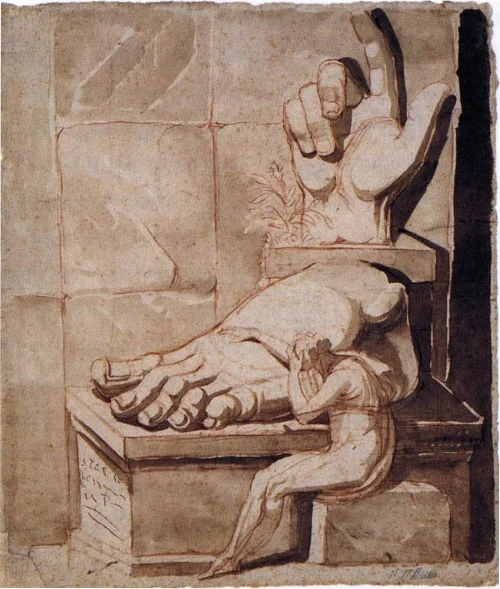
Image: Henry Fuseli, Artist Moved by the Grandeur of Ancient Ruins (1778-9). Credit: englishare.net


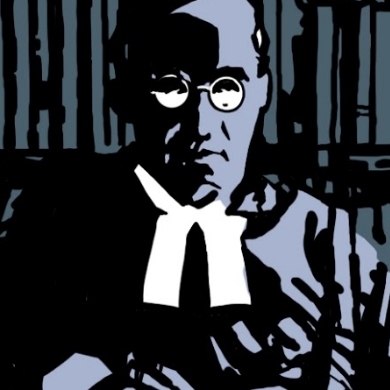
Cormac McCarthy, one of the most extraordinary prose writers of our time, spends his days in an office at the Santa Fe Institute, where he types his novels on an Olivetti. As The Chronicle of Higher Education reports, his involvement at the scientific research institute has deepened: McCarthy copy-edited one of his colleagues’ books. “He made me promise he could excise all exclamation points and semicolons, both of which he said have no place in literature,” says Lawrence M. Krauss, whose 2011 book Quantum Man, a biography of Richard Feynman, got the McCarthy treatment.
I started thinking about the equally extraordinary Richard Feynman and his memoir, Surely You’re Joking, Mr. Feynman!, whose title would suffer at least one obvious chop if McCarthy got his hands on it. McCarthy loves dialogue without much attribution or explanation, and his furious-yet-controlled prose—"He was sat before the fire naked save for his breeches and his hands rested palm down upon his knees"—as well as his propensity for extraordinary violence are a far cry from Feynman's excitable, jocular tone: "He didn't know I didn't know, and I didn't know what he said, and he didn't know what I said. But it was OK! It was great! It works!"
But how would the author of Blood Meridian, No Country for Old Men, and The Road have edited Mr. Feynman’s book? We offer a suggestion below.
ALL THE PRETTY DISBELIEVERS
OR THE EVENING MERRIMENT IN MR. FEYNMAN'S QUARTERS
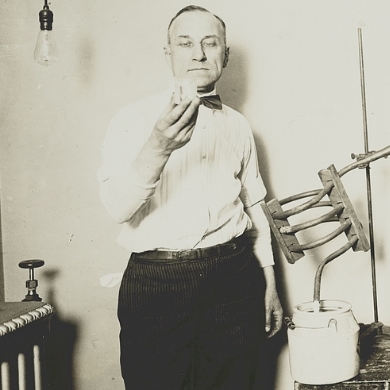
1. The Child Fixes Radios by Thinking.
See the child. He is eleven or twelve, he sets up a lab in the house. It is nothing more than a wooden packing box into which he has set shelves, and he has a heater wherein he stokes hogfat and cooks french-fried potatoes day upon day. He also possesses a storage battery and a lamp bank.
The lamp bank he builds with sockets he screws down to a wooden base. When the bulbs were in series, all half-lit, they would glow. Sublime, splendid.
He lights up the bulbs and drives burnished iridescent daggers into the naysayers who come upon his lamp bank. The dead lie by the lamp bank in a great pool of their communal blood. It has set up into a sort of pudding crisscrossed with wires from the storage battery. It has seeped into the floorboards and in between the grooves of the child’s boots. The child surveys the blood and the room and the long slow land around him.
This is great, says the child, and it’s a seller’s market and those lamp banks are only the beginning. Now it’s time to try my hand at radios. He sheathes his dagger bloodred and silvery and walks into the world and is black in the low-set sun, the shadow of evil stretching ever onward behind him.
It was okay, he foams. It was great. It works.
Image: wwnorton.com (sepia effect added)

Offering hard-nosed, common-sensical financial advice for the aspiring American writer. In this first installment, the Hustlenomicist replies to a college senior considering the big move to New York—after all, NYC is Mecca for writers, isn't it? Isn't it?!!
Read More
I am the first to admit that I’m not the greatest representative of the science fiction and fantasy publisher that employs me. If you’d have scanned my bookshelves prior to 2007, you might have found one fantasy novel among the hundreds. (Its title probably would have included the words "Harry" and "Potter.") But Slate's recent post about David Foster Wallace's ten favorite books reminded me of how much I've changed.
Read More
 A Black Balloon Publication ©