
Last week, I mused on Steven Pinker's critique of a New Yorker article on descriptivist and prescriptivist ways of thinking about language. Pinker came out swinging against that simplistic dichotomy, which is fine and dandy, but I had some qualms with his take on "standard English" (to wit: comparing the tacit rules of language to traffic patterns is a category mistake). Today, I want to talk about how we talk, and what that says about us.
People are brought up within a specific cultural environment, taking its imprint into their bodies—where you're from and how you come to know yourself wires your brain—and enacting its common codes as their habits, trains of thought, manners of speaking. These things, among them tacit rules of language, are in a real sense enfolded, engraved into the flesh. To say that a person ought to talk according to a standard that is not their own is far more alienating than telling them, for instance, to use the metric system. It is to say that those of us who didn't come from the right milieu must remake our sense of and capacity for self-fashioning. We must become what we were not, in terms we would not use.
At least, if we want to prosper ’round here.
Anybody who’s struggled to disentangle all the likes knotted into their speech after a California childhood knows how difficult it is to remove a single word, much less syntactical patterns. Besides, they are intimate indications of a person’s background: the lingering y’alls in a former southerner's worn-through drawl indicates to anyone with an ear for it where they’re from. To recognize dialect and accents—to appreciate the pompous way the guy your friend is dating always uses shall instead of will—is to recognize a linguistic territory, geographic or socioeconomic or affinitive or otherwise. And the range and variation of each contributes to the overall richness of language as a whole: each differentiation swells the sense of words and the ways they signify.
Still, there’s something compelling about the notion of a “standard English.” This shouldn’t be convincing on the face of it. What’s gained if we all converse or write precisely alike, noting with obsessive care the pedantries of long-dead, only ever partial, savants? What’ll we lose if we don’t?
Language lives and floats on the breath of those who speak it. It is continually being remade as it is exhaled from humid, living lungs, and, being caught up with the formative experiences of speakers’ identities, it comes to reflect the broader trajectory of the mouths that speak it. A lot of the shrillest warnings about language usage faltering merely indicate a shift in dominant trends, even if those issuing them would tie that shift to a decline in civilization. And disparaging specific patterns of speech as uneducated, ill-suited for high paying work, or essentially different—when in fact the only difference they signify is the history of the person that would say them—is lame. There is nothing, as Pinker says, inherently wrong about one manner of speechifying, so long as it makes sense. (Fine, this is notalways the case; more on that next week.)
What does this leave those of us who’ve grown fond of our Fowler, our elementary styles, our usage manuals, who are invested in aesthetics, in really getting down to the right stylings of linguistic awesome? It leaves us the flow of language use, past senses coursing toward future ones, and that is a turbulent current. But it is something, if you know how to fathom it. Mark twain, motherfuckers.
Stay tuned for the final installment of this series, coming at you next week.
Image: A Niagara of Alien Beauty

Steven Pinker recently released a salvo against The New Yorker, following Joan Acocella's piece on "proper" language usage. I appreciated Pinker's rebuttal, because I have a reflexive distaste for the insular, middle-length thinking that magazine inculcates in its readers, and because, more than anything, I can't stand language prigs—whether they’re lambasting each other over misperceived errors regarding the plural of "vinyl" or one-upping each other in the quest for stylistic purity by avoiding the prepositions with which the rest of us end sentences.
Why? Because, frankly, they’re wrong.
Pinker’s issue with The New Yorker concerns a supposed opposition between “descriptivists” and “prescriptivists”: respectively, those who think the best way to understand language is with descriptions of how it is actually spoken, and those who want to fathom the real laws of language and judge existing speech or writing accordingly. This opposition is old as the hills and, like many such conceptions, it isn’t really accurate. Nowadays in linguistic studies, things are not so dichotomous. This makes sense: in order to suss out formal rules, you need to approach the seething linguistic morass that gurgles outta people’s throats, and in order to describe how that morass functions in life, you outline patterns that, like it or not, regulate the way words work. And most people who actually delve into language are not so cavalier about claiming to know the final truth about the right stylings of linguistic awesome.
The thing is, Pinker errs in his endorsement of a "standard English." What would that be, anyway? The difficulty with his position reveals itself when he likens “conventions” such as standardized weights and measures to the tacit rules that govern expression within a community. Take, for instance, this analogy encouraging “standard” usage:
But the valid observation that there is nothing inherently wrong withain’t should not be confused with the invalid inference that ain’t is one of the conventions of standard English. Dichotomizers have difficulty grasping this point, so I’ll repeat it with an analogy. In the United Kingdom, everyone drives on the left, and there is nothing sinister, gauche, or socialist about their choice. Nonetheless there is an excellent reason to encourage a person in the United States to drive on the right: That’s the way it’s done around here.
See: there is nothing inherently wrong with either, but we would be poorly advising people if we told them that they could drive on the left in the States. It'd lead to horrific collisions, or at least make road-texting that much harder. Sad.
Problem is, this isn't really apt. Manners of speaking reside far deeper in our psyches, constitute much more of our identities, than familiarity with driving on the left or right side of a strip of asphalt. They constitute our very capacity for describing ourselves, our lusts, aspirations, sexual fantasies, fealties, and relation to the divine. (Intimate things, those.) Nor is language learning managed by the ISO, or other bodies that govern the “conventions” to which Pinker compares standard English; there have been no agreements about what words should be said to infants, and in which order, and it’s unlikely there will be. Hence, the way we speak isn't a practice that can be instrumentalized like driving within a territory—though perhaps children shouldn’t get a speaker’s permit until they turn 15, and only after a bleak, Red Asphalt-style course on hurried sentences and the influence of alcohol on utterance.
Somehow I don’t think that’s likely scenario. And somehow I don't think hearing ain't used in a sentence causes many semis to swerve into oncoming traffic.
Watch this space next week for Part 2 of "Describing Your Prescriptivism."
Image: Planet of the Apes


Since it turns out that writers aren't all that influenced by past writers, what goes into novels then? The author's own life? I realized that every author was getting asked the same thing, and I started worrying about the assumptions behind the question, “Is your fiction autobiographical?”
Jonathan Franzen, author of The Corrections and Freedom, gave an eloquent, but direct reply in The Guardian, looking at the relationship between actual, real events and how much his writing relates to the things he’s seen:
In 30 years, I don't think I've published more than 20 or 30 pages of scenes drawn directly from real-life events that I participated in...What is fiction, after all, if not a kind of purposeful dreaming? The writer works to create a dream that is vivid and has meaning, so that the reader can then vividly dream it and experience meaning. And work like Kafka's, which seems to proceed directly from dream, is therefore an exceptionally pure form of autobiography. There is an important paradox here that I would like to stress: the greater the autobiographical content of a fiction writer's work, the smaller its superficial resemblance to the writer's actual life. The deeper the writer digs for meaning, the more the random particulars of the writer's life become impediments to deliberate dreaming.
And this is why writing good fiction is almost never easy.
It’s a good answer, but Franzen’s colluding with the interviewer. Both of them are propagating the idea that fiction is necessarily rooted in the visible world, and that once the relationship between experience and fiction is established, then anybody can put a pen to paper and make a masterpiece.
But fiction is not always based on the world we see around us. Sometimes things have to just be made up wholesale—with more logic than a dream. Genre fiction in particular depends on this fact: science fiction and historical fiction fixate on details that for the authors only exist in the imagination. A recent bestseller in France, Hate: A Romance, is about two men during the AIDS epidemic, and was written by a man born during the last years of the political activism related to that. Tristan Garcia’s book landed like a hand grenade amid the piles of monotonous French autobiographical fiction. And when asked why he didn’t write from his own life and experience, he said:
I wanted to write about something far removed from myself, which has nothing to do with my existence, even my nature—I’m too well-behaved, my soul is too well-adapted to the world, in a sense.Autofiction doesn’t interest me, and I’m not very interested in myself either. For a time, it was believed that because people were writing to tell their stories—as if to a psychoanalyst or a confessor—literature was self-expression, first and foremost, and, sometimes, the fictional expression of self: speech, a voice, the voice of the person writing. For me, it is the contrary. Writing is a refined form of empathy through which man extends his ability to be an Other, to feel what someone else feels, to trade his sensibility and voice with others without losing his soul.
There you have it. Fiction as a form of negative capability. This is why the question “Is your fiction autobiographical?” is so useless. When you have to imagine someone else’s life, you do so by ignoring the details of your own life. A correlation between the two is simply a coincidence. And, as we all know, correlation does not imply causation.
It’s best, really, not to worry about the parallels between fiction and life; the author writes to keep his soul whole. He’s not a memoirist. Those writers pay dearly for aestheticizing their lives, as in the case of Karl Ove Knausgaard, the Norwegian author of the record-breaking bestseller My Struggle. He openly admits:
I wrote this in a kind of autistic mood. Just me and my computer in a room, by myself. It never occurred to me that it might cause problems – I was just telling the truth, wasn't I? But I was also being very naïve. I sent a copy to everyone involved before the first volume was published, and then I discovered how difficult this was going to be. It was like hell ... I couldn't have done it any other way. I will never do anything like this again, though, for sure. I have given away my soul.


Craig Mod sings a funeral dirge for book covers, yet another beautiful casualty of the shift toward digital distribution of “books.” Because they have lost their purpose, covers must die: as bookstores finally succumb to the efficiencies of Internet distribution, book covers themselves will lose the emphasis they currently have in the publishing world. Instead, clever designers will continually tweak covers—or app icons?—to leverage the characteristics of whichever particular method of distribution—Kindle, Apple Store, whatever—to their favor. Or so it would seem.
I wonder about this. I'm not so sure that major publishers will be keen to give up the "branding" achieved by iconic cover design. While Mod is definitely correct that the cover image at an Amazon book page doesn’t dominate your impression the way physical covers do when you approach a table display, I think he trivializes its importance. When you search for a book, there is the momentary, all important recognition of a particular cover: I want this edition; I recognize that book. And I bet, as was shown with comprehension and retention of hypertext compared to linear text, that the much vaunted “data” presented to customers on a typical Amazon book page rarely enters memory or affects cognition or purchasing behavior—at least, not as much as the initial impression of recognizing the book’s cover does. Certainly someone at Amazon has metrics on that. [See note on metrics below.]
It is this snap of recognition that makes bestsellers. The industry knows this. Hence, the dextrous marketeers have worked to craft immediately recognizable bestsellers through standardizing distribution channels, optimizing displays, and studying consumers perceptual habits. Marketing departments will want to continue to have control over of each book’s brand, hoping to win the lottery by hitting on the next Fifty Shades of Grey,Harry Potter, Twilight, etc. Covers will still get the most design attention, even if their function and role are in transition for some time.
Still, many of the observations Mod makes about the ghostly controls on electronic books are apt. For instance, the Kindle opens directly to the first page of text—I wonder if publishers make this choice or if it is an aspect of the product they’ve ceded to end retailers, along with price—tucking away the front matter and indicating that the information it contains is of little use to the usual reader. Who knows how to decipher that Library of Congress info, anyway?
Anyway, covers. We may mourn them. They’re doomed because they’re not essential to the non-object ebook. Virtual guts need no physical protection as they’re removed from a virtual shelf and “opened.” And it’s hard to see how methods of preventing remote deletion or emendation of your library would be integrated aesthetically into overall book design.
But fear not. You can still sticker your device.
[Note on metrics: There’s a difficulty in leveraging them as efficiently as possible. Publishers may well be interested doing so through the perpetual refinement of "customer experience" through things like A/B testing. Because of the constant accrual of data about customer behavior that is harvested, there is enormous potential to positively encourage sales. By having two versions of a cover and tracking if either seriously outperforms the other a retail site, marketing teams could, hypothetically, select the cover that performed better and make it, thereafter, the official cover for the book. Problem is, I doubt that Amazon or the other end retailers of ebooks would be enthusiastic about freely sharing the info they gather on customers. So there’d be less integration of data into decisions about which cover did best where. And I doubt publishers will be eager to cede ultimate control over their covers to Amazon, et al. Of course, this isn’t a problem for Amazon’s publishing wing. Then there’s the insidious side of A/B testing. It happens so fast now that marketeers rarely take the time to think about the why B outdoes A in this instance. This is because, essentially, why don't matter. Final causes aren’t as important as immediate effects—namely, money for the company—and so don’t need to be investigated. The danger of this is that marketeers tend lose sight of the fact that they have an impact on the results: you put meat and potatoes in front of a hungry person, they're going to eat it.]
Image: etsy user ilovedoodle


The Nation has devoted a substantial chunk of their new issue, including a post-apocalyptically gloomy cover, to the subject of the most revered and loathed retail behemoth on the planet. The issue, "Amazon and the Conquest of Publishing," offers three long essays on Jeff Bezos's company's origins, controversial labor practices, tax-evasion efforts, data mining tactics, and its conflict-of-interest-y slouching towards publishing its own titles. (Sidebar: Amazon quietly bought Avalon Books, an imprint specializing in romances and mysteries, this week.)
The best and most comprehensive of the essays is Steve Wasserman's "The Amazon Effect." Wasserman, a former editor of the Los Angeles Times Book Review (which folded its print edition in 2008), paints a startlingly dystopian picture of Amazon as a company which, like its social networking counterparts, seems to harbor a sinister messianic ambition for itself, a desire to braid itself into our neural pathways.
From street level, they seem to be succeeding. Amazon has always seemed to me less a company than an idea. As Wasserman notes, it has no physical space (at least none that it pays fair taxes on). No one walks into an Amazon store; there are no Amazon greeters. And news that the company would like to replace its human workers, ostensibly the ones who saran-wrap your paperbacks to pieces of cardboard, with robots, hardly surprises, even if it is speeding us towards a vision of the future that would have made Aldous Huxley give us a withering look.
And it seems as though Amazon is banking on the fact that, like it's social network counterparts, it has become an idea, an ingrained feeling, a Pavlovian reflex—a verb. "To Amazon," in my working definition, might refer to "the immediate silent flush of gratification felt upon purchasing a dozen books one has been meaning to read with only a few clicks of a mouse, some of the books hard-to-find novels at scandalous mark-downs."
My sensitive information is saved on the site; I click hectically through to checkout, not the least bit anxious that Amazon has this information, maybe even a bit annoyed to be reminded it does, because a kind of anticipatory saliva has already started accumulating in a part of my brain I didn't know existed before Amazon. Finally, the words "free shipping" mitigate any subsequent feelings of buyer's remorse I might feel as the confirmation emails start cluttering my inbox. My wallet has not moved from my pocket. I have not moved from my chair. Twelve books are on their way to me, and nevermind that it might realistically take me several years to finish them all (in between reading the other stacks of books I ordered last month, and the month before, etc.). The shipping was free. I win.
Understandably, Amazon has its evangelizers, people like Slate's Farhad Manjoo, who argued several months ago that Amazon is "the only thing saving" literary culture, because the company has increased the number of books people buy, which (fishily) leads Manjoo to wish death on public spaces that encourage the buying of said books, a.k.a. independent bookstores. (This seems especially fishy given that said journalist writes for said website which, he admits, is in business with said online retailing behemoth.)
You might recall that this is the same article in which novelist Richard Russo is taken to task for a New York Times op-ed in which he pleaded the case for independent bookstores, the same Richard Russo who spoke at BEA this week, urging publishers to "find a spine" against the Amazonian bully.
But Manjoo is right: Amazon is, in many ways, the ideal friend and accomplice to young literary persons of the Great Recession era. The company appeals seductively to our general poverty, agoraphobia, sense of entitlement, and desire for immediate gratification. And with e-books, which, unlike toaster ovens, can be downloaded to your Amazon Kindle™ instantaneously (in a proprietary format locked to other e-readers), you don't even have to get up and run an illegible squiggle representing your signature™ across the UPS™ guy's Delivery Information Acquisition Device (DIAD)™.
A number of us who return again and again to Amazon aren't even lazy or agoraphobic; we're just broke. We go to our independent bookstores to browse and read on the big "poofy" (Manjoo) couches, buy a coffee, engage the sales attendants in English major banter: a combination of activities which we like to think of as "showing our support." And then we go home and buy a dozen books in a few clicks from the enemy.
What to do, Independent Bookstore, when my heart is your husband, but, as Bezos knows, my wallet's a slut?


Mid-May through end of June, graduation presents are flung to young people like so many palm fronds under asses’ feet. It's been a while since I've had a successful encounter with an institution of booklearnin', but I remember getting Zen and the Art of Motorcycle Maintenance when I finished high school. Never mind that subsequent studies disinclined me to take Pirsig seriously; I read his book when I got it and dreamt of cycling across the plains with nothing but a tent and my meager late-teenage wits.
People like to wrap books up for grads. There's something about it that’s less crass than a sappy card padded with cash or stiffened with an Applebee's gift card. Books enrich, even if they were purchased off a display table with a GIFTS FOR GRADS placard on it. And booksellers love to promote graduation books: they’re part of a spring giving trifecta, along with Mothers’ Day and Fathers’ Day, that gives a major boost to sales. Way back in ’97, Publishers Weekly noted that this growing “holiday-ization” of book sales—employed mostly by chains, but also by your beloved indies—had helped make May and June the best sales months behind the Christmas season.
Which is only natural. We purchase because we love, y’know.
Now, fifteen years after the industry woke up to its own practices, bookshops are bursting with that vanilla version of graduation gifting, Oh, the Places You’ll Go! Dr. Suess's book is supposed to be whimsical, apt, indicative. This cynic doesn’t much think OTPYG is much of the latter two, but it does jiggle with whimsy. And cliché. Because (some) folks take graduation as a cultural milestone that suggests a future wide open with potential greatness and achievement. It’s a token way of saying, "You're destined for great things!" And all the while it affirms the aspirations of a generation of egotists assured they will get exactly what they want, cuz they deserve it. (Never mind if we’re all that way from eighteen to twenty-two.)
But let’s talk about the grad on your list. Let’s say you want to let them know that you actually have given some thought to the unique qualities that make them a human being, qualities that will deepen over the course of their life and make them as pleasant and savory as pi dan. In that case, get them a book that fits with those traits! Not one that was intended for five year olds!
If you haven’t given thought to your giftee's unique qualities, don’t despair. The trick is to not aim at producing easy happiness or honing in on whatever they’re enthusiastic about this year; that shit fades. Instead, giveMiddlemarch. Or Moby-Dick. By the time they get around to reading your book (if they ever do), its emotional complexity and portrayal of life's twisted course will make the sweetest sort of sense it can—that it doesn’t have to.
And in the interim, the book's spine will make your loved one look that much more intelligent whenever their houseguests are looking for the bathroom.
Image: flickr user David Bivins
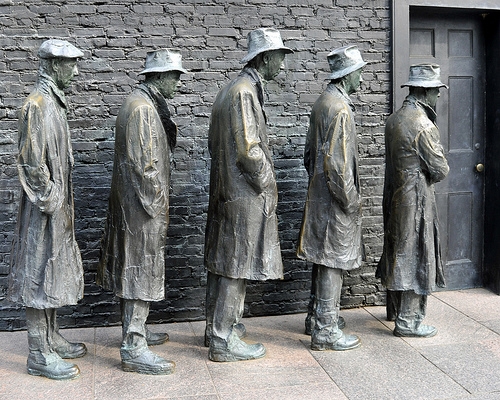
According to a highly dispiriting article in the Chronicle of Higher Education, "the percentage of graduate-degree holders who receive food stamps or some other aid more than doubled between 2007 and 2010."
Read More

Something weighing you down? Why don't you come to Ayn Rand for help?
It may help you more than all those self-help books you got after graduating.
Though if one of those books happened to have a one-word title, you may want to give it a second chance.
Just don't go and feel entitled when your self-published one-word title fails to become a bestseller.
You don't want to find yourself turning into a psychotic fictional character over the ordeal.
Just try to calm down, perhaps by turning on some disco?
Don't be ashamed. Afterall, all writers have their own particular quirks.
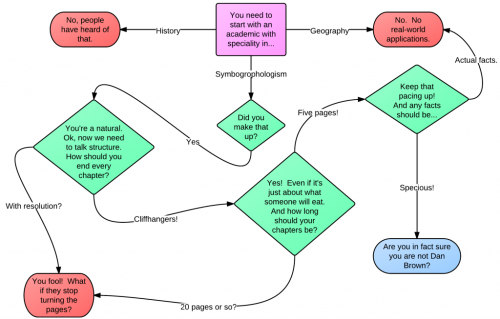
Dan Brown's quirks are so hard-wired into his system that it can be explained via a handy flowchart.
Image source: USA Today

Nnnndude. To celebrate the release of Tenacious D's new album, Rize of the Fenix, here's a glossary of JB and Rage Cage-minted terms.
Read More

A recent Brain Pickings post on Gertrude Stein’s posthumously published children’s book, To Do: A Book of Alphabets and Birthdays, has sent me on a journey to nonsense. Or rather, it has revived a kind of determination to spread an enthusiasm for reading with your guts and heart, not just your head.
In a press release for her first children’s book, Stein wrote something that could just as easily be applied to her grownup fiction:
Don’t bother about the commas which aren’t there, read the words.
Don’t worry about the sense that is there, read the words faster. If you
have any trouble, read faster and faster until you don’t.
While it’s easier to calibrate your expectations of deliberately nonsensical writing, e.g. Lewis Carroll or Edward Lear, reading for purposes other than understanding gets tricky in other areas. At least, in my mind, readers often resist writing that doesn't immediately make sense, that proceeds with a certain tension-filled ambiguity.
Last week, I came across an htmlgiant post that might be useful in terms of articulating a purpose for reading other than understanding. Before recommending five works of theory (touching upon such topics as "interassemblage haecceities"), Christopher Higgs writes:
I think it’s quite productive to read theory as if it were poetry or fiction,
which is to say as if its primary function was to affect rather than educate...
I read theory and fiction and poetry to experience, to consider, to become
other, to shift, to mutate, to change. I most certainly do not read those things
to understand them.
I was reminded of the first time I encountered Foucault, Derrida, and Lacan in an undergraduate literary theory course (which yes, meant that I was reading in order to understand what was being written). Part of my absolute joy at reading theory was the complete tizzy my head went through in its attempts to grasp or even contain the expanse of the ideas written down. The joy, for me, was the experience of reading it. At times I barely thought my feet were touching ground. In the end, I believe I understood less. And this is wonderful.
My point is not to bash understanding or encourage everyone to smoke pot and listen to whale sounds. I mean, go ahead and all, but what I’d like to promote here is an experience of reading that doesn’t insist on pinning something down. Do not be afraid. Try not to read with the goal of saying “Aha! I get it!” when you’re finished. Allow for uncertainty, for ambiguity, for mystery that resonates beyond the page. Let your senses experience a truth your mind can't get a handle on.
This is also not to encourage laziness; quite the contrary. This is to encourage a kind of pleasure in the sound of words and the power of words to bring you to an unrecognized place.
Don't bother about the commas.
image: guardian.co.uk
 A Black Balloon Publication ©