



Intrigued by the trend of clothing stores using books as props, as noted by the Paris Review, and peeking into some of the most anticipated books of 2012, I thought it might be useful to provide a kind of style guide that could help readers match their outfits to their reading material. After all, no one wants to be caught on the train reading David Foster Wallace in an Armani suit (reeking of effort) or lounging at the coffee shop in sweatpants reading Joan Didion (too depressing).

The Flame Alphabet by Ben Marcus
The most important thing to keep in mind while preparing an outfit to go along with Ben Marcus’ new novel is that you are not a student at Columbia. Every student at Columbia has already read it, and why are you trying to impress twenty-year-olds anyway? That is gross. Find accessories that make you look older, like a super worn leather book bag (no totes, please), or a sweater that once belonged to your grandfather. Twenty-year-olds totally dig old vintage stuff.

Threats by Amelia Gray
If you’re spending the afternoon at a cafe in Greenpoint and have a lot of scarves, and maybe you even got into that weird feather hair clip thing for a minute but totally don’t wear it anymore cause that was so 2011, you might want to drop Amelia Gray into your tote bag (yes, tote bag).

Hot Pink by Adam Levin
This is one of the few anticipated 2012 novels that you can safely wear sneakers while reading. For the most part, tennis shoes are unacceptable, but choice of footwear is somehow forgiven in the case of Adam Levin. Just be careful: the assumption will be that you’re too intellectually distracted to notice that you’re wearing sneakers, so make sure to look around in surprise every once in a while.

When I Was a Child I Read Books by Marilynne Robinson
Marilynne Robinson is really best read at home, but if you insist on parading her around in public, the least you can do is dress sensibly. Loose sweaters paired with a thin pants and oxfords would do nicely. Be careful not to apply too much makeup; mascara alone should do it.

The Newlyweds by Nell Freudenberger
Even if you don’t own a single item of Chanel clothing, you should look like you have at least one essential go-to Chanel jacket in your wardrobe (likely handed down from a family member) while reading Nell Freudenberger. Any floral print or chiffon dress would work splendidly.

Daniel Fights a Hurricane by Shane Jones
Have you been dying to wear that old army jacket you bought at Salvation Army in 1994, but don’t know how to pull it off without looking like an agro-political grunge throwback? Enter Daniel Fights a Hurricane. The presence of this novel alone will tell us that you’re not on your way to OWS, but rather on a brief hiatus from your time on the internet.
Don’t worry, you won’t have to get a haircut till after you’ve finished reading.
Front image: vulpeslibris.wordpress.com; book cover images: flavorwire.com


Did you know writing is the greatest invention of all time?
Though, bronies (male My Little Pony enthusiasts) may be a close second.
But bronies can do little to compete with a good, solid epigraph.
If that doesn't get your creative juices flowing, perhaps Plotto will.
Either that, or you can try to win a walk-on role on Breaking Bad.
Or maybe Murakami's big screen debut could be the ticket.
Listening to music is always helps, or maybe it doesn't?
Whatever you choose, make sure to include them in your acknowledgments page.
Just don't expect a docile stay-at-home wife to do all the work for you.


Some folks make New Years resolutions to drink less and exercise more. This year, I’ve resolved to write better marginalia in the books I read.
In the December 30 issue of the New York Times Magazine, Sam Anderson offers a sampling of his marginalia from some of the books he read in 2011. I admire Anderson for this—it’s like peeking inside another’s intellect and imagination. And his article inspired me to take a closer look at what I write (or don’t write) in the books I read.
I am currently reading Dostoevsky’s The Idiot. Which means Dostoevsky’s text is being slowly invaded by my own jottings. I underline, I circle, I draw arrows to connect specific words and phrases, I use exclamation marks to highlight passages I like and large Xs to cross out phrases or plot developments I find obnoxious. And like Anderson, I’m a chronic margin scribbler.
Sometimes my comments are of the ordinary roadmap variety (page 31: “Note importance of physiognomies in D’s descriptions”). Other times, they might point out parallels with other characters/works (page 227: “Note similarities to Raskolnikov’s wandering in C&P) or try to draw out the philosophical depths of Dostoevsky’s story (page 226: “pre-epileptic epiphanic illumination --> higher existence --> fleeting --> sublime moments of infinite clarity and understanding accompanied by suffering”). These notes aren’t intended for some greater end or project (although, come to think of it, it would be interesting to trace the meaning, use, and development of human “strain” throughout Dostoevsky’s novels); they simply represent my brief thoughts and reflections. They help keep me engaged while I read.
Unfortunately, however, I’m a hyper-self-conscious marginalia writer. I dwell too much over the right words, worry too much about trying to express an exact thought. Perhaps I’m also worried about what others might think if they read my scribblings. What if, after I died, a friend came across my marked-up copy of The Idiot? “Why the hell did he write that?" this friend would say. "That wasn’t what Dostoevsky was going for at all! I didn’t know Todd was such a simpleton.” But marginalia ought not be an art of perfection. It should be an informal stream-of-consciousness dialogue with the text. As Rachel recently blogged, marginalia makes reading more participatory and performative.
So as I wrap up The Idiot and begin re-reading The Brothers Karamazov, I’m resolved to become a less self-conscious and more expressive scrawler. Here’s to a 2012 filled with better marginalia.
Photo: Author

What follows is not an attempt at grammar Nazism, even though the first thing that pops up when you google the word “literally” is a definition that includes the words “not literally.”
Read More

1. “Whoever causes hurt by corrosive substance shall be punished with imprisonment for life or imprisonment of either description which shall not be less than fourteen years with a minimum fine of Rs1 million.” —Acid Control and Acid Crime Prevention Act, amendment to the Pakistan Penal Code, passed unanimously in the Pakistan Senate on Dec 12, 2011.
2. "A person, for example, who mixes a deleterious potion, and places it on the table of another; a person who conceals a scythe in the grass on which another is in the habit of walking; a person who digs a pit in a public path, intending that another may fall into it, may cause serious hurt, and may be justly punished for causing such hurt; but they cannot, without extreme violence to language, be said to have committed assaults. We propose to designate all pain, disease, and infirmity, by the name of hurt. We have found it very difficult to draw a line between those bodily hurts which are serious and those which are slight. To draw such a line with perfect accuracy is, indeed, absolutely impossible, but it is far better that such a line should be drawn….We have, therefore, designated certain kinds of hurt as grievous. We have given this name to emasculation…” —Annotated Indian Penal Code, 1838.
3. “Le Verbeau hit Marie Champion right on her breasts, but burned his eye, because acid is not a precision weapon.” —Félix Fénéon, Novels in Three Lines, 1906.
Let Me Recite What History Teaches (LMRWHT) is a weekly column that flashes the lavalamp, gaslight, candlelight, campfire, torch, sometimes even the starlight of the past on something that is happening now. The form of the column strives to recover what might be best about the “wide-eyed presentation of mere facts.” Each week you will find here some citational constellation, offered with astonishment, that can serve as an end in itself, or an occasion for further thought or writing. The title is taken from the last line of Stein’s poem “If I Told Him (A Completed Portrait of Picasso)"
Image: blogs.amctv.com


The flight from Los Angeles to Honolulu takes almost six hours, so when I went with my family a few years ago, Swann’s Way went into my carry-on.
Days later, deep in the book, I wondered: What if Proust was Hawaiian? An aging man with an aloha-print shirt eating chocolate-covered macadamia nuts and lying in a cork-lined room to write his masterpiece set in France? And what do Proust’s Hawaiian readers make of his book? If authors can be surprised and even delighted at their readers’ various and unexpected readings of their novels, then I’m inclined to believe that each reader creates an personal canon and reacts to specific works of literature wholly in light of what she or he has read before.
Proust’s A Remembrance of Things Past can be, and often has been, reduced to narrow contexts. It’s been treated as an overtly French work; it’s so easy to relish the names of specific cities and particular French customs. This certainly can be part of Proust’s appeal—the book covers I’ve seen have practically cried out, Pick up the book! I’m sophisticated and glamorous and French!—but to read it as a French souvenir makes the book deeply foreign. Even the different translations reflect this—the more literal translation, In Search of Lost Time, offers a far less dreamy perspective on the French text.
Or there’s the autobiographical reading (did the author really have to name his narrator Marcel?), which could structure the text into “fictional” and “non-fictional” sections.
The tropics revealed a great deal in Proust’s text that the man never would have envisioned. Proust critiques French aristocracy though the Duc de Guermantes’s vulgarities, and Hawaiian readers might well find a parallel to the disdainful divide between Hawaiian natives and non-natives, but the not-particularly-hierarchal relationship between those two segments of Hawaiian society certainly reframes Marcel’s role as an impertinent social critic. Marcel’s weaknesses of memory become both a metaphor and an indictment of Hawaiian culture’s unintentional failure to fully account for historical truth. And when I came across a mention of the high price of quality goods in France, I looked out the window and saw the bewildering price of gas on the island.
I’ve only touched on what might come to light if we looked at A Remembrance of Things Past from the wrong end of a Hawaiian telescope. This is the first in a series of (mis)readings, which will range from considering Victorian literature’s response to AIDS to how Crime and Punishment could be understood if it turned out to have been written by Borges. Keep your eyes peeled, and don’t hesitate to suggest your own (mis)readings in the comments.
Image: aquawaikikiwave.com

The fantasy-bots in my iBrain started humming after I read this provocative WSJ essay by Nicholas Carr, author of The Shallows: What the Internet Is Doing to Our Brains.
Read More

You know what’s better than coming up with New Year’s Resolutions? Adopting an obsessive compulsive disorder and disguising it as art.
As someone who spent the first two days of 2012 spending more than she could afford on food and alcohol, I can support the gesture of giving significant slack to your best intentions, championed here by Gothamist. Why should I be ashamed of my undesirable behavior when I can justexpect less of myself, as Oprah suggests? But to be honest, I’m just not interested in improvements that are so damned reasonable. Achievable resolutions feel like the boring tedium of becoming someone who is well-adjusted.
In my quest for a little New Year’s something to tickle my fancy—to take advantage of the promise and optimism inherent in a brand new year—I ran across a tidbit in Ruth Franklin’s Literary Resolutions in the New Republic that left me utterly inspired. Peter Dreher is an artist who paints the same water glass every day and now has over 2,500 paintings of this water glass. This exercise has incredible artistic and philosophical consequences, much of which is discussed in this interview with Lynne Tillman over at BOMB.
For me, the repetition and the obsessive nature of the exercise (the water glass is always on the same white table in a white room; the perspective and frame are uniform) make the perfect grounds on which to perform awesome, if not meaningful, resolutions.
Instead of resolving to keep in better touch with family and friends, why not resolve to write a letter every day to the same person you don’t know very well? Instead of resolving to hear more music, why not resolve to listen to the same song every day at the same time of day? Instead of eating healthier, why not try to draw a piece of crumpled white paper that you then re-crumple and draw again the next day?
The possibilities are endless. What’s important is to do something obsessively, with precision and care to maintain a particular sameness, every day. The accumulation, whether it be of particular objects or simple experience, would inevitably reveal something. And even if the exercise fails artistically, there is still the pure satisfaction of daily work.
Photo: Monique Knowlton Gallery via bombsite.com
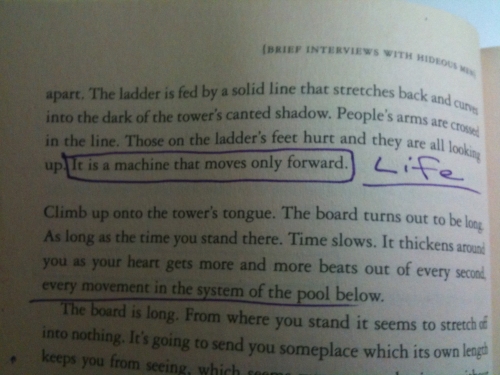
The inner blogosphere of Black Balloon has been abuzz with fake authorial gushiness versus real teen gushiness versus the gush-worthiness of David Foster Wallace faking out teens for real. And this past week, when a package of my old books arrived from my mom, complete with my own teen copy of Wallace's Brief Interviews with Hideous Men, all three confluenced in a cosmic and darkly underscored conclusion.
Read More

Natalie Babbitt, Chip Kidd, and Roberto Bolano wrote some of Flavorwire's most anticipated books of 2012.
If you're a man, you'll probably be buying those books in bulk if you end up liking them.
Let's hope none of them are reduced to window dressing at your local J. Crew.
Though, whatever happens to James Joyce can't be predicted, now that his books are public domain.
Although, that's not the only thing of Joyce that's public. See also: his penchant for flatulance.
Or if you're like Verlaine, with a penchant for absinthe, you'd better check out science's best hangover cures.
Just make sure to take notes on everything you read—for posterity's sake.
But is all that reading's giving you a headache, make yourself a hot toddy, courtesy of Faulkner.
Or if you're in the mood for laughs, you could always check out Rupert Murdoch's Twitter.
Beware of the sudden prevalence fake Michiko Kakutani's while you're over.

 A Black Balloon Publication ©