
October 11, 2012
Welcome to Clementine’s Weekly Reading Series, where Clem the hedgehog talks about whatever she is currently reading. This week: Laura Lamont’s Life in Pictures by Emma Straub. Spoilers ahead.
Read More

Welcome to Clementine’s Weekly Reading Series, where Clem the hedgehog talks about whatever she is currently reading. This week: Laura Lamont’s Life in Pictures by Emma Straub. Spoilers ahead.
Read MoreIf brevity is truly the soul of wit, then your Twitter feed is the Algonquin round table of today's digital Dorothy Parkers and Ogden Nashes. Here's a selection of our favorite tweets from the week; nominate yours by submitting to @blackballoonpub with #twitwit.










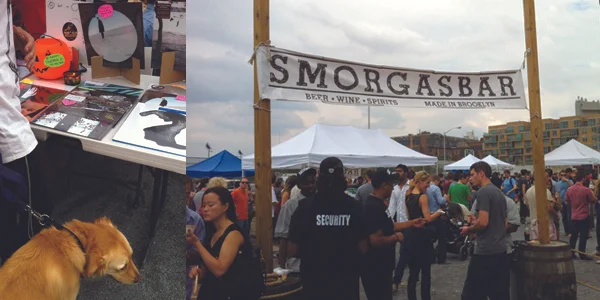
“Yo, who's that guy everybody's lined up for?” asked this tall dude with Beats by Dre headphones, nodding at the swelling crowd around the Warp Records booth. I'd been at the Brooklyn Flea Record Fair for a couple hours and was a bit buzzed on Bitches Brew, but the question snapped me back to lucidity. “That's Flying Lotus, man!” I said. “He's signing his new LP Until the Quiet Comes.” I believe I dropped the adjective “dope” multiple times here.
As winds across the Williamsburg Waterfront concluded NYC's Indian summer, the arrival of Flying Lotus (né Steven Ellison) signaled the Cali producer's brief local residency, which includes a Terminal 5 show Sunday night and a Brainfeeder “takedown” on East Village Radio this afternoon. Basking in the man's broken-beat aura was a sublime bookend to an afternoon spent navigating the record fair's creamy nougat center withinSmorgasburg.
Moving away from NYC last year was rough, but rarely have I felt it so acutely as the walk on N 6th away from Bedford Ave, where the population of black-garbed Brooklyn girls — some in heels, more in skinny jeans, most sporting 12”-sized tote bags — increased tenfold. Couple that with Dogfish Head on tap at the barrel-bordered SmorgasBar, and I realized I'd landed in a specific sort of nirvana.
If I hadn't sent a Brooklyn Bangers weißwurst to my gullet like a scrumptious lead luftballon, I would've hit Yuji Ramen, where chef Haraguchi-san and crew concocted uni mazemen (sea urchin roe in dry-mixed ramen) assembly-line style. I'd pledged to remain sober for the first half of my record fair visit; besides, it's hard to juggle a notepad and a beer while digging through crates of LPs.
“You don't have any dubstep?” someone asked DUMBO-based techno titans Halcyon. I stifled an oath. The young woman next to me nabbed OutKast's Stankonia (LaFace) double-LP, and I stifled another oath.
I lingered at the Minimal Wave booth as founder/owner Veronica Vasicka updated me on Japanese pre-MIDI pioneer Sympathy Nervous. We recounted Modern Love's mind-altering sonic experience last night at Public Assembly, and I walked away with Sympathy Nervous' crystallinePlastic Love (Minimal Wave).
As the day progressed, rotating DJs segued from the Rolling Stones' “Get Off Of My Cloud” to Kraftwerk's “Boom Boom Tschak.” Clutching another cup of Bitches Brew, I mulled over the re-released Eraserhead Original Soundtrack (I.R.S.) at Sacred Bones and the rare stuff at Mondo Kim's: from Willie Hutch's Foxy Brown (Motown) to Squarepusher's caffeinated breakbeat Big Loada (Nothing/Warp). “Hey man, you see any dub?” one Kim's employee asked another, gesturing to a customer. “He's looking for dub.”
Now that's more like it, man. Flying Lotus would approve.
Images courtesy the author


Images: NYTimes, Jezebel, logotv.com, CBS News, Huffington Post
Answers to last week's installment:
Explosions, weapons of mankind, friendship, and above all, pants. These are the things important to Maverick Jetpants in the City of Quality, which is now available online and at awesome bookstores everywhere. Set in the urban decay of upstate New York, the novel follows a group of friends clinging to each other in the face of adulthood. Publishers Weekly calls it “the novel that's going to put Rochester on the map” and named it one of the Best Books for the Week. Anyone who's ever had their own version of Applebees and the Vomit Cruiser will see their own hometown in Maverick Jetpants.
Once a week, Black Balloon's editorial assistant Kate Gavino chooses the best Q and the best A from one of New York's literary in-store events. Here, Kate draws from Zadie Smith's reading at Greenlight Bookstore on September 28.
What made you want to write about your hometown?
Zadie Smith: What drew me back to [Hackney] is fiction. I love to think about it and write about it. Some of the changes I fought to put in the book since there's been a great deal of gentrification, which in Brooklyn you're perfectly familiar with. It's always most painful for long-term locals, and some of it I feel is justified. But some of it is also irrational. You're really angry about the cupcake shop even though what was there before was a wasteland with a dead body on it. That's the way it is. I do find myself when I'm [in Hackney] complaining a lot, which I probably shouldn't do.
To me, half my area is very homogenous. It's just the kind of thing that mainstream media doesn't complain about. For a lot of people, when your neighborhood becomes entirely white and entirely upper middle class, it is a different kind of invasion – stressful to the people who live there. Most stressful is the assumption on the part of that community that you are grateful that they come. That's the difference because most immigrants don't assume that you'd be grateful that they've appeared in masses. But that particular contingent thinks they're a great blessing to wherever they land.
Image courtesy the author
The 2012 Nobel Prize in Literature is set to be announced on Thursday, and you can bet there's a gambling pool around the winners. As of Monday morning, Haruki Murakami was in the lead with 2:1 odds, while Alice Munro, Péter Nádas, and the Chinese writer Mo Yan were in a dead heat for second place.
How good are the odds that Ladbrokes got the answer? I wouldn't wager too high. Last year, Murakami and Nádas were at the top of the list (as was the reclusive Australian writer Gerald Murnane), hot on the heels of recently published books, but Bob Dylan was getting pretty good money as well. Then the Swedish writer Tomas Tranströmer pulled into the fore, as did Mario Vargas Llosa the year before, so I think we can assume this year's winner won't be terribly controversial.
Which means my money's on a capital-L Literary author. Scanning down the list, I see the Nobel Prize-winning economist Daniel Kahneman. Really, Ladbrokes? The only people to win multiple prizes — Marie Curie, Linus Pauling, John Bardeen, and Frederick Sanger — were all in the sciences, and stayed in the sciences (even the one who won the Peace prize for anti-nuclear activism). Don't get me wrong. Thinking, Fast and Slow is indeed brilliant, but hardly the stuff of English classes. Then again, neither is Fifty Shades of Grey, currently sitting at the very bottom of Ladbrokes' list. It's okay; E.L. James doesn't need the money or fame anyway.
The people picking the winner are a select group: only eighteen members, all of whom are in the Swedish Academy. There are plenty of authors who are shortlisted year after year, and only awarded the prize after repeated consideration.
Recently, there's been a strong anti-American bias; four years ago, the Committee's secretary, Horace Engdahl, made headlines when he averred that "the U.S. is too isolated, too insular." As an American, I'd love to help make an argument to the contrary, but Engdahl has since stepped down, and the recent peace prize to Barack Obama implies that American authors do have a chance again to capture the Nobel. Maybe there's hope for Philip Roth this year.
So who do I think will win? I think Murakami has very good chances indeed, although he merits the prize less for 1Q84 than for The Wind-Up Bird Chronicle, which tackles the Sino-Japanese war among other things. I'd love to see Péter Nádas win for his monumental Parallel Stories, which is easily one of the most brilliant and dense books I've read since college. But the ones who are most likely to win are probably further down the list right now. The Dutch author Cees Nooteboom has been in the running for years, and has slowly amassed an extraordinary oeuvre that taps into great themes and gorgeous allusions. Adonis, a Syrian poet, consistently ranks among the greatest writers in Arabic, and his recently-translated Selected Poems is a wonder to read. And Salman Rushdie's books have probably had a greater effect on the world at large than nearly any other living author; his Joseph Anton gives us a small idea of his experience after The Satanic Verses and his subsequent fatwa. They'd all be deserving winners.
Go on, place your bets.
Image: J.M. Coetzee, the 2003 prize winner, giving his speech at the Nobel Prize Banquet. Credit: Nobelprize.org
A group of young professionals waits in line at Bi-Rite Creamery.
(Teasing): "Look at her, rockin' that like 1987 flip phone!"
(Brandishing): "Yeah, I gotta admit it, I'm kinda proud of my flip phone."
(Defending:): "Hey man, nothin' wrong with that. She's thrifty. That's how she's a homeowner now!"
[Unintelligible financial small talk]
(She, being thrifty:) "Hey, you wanna live in the basement of my house? I'll give you good rent."
Image courtesy the author
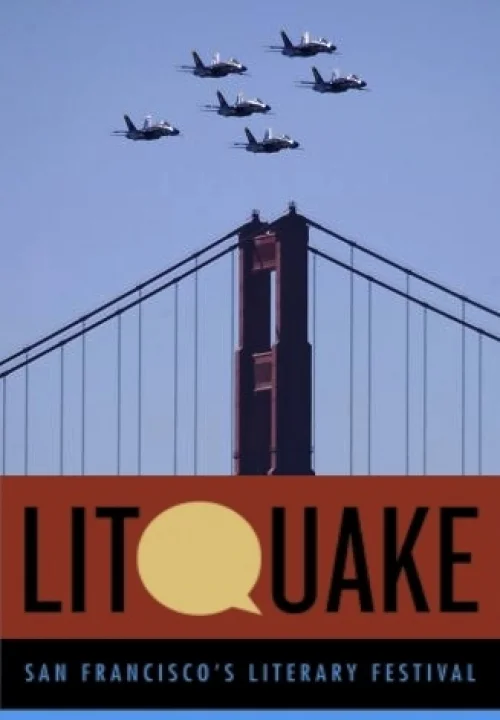
The first day of Litquake, San Francisco’s annual literary binge, had some serious competition: on Saturday afternoon, the SF Giants were in the playoffs; Hardly Strictly Bluegrass drew hundreds of thousands to Golden Gate Park; the America’s Cup occupied the waterfront with 1%-ers; and it was Fleet Week, that quaint local tradition in which the Blue Angels tear back and forth above our city in a bizarrely irony-free celebration of America’s militarized cultural identity.
In a dimly lit room at the California Institute of Integral Studies, the thoughtful mood punctuated by the sonic rumbles of the Blue Angels, four writers of color gathered to talk about Rewriting America: Race and Re-imaginings in Post-9/11 America. This certainly wasn’t the Banjo Stage; things got serious, and political, and quickly.
“I am the new enemy,” said Francisco X. Alarcón, who identifies as Mexticoand is involved in the fight against SB 1070, the Arizona state bill outlawing cultural studies (and, effectively, literature by non-white writers). “Now that there are no Commies, they’re coming for people who look like me.”
Elmaz Abinader, a multi-genre writer who founded VONA: Voices of Our Nation Arts Foundation, the prestigious writing workshop for writers of color, began her reading of poems about Palestine with the observation that “America is the only country in the world where people run outsidewhen fighter planes fly over.”
Panel moderator Pireeni Sundaralingam read several selections fromIndivisible: An Anthology of Contemporary South Asian American Poetry, which she coedited with Neelanjana Banarjee and Summi Kaipa.Sundaralingam spoke of the difficulty in getting the book greenlighted in the face of publishing industry types who couldn’t comprehend that "South Asian American” writers are, in fact, Americans.
And Cave Canem Prize winner Ronaldo V. Wilson performed a chilling sound poem mashup: his own recorded voice recalling New York on the day the towers fell vs. his live reading of freewheeling poems touching on race, sexual identity, and class conflict.
Each writer discussed the complexities involved in existing outside of the mainstream in a country where people who look a certain way or practice a certain religion are now required to spend the bulk of their energy reassuring others that, as Sundaralingam put it, “We’re not terrorists.”
To end the afternoon, the panelists each doled out some quick tips for young writers of color — and for all writers.
On navigating the “establishment,” whether in academia or the publishing process:
“Go hard and strong on what you believe and don’t get pushed.”
—Abinader
“When they tell you no, you have to say yes. Don’t be so concerned with mainstream America; the gatekeepers will always be gatekeepers.”
—Alarcón
“Forget it — I’m just gonna make art … and let everyone else figure it out. [When I wrote my first book] I had an audience in mind: all the unusuals, all the freaks.” —Wilson
On creating a space for writers of colors within the larger literary scene:
“When you see other writers [of color] taking risks, support them — critique, publish, review their work, serve as their editors.” —Sundaralingam
“Everything you write creates a community around it. Go out and find it.” —Abinader
On the death of literary magazines, and the rapid disappearing act of arts funding in general:
“Think long term, invest in yourself. The institutions won’t survive.”
—Alarcón
“Defeat Romney. Keep arts consciousness alive. We can’t let this die.”
—Abinader
Great way to take stock of issues of race in the lit industry before what promises to be a week of copious — and often overwhelmingly white — literary scene-making in San Francisco. Now if only those damn planes would shut up, we'd be getting somewhere.
Images: Blue Angels photo via Paul Chinn, The Chronicle / SF ; Litquake logo via Litquake's Tumblr.
Party of five: Grandma, Grandpa, Mom, and two young sisters crouched together staring at a smartphone. They are not talkative but not unfriendly. The three adults order their breakfasts but the sisters do not look up when it's their turn. Grandpa looks at Mom and says:
"Are you going to coach your daughters on how to order?"
Image: closetcooking.com







 A Black Balloon Publication ©