


If Marilyn Monroe had won an Oscar, the alternate history would have turned out very, very bad for her.
Though not as bad as the vampire scare going around in New England -- and no, these vampires do not sparkle.
Perhaps we're just going to have to meet the real life version of Dracula, and who knows? He could be perfectly charming.
But if you're looking to treat a recent vampire bite, don't trust all the medical advice you find on the interwebs.
But if you're going to turn to books, make sure you know the true origins of any used ones you may happen to come across.
That alone could be a strong case for shaping your brain to be only accustomed to ebooks.
But then again, where will all your crazy marginalia go?

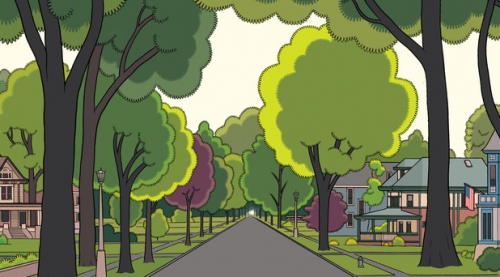
I walked through the pouring rain to the opening night of Chris Ware's gallery exhibition. His latest book, Building Stories, just came out, and I wanted to see the artistic process behind my favorite book cover and, well,
I wanted to see who else was obsessed with this graphic-novel master.
There were a few people who, like me, were sipping white wine and looking at the panels for the sheer enjoyment of it all. I first learned about Chris Ware when I held Jimmy Corrigan, the Smartest Kid on Earth in my hands. Not knowing what to expect, I had flipped through the book and seen a wide array of ligne-claire faces (just like Hergé's Tintin series!) and carefully proportioned panels that were way more complicated than the Batman comics I'd read in grade school. And this Jimmy Corrigan wasn't a little kid, either. He was a middle-aged man and his entire life was depicted in hundreds of pages, some without any text at all (including some beautiful montages of the sun moving across landscapes), and some swallowed up by a single panel. I was hooked.
I read this book when I was seventeen, so I wasn't terribly surprised to see a few high-school students with backpacks peering at the art gallery's walls. They looked, snapped pictures, and then texted their friends.
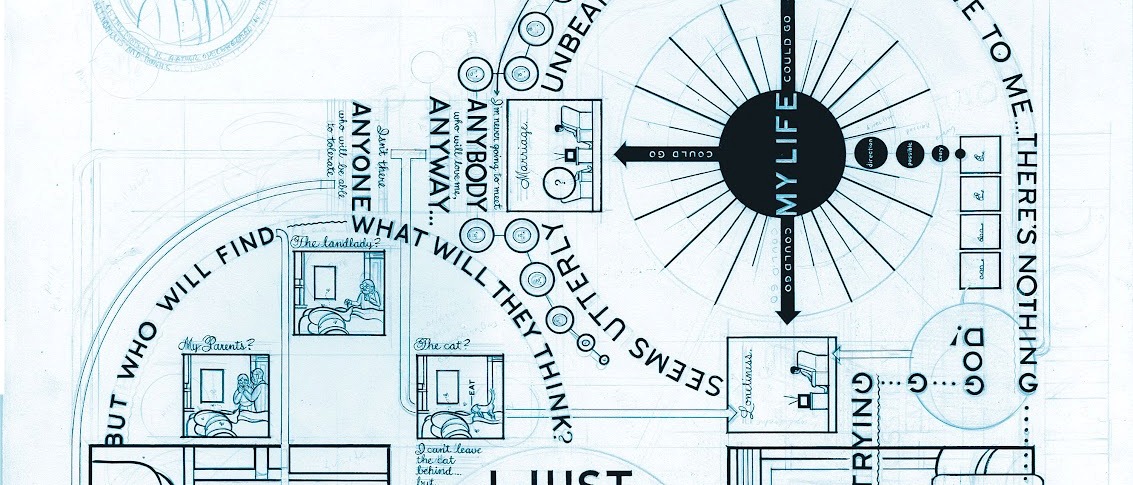
The title of Chris Ware's Building Stories is a double entendre, of course: even as he details the lives of various inhabitants within a single apartment building, he lays bare the ways in which he constructed those stories. I love sketches and other evidence of the artistic process, and so I wasn't disappointed to see
gigantic pages that swirled with text and images laid out in all directions. Even in the most chaotic pages, Chris Ware so clearly anticipated the human eye's motions that I was able to piece together the stories he was telling. And it wasn't just the eye that he understood; as I read the stories of men and women, children and adults, I realized that he had found a way to encapsulate the difficulty and beauty of human life into squares and lines.
Near the end of one panel, a mother tells her grown daughter that she dreamed she had found a book filled with everything she'd done in her life: "The point is, I dreamed [it up]... I saw it — made it — with my own two eyes [...] I just never thought I had it in me, that's all, you know? *snf* ... I never thought I actually had it in me..." I'm pretty sure Chris Ware himself walked past me at that moment, or at least I hope he did. He reportedly struggled over the years of Building Stories's creation; he mentions the almost complete loss of his virility, and he's notoriously press-shy. This was the first time I had seen that particular strain of grief, recognition, and summation immortalized in art.
I repeatedly squeezed past a man who was holding a baby. Another type of person I hadn't expected to see at a gallery opening. Maybe these comics looked kid-friendly on the outside? Or they were just looking at the model house built by the artist? Ware's characters are so driven by feelings of longing, guilt, despair, surprise, and sexuality that I almost worry about minors looking at them.
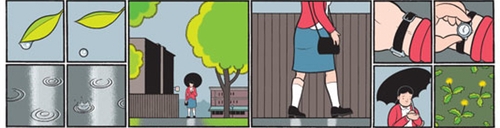
But out of Ware's honesty great beauty arises: sequential art that can modulate the passage of time and memory, that can move us (in one of my favorite panels, linked above) from a drop of water falling to a woman checking the time and, in her mind, seeing daisies. I knew I had to buy the entire Building Stories and open the box with its fourteen different booklets and posters and newspapers inside. I kept looking at the panels along the wall. I forgot all the unexpected people around me and lost myself in Chris Ware's square panels, solid colors, and clear lines.

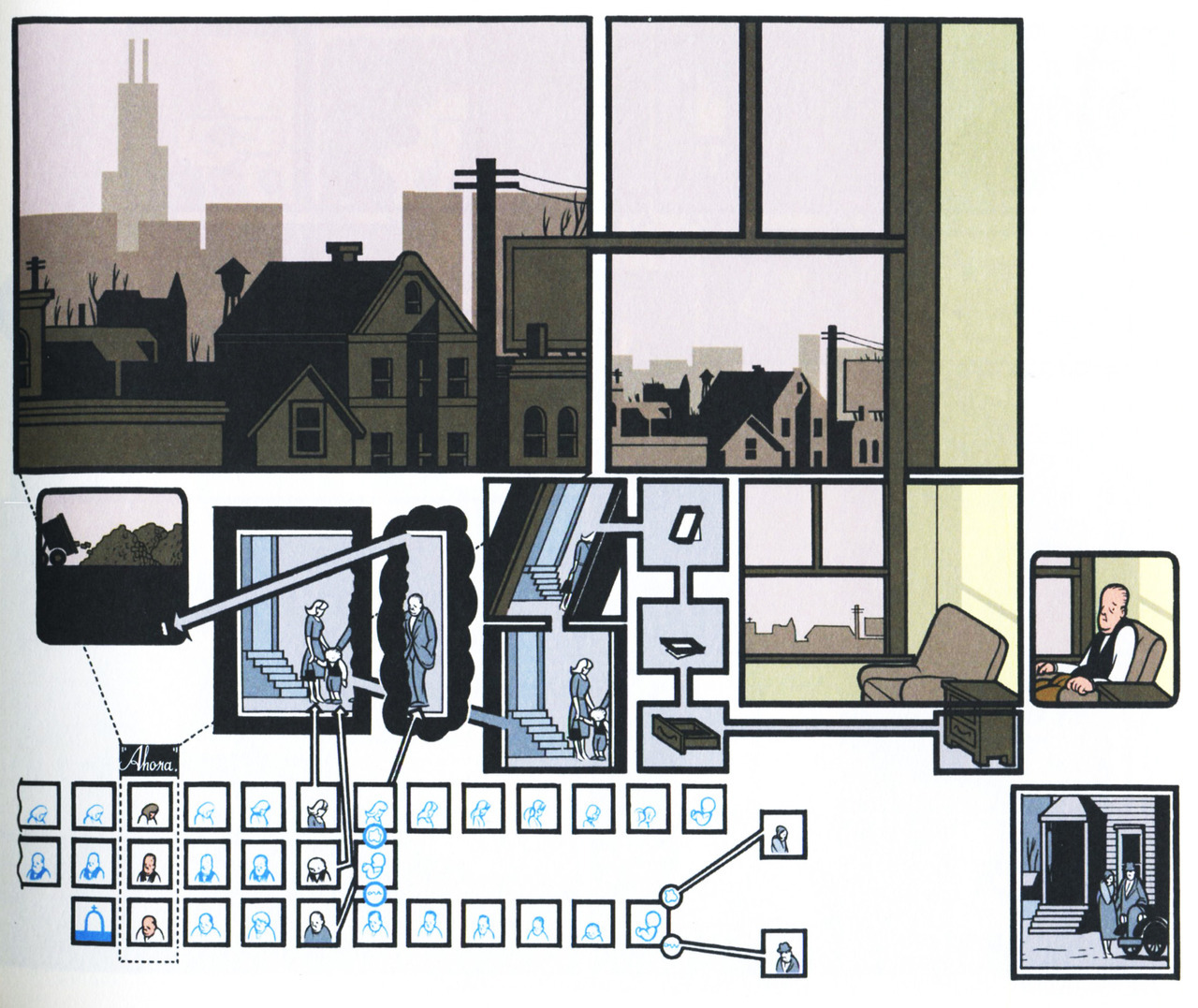


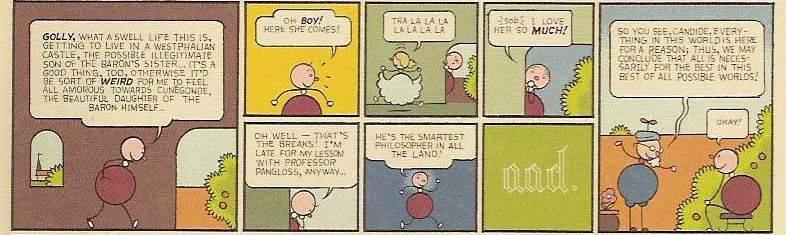
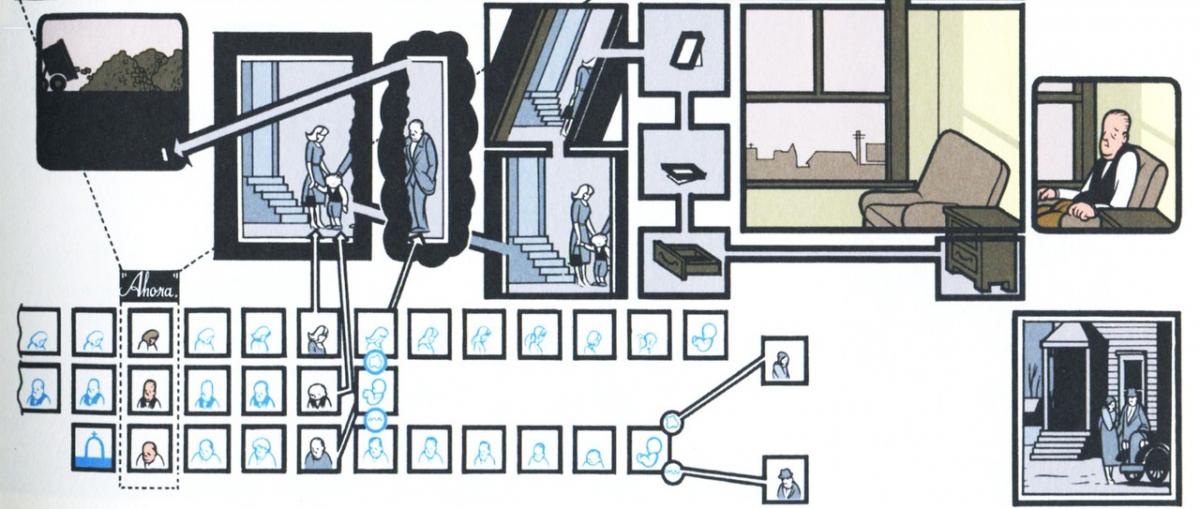
All images by Chris Ware. Sources: fastcocreate.com; thefashionchronicles.com; arquitectoserectos.tumblr.com; nycgraphicnovelists.com; sparehd.com. Click on the pictures for full-page layouts.

Welcome to Clementine’s Weekly Reading Series, where Clem the hedgehog talks about whatever she is currently reading. This week: Mr. Penumbra’s 24 Hour Bookstore by Robin Sloan.
Read More
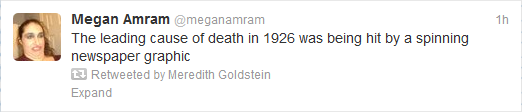
If brevity is truly the soul of wit, then your Twitter feed is the Algonquin round table of today's digital Dorothy Parkers and Ogden Nashes. Here's a selection of our favorite tweets from the week; nominate yours by submitting to @blackballoonpub with #twitwit.










Brooklyn Shaken & Stirred, an event “celebrating Brooklyn imbibing,” was held two days ago in the Green Building, on the Carroll Gardens side of the stinky, superfundy Gowanus. As an imbiber from Brooklyn, I went to the event to see what could be tippled.
Read More
I know it’s October, but have a look at these ads, all from the Manhattan-bound platform of the Court Square E/M stop, and consider that there was barely enough remaining wallspace to accommodate that new Paul Blart spinoff.
Read More

A weekly series that explores a featured theme by pairing classic quotations with urgent images. What recent news items inspired these textual/visual sets? Leave your guesses in the comments, and check back next Wednesday for the answers.

“You should never wear your best trousers when you go out to fight for freedom and truth.”
—Henrik Ibsen

“A person who publishes a book willfully appears before the populace with his pants down.”
—Edna St. Vincent Millay

“I like being a woman, even in a man's world. After all, men can't wear dresses, but we can wear the pants.”
—Whitney Houston

“Sex stops when you pull up your pants,
Love never lets you go.”
—Kingsley Amis

“I grow old...I grow old...
I shall wear the bottoms of my trousers rolled.”
—T.S. Eliot
See the connections? Write your guesses in the comments — and feel free to leave your own "pants" quotes — and check in next Wednesday to find the headlines that inspired these pairings.
Images: ABC News, India Times, MTV.com, yourtango.com, New York Times
Answers to last week's installment:
- "We can no longer say the replacement referees didn't directly impact the result of a game" (faniq.com)
- "Iran’s President Spreads the Outrage in New York" (New York Times)
- "App offers peek into Einstein's brain" (sfgate.com)
- "The Sin of Sowing Hatred of Islam" (New York Times; image:atlasshrugs2000.typepad.com)
- "New Caledonian crows reason about hidden causal agents" (pnas.org; image: pbs.org)


As the celluloid dust settles over Austin, and my liver relaxes to normal functionality, I bid Fantastic Fest 2012 adieu. Funny how a succession of 16-hour moviegoing days can fly by so quickly.
Here's the catch-22: solid screening schedules subtract from meet-and-greets with the hyper-creative international community, and the parties are sometimes as dope as the films they celebrate. I spent much of opening night plotting out 15 minutes to catch up with Team Tokyo, but due to massive red carpet premieres, I didn't find a free moment until night two.

“In my role, well...I'm not wearing this corset, for example. And I'm covered in blood. I think you'll love it.” — Je$$ica (star of “Z is for Zetsumetsu” in The ABC's of Death; my translation)
Besides the usual suspects, I befriended (i.e. became totally enamored with) platinum-coiffed jo-ō-sama Je$$ica, seductive starlet of Yoshihiro Nishimura's contribution to The ABC's of Death. We run in similar circles in that neon metropolis, so I'll definitely look her up when I return in November.

“I really want to split her lip. That's kinda my goal, so everyone can see the shame on her face at how pathetic she was in the ring against me.” — Sylvia Soska (co-director of American Mary, on her twin, co-director Jen, at the Fantastic Debates)

At the Fantastic Fest 2012 Awards, pint-sized powerhouse Rina Takeda nabbed “Best Actress” in the Gutbusters category for Dead Sushi. Only at Fantastic Fest can a film about carnivorous raw fish be considered a comedy. The Fantastic Debates began with discussion — like Twisted TwinsJen and Sylvia Soska, arguing pro and contra remaking films — and concluded with boxing! A shining moment at Chaos Reigns Karaoke wasHere Comes the Devil's Laura Caro channeling her inner Whitney in a room-scorching serenade of “I Will Always Love You.”

“Watching yourself die onscreen is a weird, strangely satisfying thing.” — Eli Roth (co-writer, producer, and star of Aftershock)
Latin America brought the heat. Mexico's Here Comes the Devil joined Sao Paulo-based fever-dream Two Rabbits and two Chilean films — Bring Me the Head of Machine Gun Woman (I'm convinced Fernanda Urrejola's bikini'ed badass heralds my ideal woman) and Aftershock (the seismic lurch from party flick to natural disaster terror totally worked) — as personal favorites. Though I gotta give the top spot to France and Holy Motors, infused with an irresistible cinematic je ne sais quoi. New York: this screens on October 11 at the NYFF, and I encourage cineastes to not miss it.

All told, I surmounted successfully 26 films, beating last year's record — barely. See, there's another double-F-bomb related to this festival: the “Fantastic Flu.” The combination of dry Central Texas heat and icebox theaters, surrounded by hundreds of film geeks, plus the extra-late hours and torrents of beer, equals a cinematically proportioned common cold. I left my flat in the morning only after coking up on green tea and vitamin C.
And now, I wade back to normality by returning to NYC for work. I may even catch some of NYFF while I'm in town, if I can will myself to sit in a theater.
Images: Main image and non-film-still images courtesy the author; ABC's of Death still via Monster Pictures; all other film stills via Fantastic Fest; Fantastic Debates boxing via David Hill/Fantastic Fest

Once a week, Black Balloon's editorial assistant Kate Gavino chooses the best Q and the best A from one of New York's literary in-store events. Here, Kate draws from Michael Chabon's reading at Greenlight Bookstore on September 17.
Tell us about your research process, especially using the Internet.
Michael Chabon: [The internet] is very tempting, encouraging you, whispering insidiously into your ear to indulge the need to know something immediately. Sometimes I feel like I actually pose those research problems to myself just so I have an excuse to check my email. Like say, how many spark plugs were in the engine of a standard issue US army truck that was used by the troops in Europe in 1944? You know you can find that. You know there's a whole spark plug website or military spark plug archive. It's there waiting for you, and it's very tempting right then to just get that information because a lot of the times you go looking, you find out way more than you bargained for. It's a great thing. Many times I've made important discoveries about books I was writing that I would not have know if I hadn't gone and done the research.
But usually, you can just put “tk” and leave it and go on and that took me a long time to learn. Most of the time it's just a lame excuse to go on Gilt.com and just waste time. Now I actually try to shut off the Internet, and that's really increased my productivity to a terrifying degree. I used to blame the fact that I have kids for the fact that I wasn't getting much done but it turns out it wasn't their fault. Well, it's partly their fault.

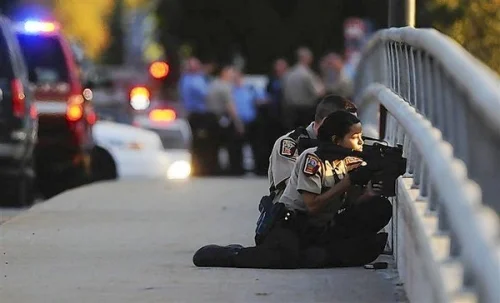
Last week, I ventured into a Minneapolis mystery bookstore to hear William Swanson read from Black White Blue: the nonfiction account of a St. Paul police officer killed in the line of duty forty years ago. The next morning, I learned that a man in Minneapolis had shot and killed five people, injuring several others, at his former place of employment, before killing himself.
Two things struck me: at the reading, the audience responded forcefully to the story of the assassinated officer and the subsequent legal case, but they didn't seem as interested in the tumultuous cultural environment in which the crime took place. And in Friday morning's paper, it was a line spoken by the Minneapolis Deputy Police Chief: "This is something we see on the news in other parts of the country, not here in Minneapolis."
For me, such a statement only conveys a desire to separate one's sense of regional identity from unwanted behavior. It communicates, most immediately, I am afraid.
The audience at the bookstore was, I can only assume, typical of nonfiction crime fans: most sat in bright, inquisitive attention as they asked about the specifics of the legal proceedings and the author's access to sources. The murder described in Black White Blue seems to have been entirely sociopolitically motivated: the State's case claimed the perpetrator was vying for the attention of the Black Panthers by orchestrating the shooting of a random white cop. Yet beyond a general description of the seventies as tumultuous, full of police brutality and politically very active (shit being blown up, etc.), very few specifics were brought up about the particular racial climate in St. Paul at the time.
At one point, Swanson said that in addition to the chaos, it was a rather exciting and liberating time, and the one black man in the audience pointed out that it wasn't exactly exciting and liberating for others in the community. I sensed that few attendees wanted to get anywhere near talking about the racism or police brutality or segregation or inequality. In this case, "not here" suggests a different kind of avoidance from the kind the Deputy Police Chief conjured after last week's shooting. But it could've been uttered just the same.
There is likely no better way to write nonfiction crime than to focus on a central character or pinnacle case around which everything else can be explored. Since last Thursday, the local papers have been focusing on two central characters: the shooter, Andrew Engeldinger, and his boss (who had fired Engeldinger that afternoon), Reuven Rahamim. Without fail, this story will be compared to other office shootings and other mass shootings, Colorado no doubt on the top of the list. I won't be surprised when op-eds begin to spring up about modern mental health practices and accessibility, the desperation of the economy, gun control. And other attempts at feeling productive after an event for which there is nothing to be done.
We will come together as a community and be defined by our response, our social activism, our Minnesotan sense of civic duty. Meanwhile, it might help if we stopped trying to cast certain behaviors as un-Minnesotan, so we could be able to move just a little further forward.
Image: Stringer/Reuters
 A Black Balloon Publication ©