Since passing in 2003, Roberto Bolaño has published a lot of books, probably more than you or I will put out in our combined afterlives. Because once you get famous—and you must be pretty famous if Heidi Julavits and other lit bigwigs are singing your praises at Galapagos—it’s not just your finished work that attracts readerly eyes. Some greedy fans will find the time to scrutinize marginal notes in your correspondence or drafts and sketches taken from your computer. When it comes to Bolaño, I am one of those eager gleaners; I have been ever since The Savage Detectives made me regret my somewhat sensible (read: mostly boring) life and pine for those of its voluntarily down-and-out (read: awesomely authentic) characters.
So I was excited about The Secret of Evil, the latest of Bolaño’s work to be translated into English. It’s a collection of “stories,” though it contains some of the putatively autobiographical work released last year in Between Parentheses (including a favorite of mine, “Beach,” the account of a recovering dope addict—perhaps Bolaño, perhaps not). That The Secret of Evil draws from the previous book is suggested even in its design: Evil has a blind embossed set of horns on its dust jacket, recalling, in invisible tactility, the foil-stamped parentheses on the cover of the former collection. Clever clever.
I’ve invested a lot of time both in Bolaño and Arturo Belano, the former's fictionalized self. But what about you non-fanatics? What would you think of the The Secret of Evil? It’s a solid collection of stories, sure, but some of them are hard to appreciate without the rest of Bolaño’s writings there in the background. And unlike, say, 2666, this was in no way close to being finalized for print.
Evil also marks a turning point in the way we pilfer dead authors’ “papers.” Its introduction goes into some detail about how the pieces were taken from Bolaño’s computer, going so far as to name the files it drew from. Hard-copy drafts are probably a thing of the past. The next thing to disappear may be the locally stored digital file; instead, all our manuscripts will be up in the cloud. And, of course, letters: they’re dead, and we're sure to see more and more volumes of email correspondence.
What's next? Maybe writerly Twitter and Facebook accounts will be combined with smartphone GPS logs—along with, we gotta hope, those of the writer's spouse, friends, publishers, fuckbuddies, etc.—and published as an app. Then future academics will make observations like this: "It appears that Rushdie was more prolific in the days he spent with Lakshmi than when he was when he was about town with Lieskovsky. I will use this dataset to to construct an algorithm that rates muses like Klout does social media yuppies."
The digitization of everything is gonna make for exciting, horrifying stuff, people. Just hope you don't become famous. Because if you do, you will have no secrets, no secrets at all.
Image: flickr user Kleiber Fragoso


While I did find the recent note from Werner Herzog to his cleaning lady up on Sabotage Times to be really quite hilarious, I think I’d be at fault if I didn’t extrapolate on the obvious lesson learned: We should all be cleaning ladies. How many times have I attempted—in vain—to invade other people’s houses? There’s so much to learn! So much to explore! Do you have any idea what you can learn from people’s objects? Have you stolen this information and put it in a story? Maybe it’s time.
While my cleaning lady credentials really aren’t up to snuff—the last time I cleaned anyone’s toilet, it was 1994 and occurred in the previous residence of Soul Asylum frontman Dave Pirner (he wasn’t living there anymore, but he totally pooped there!)—I have had a vast amount of experience dog-sitting, which grants you a similar type of access to people's private lives. Sure, there is a bunch of actual work involved, but you need to focus on what can be gleamed from your physical surround.
First off, there’s no need for snooping. Secret drawers and hidden cabinets don’t need your attention. That’s for perverts. You are a writer. Presumably. And anyhow, there are too many details out in the open that you need to pay attention to in order to reconstruct the proper environs for your next American novella. Here’s a run-through of the most important rooms and what you’ll need to consider.
The Bathroom. How I love bathrooms. What kind of soap do they use? How many of the items are purely aesthetic flourishes, e.g. is that loofah there for a calm bath or to insert personality? Do perfumes or a rusty razor grace the counter? An overflow of cosmetic devices or a pristine assortment of decided upkeep? Remember: you are not here to judge, but to learn.
Kitchen. A whole book could be written about what’s left in the sink. Do your hosts require the most advanced of gadgetry or is it difficult to even locate a working can opener? Is there a smell? What have they left in their cupboards and fridge? Capers and produce? Perhaps a can of soup and something sour with packaging from the 1980s? Feed on this! For information. There should be take-out menus in the left hand drawer.
Bedroom. And how do they sleep? Is that shit a pillow-top? Does a television sit alone in the corner? Is there any reading to be had at night or do your absent hosts sleep fast to chillwave performed by whales?
Having made these rounds, you'll have all you need to reconstruct your unwitting clients. A house, even a one-bedroom apartment, as long as it’s not yours, should provide years of fiction fodder. Screw your corporate longings with the health insurance and dependable pay; what you need are some rubber gloves and a vacuum.
But please, please, be careful. Just in case you end up with a client like Mr. Herzog. "The situation regarding spoons remains unchanged. If I see one, I will kill it."
image: theadventuresofmothertucker.blogspot.com


Apparently all men have a required reading list, and it doesn't seem to include much female writers.
Which supports the case for pseudonyms, though J.K. Rowling seems to have done alright for herself.
If this Warner Herzog note to his cleaning lady had been real, then he'd probably need to find a pseudonym as well.
Though that note isn't something you'd want to re-read, there are plenty of books that people just keep coming back to.
Perhaps they are particularly influential books that were read to them by their geeky parents.
Such parental acts are important, considering that we may be facing a Ray Bradbury-ian future ahead of us.
And looking back at some of the trends of the 90's, that may not be such a bad thing.
Though an entire generation can't be summed up so easily, unlike some of these classic genres.
But if you ask the Pulitzer prize committee to do it, they'd probably just keep putting off until the last minute.
Illustration by Maximilian Bode.


If you, like me, grew up in the '90s, you're probably familiar with the dilemma of blocking out parts of that decade whilst embracing others. For every instance of President Clinton ripping into a sax solo on The Arsenio Hall Show, there is smooth-jazz circular breather Kenny G butchering the damn instrument. Another case in point: the Awl's profile on Dustin Mikulski, known to the world as the Dancing Baby from Ally McBeal. The fact that this man, once a cha-cha-ing child whose birth coincided with that of viral video, can still draw a crowd, proves our enduring love/hate relationship with that schizophrenic decade.
Whatever. Dancing Baby can oogachaka his animated ass outta here. It's one facet of the '90s I wish would disappear, like JNCOs and Beanie Babies. Now '90s music...that's a complicated one, encompassing both Kurt Cobain's suicide and 2Pac's murder. Then again, with 'Pac's hologram sharing the stage with Snoop Dogg and Dr. Dre at Coachella, the '90s have never felt so close. Below are a few songs that, to me, define the decade and its transitions between Kurt and that demonic dancing baby—but I'll be damned if I include Aqua.
1994: Nirvana, “Drain You” (live on French TV). Recorded just two months prior to Cobain's suicide, and his chill-eliciting scream still hits me hard. I was just a kid but Nirvana meant the world.
Late 1994: The Prodigy, “Voodoo People.” Charred breakbeats collide with a sampled punk guitar riff. If America could only predict dance music's ubiquity in the following years: just look at the damn commercials, like Mr. Oizo's "Flat Beat" advertising Levi's or that Mitsubishi honey popping to Dirty Vegas' "Days Go By."
Late 1994: Lush, “Hypocrite.” I fell I love with a girl, and she was the Kool-Aid-coiffed frontwoman for Lush, Miki Berenyi. They and (London) Suede were sharp answers to the Britpop.
1995: Massive Attack, “Karmacoma.” The Bristol sound: suffocating sonics and sinister soul. Plus, Tricky (who released his superlative debutMaxinquaye that same year) shares the mic.
Late 1995: 2Pac, “California Love” (feat. Dr. Dre). Pac's comeback track was a sunny exhale of West Coast love, but it was shadowed by his untimely death less than a year later.
1996: Smashing Pumpkins, “1979.” Emo wasn't a widespread term in Texas back in '96, but this guitar-glistening anthem provided the emotional background music to my formative days.
1997: Roni Size/Reprazent, “Brown Paper Bag.” So technically this live clip is not from '97, but this Bristol-based drum-n-bass ensemble won the 1997Mercury Music Prize for their jazz-inflected tracks (beating out Radiohead'sOK Computer and Spice Girls' Spice, just to keep the whole thing in perspective). All you dubstep heads: this is how you bring the bass.
1998: Usher, “Nice & Slow.” Check it: 1998 is the year Dancing Baby debuted on Ally McBeal. It's also the year R&B phenom Usher dropped this breathy single. Just think what this track meant for a sensitive young high-schooler with a learner's permit. As Usher croons: "now here we are, drivin' 'round town. Contemplating where I'm gonna lay you down." Poetry, man. Grunge felt a decade away.
Long live the '90s, I say!
Image: Memesgroupproject (Dancing Baby) and Wikipedia (Tupac Shakur), slightly photo-chopped by the author

Andrés Neuman’s Traveler of the Century, brilliantly translated from the Spanish by Nick Caistor and Lorenza Garcia, is out from FSG this week. In it, a translator and all-around dandy finds himself romancing a beautiful (and already engaged) woman in the "moving city" of Wandernburg, Germany. All the while, he attends salons to debate about art, philosophy, and other questions of the nineteenth century, and wonders how to escape from the ever-shifting locale.
It occured to me that Wandernburg is the latest in a long lineage of uncharted territories, so I've put together a brief history—from Laputa to Lost.
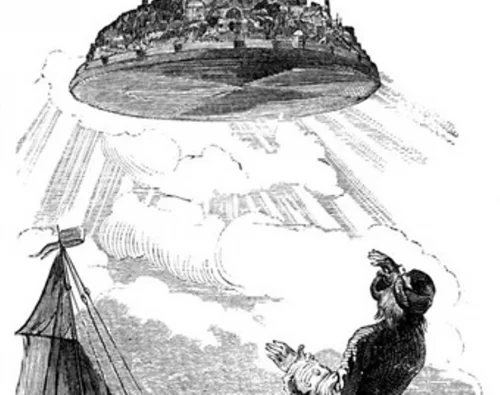
Laputa, from Jonathan Swift’s Gulliver’s Travels

"The reader can hardly conceive my astonishment, to behold an island in the air, inhabited by men, who were able (as it should seem) to raise or sink, or put it into progressive motion, as they pleased...it advanced nearer, and I could see the sides of it encompassed with several gradations of galleries, and stairs, at certain intervals, to descend from one to the other. In the lowest gallery, I beheld some people fishing with long angling rods, and others looking on."
In the third book of Gulliver's Travels, Swift satirizes the stormy relationship between England and Ireland as a large landmass and an airborne island. The latter, which also satirizes the Royal Society, boasts such eccentricities as "a shoulder of mutton cut into an equilateral triangle" and workers "softening marble, for pillows and pin-cushions."
Lincoln Island, from Jules Verne’s The Mysterious Island
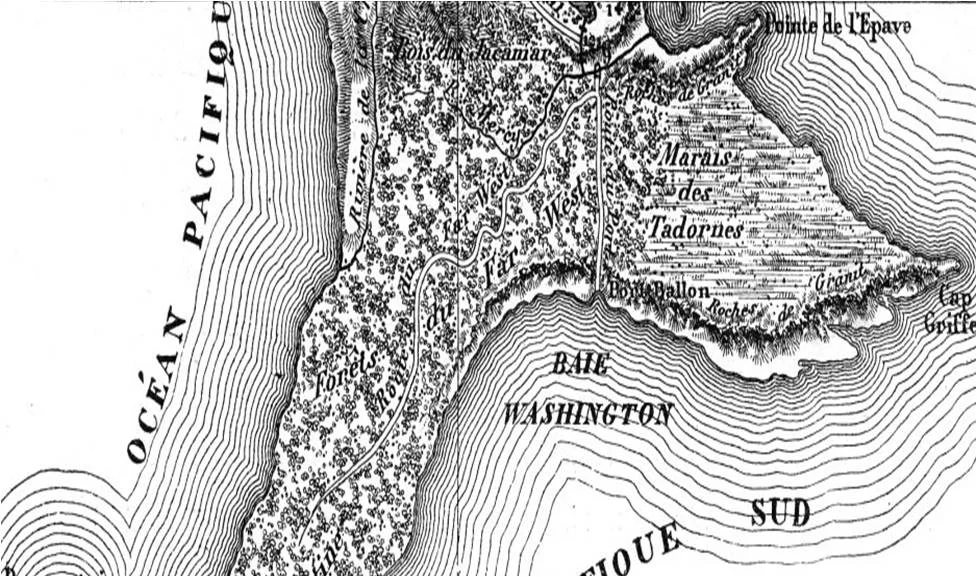
"The balloon, which the wind still drove towards the southwest, had since daybreak gone a considerable distance, which might be reckoned by hundreds of miles, and a tolerably high land had, in fact, appeared in that direction...They were ignorant of what it was, whether an island or a continent, for they did not know to what part of the world the hurricane had driven them. But they must reach this land, whether inhabited or desolate, whether hospitable or not."
After a disastrous balloon flight, a group of explorers lands on a deserted island somewhere in the South Pacific, and—in line with Jules Verne's boundless optimism—makes buildings out of bricks and even constructs an electric telegraph. However, the island abounds with mysteries (such as a pig with a bullet in it) and the group must figure out where the other humans are, if there are any at all.
The city Earth, from Christopher Priest’s Inverted World
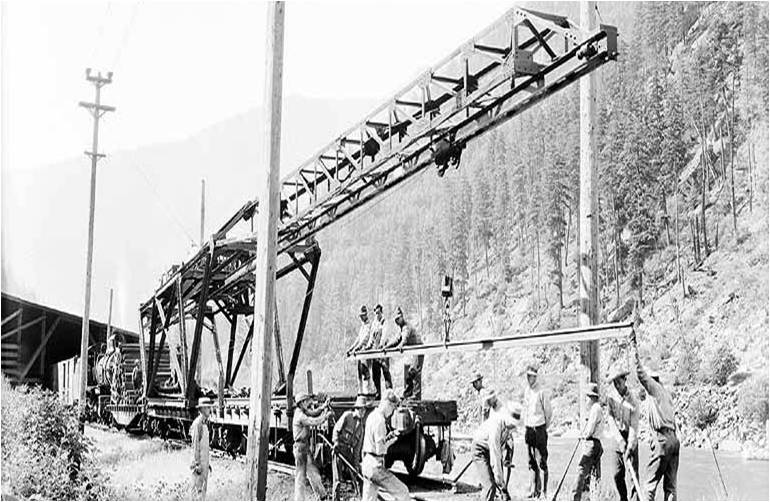
"[I]t was clear that the rest of the tracks led along a downhill gradient. In due course the final pulley was removed, and all five cables were once again taut. There was a short wait until, at a signal from the Traction man at the stays, the slow progress of the city continued…down the slope towards us. Contrary to what I had imagined, the city did not run smoothly of its own accord on the advantageous gradient. By the evidence of what I saw the cables were still taut; the city was still having to pull itself."
"Earth" in this science-fiction novel refers not to a planet but to a city that moves on tracks at a controlled rate toward an unknown destination. Hundreds of guildsmen must lay tracks ahead of the gigantic structure, and remove the tracks that have already been crossed. In this strange universe, distance literally becomes time—"I had reached the age of six hundred and fifty miles" is the first line—and the ramifications of this city's perpetual movement into the future become increasingly bizarre.
The Island, from Lost
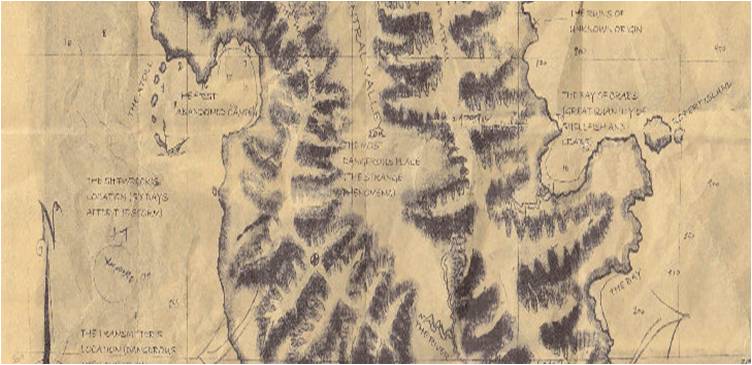
"I've looked into the eye of this island, and what I saw was beautiful." —Locke
When an airplane going from Sydney to Los Angeles crashes on an island in the South Pacific, survival is the first aim of the marooned travelers. But this TV show, which owes an obvious debt to Jules Verne's earlier island, slowly reveals bizarre phenomena—Arctic polar bears, a metal hatch in the jungle's ground—and suggests a very a disturbing reality. The show itself becomes increasingly disorienting, switching from flashbacks and flash-forwards to flash-sideways storylines as it becomes clear that the island can move in time as well as space.
Wandernburg, from Andrés Neuman’s Traveler of the Century

"Wandernburg: moving city, sit. approx. between ancient states of Saxony and Prussia. Cap. of ancient principality of same name...Despite accounts of chroniclers and travellers, precise loc. unknown."
In comparison to these other fantastical inventions, Andrés Neuman’s uncharted city seems positively pedestrian. Although storefronts and streets switch positions overnight, the city as a whole remains relatively moored on land: Hans, the eponymous traveler, is able to send mail to and from various cities in Europe. The focus is less on an isolated space in the world than on an isolated space in the philosophy and intellectual discourse of the nineteenth century. As Hans sits between two countries, so he translates between many languages and the novel itself melds the details of nineteenth-century doorstops with twenty-first-century novelistic techniques. The result is an enthralling epic of a man who bridges gaps of all sorts while looking, always, toward the future.
Image credits: Gulliver beholding Laputa, wikipedia.org; Laputa map, books.google.com; Mysterious Island map, verne.garmtdevries.nl; Great Northern Railway track-laying image, lib.washington.edu; Lost island map, lostified.com; Andrés Neuman photo, nutopia2sergiofalcone.blogspot.com


Between the dog gardener and the talking Pineapple, this year’s New York State English Language Arts test sounds like an absolutely hilarious failure. In addition to the menagerie of ambitious flora and fauna, it appears another question, this time featuring a talking yam, has excited some debate. State education spokesman John Burman draws a comparison between the yam and Martin Luther King Jr., an Invisible Man considers a life in the "sweet yellowish," and tuber culture, according to Catherine Gallagher and Stephen Greenblatt, circumvents the whole conversation.
1. “The folk tale involves a farmer startled by his talking yam. Everyone he meets dismisses him as crazy and insists the tubers can’t talk—including, amusingly, other mute objects like a fish, melon and chair. But a version of the yam story appears in a fourth-grade Houghton Mifflin reader and other test prep material available for city schools to purchase, officials said…’It is absurd to suggest that a passage cannot be used on an exam simply because some students may have previously read that passage,’ [State Education spokesman Jonathan Burman] said. ‘Using that logic, we would be unable to ask children to read and answer questions about Dr. King's ‘I Have a Dream’ speech.’”
—Rachel Monahan, “After controversy over pineapple question on city schools test, a question about a yam stirs new troubles,” New York Daily News, 24 April, 2012.
2. “ ‘They’re my birthmark,’ I said. ‘I yam what I am!’ … [c]ontinue on the yam level and life would be sweet—though somewhat yellowish.”
—Ralph Ellison, Invisible Man, 1952.
3. “Wheat, which bears its grains aboveground, ripens all golden in the sunlit air, while potato tubers expand unseen in occulted darkness. Passing through few stages of civilized productive mediation, the potato makes a startlingly abrupt transition from ground to human being. The whole satisfyingly social and symbolic cycle of planting, germination, sprouting, growing, ripening, harvesting, thrashing, milling, mixing, kneading, and baking, which makes wheat into bread, is bypassed in tuber culture.”
—Catherine Gallagher and Stephen Greenblatt, Practicing New Historicism, 2000.
Let Me Recite What History Teaches (LMRWHT) is a weekly column that flashes the lavalamp, gaslight, candlelight, campfire, torch, sometimes even the starlight of the past on something that is happening now. The form of the column strives to recover what might be best about the “wide-eyed presentation of mere facts.” Each week you will find here some citational constellation, offered with astonishment and without comment, that can serve as an end in itself, dinner party fodder, or an occasion for further thought or writing. The title is taken from the last line of Stein’s poem “If I Told Him (A Completed Portrait of Picasso)."


Whenever I hear about The Great Gatsby, my mind shuttles to a passage of Haruki Murakami's Norwegian Wood, one of my oft-read favorite novels. Like me, the protagonist Toru is a serious rereader: “This is my third time through [Gatsby], and every time I find something new that I like even more than the last time.” So it's not too surprising that The Millions (and a linkedGuardian article) posits The Great Gatsby as the most “rereadable” fiction. Since my rereading habits tend to change with the seasons, let me offer a few recommendations for winter nesting, summer tanning, astral projecting, and more.
• Cocooning for the winter: I plowed through Fyodor Dostoevsky's The Idiot and Crime and Punishment in a chair next my studio's radiator, where the hiss and clatter of pipes covered whatever music was playing the background. To me, they're the most cold-weather appropriate of this Russian's enveloping oeuvre.
• Beach jaunts: Thomas Mann's Death in Venice radiates with dry summer heat and soothing Adriatic air, and its novella length is perfect for beach reading (tack on 45 minutes for the Nassau County train ride). Dostoevsky's short novel The Gambler is another warm-weather favorite—and I'm admittedly smitten with Mlle Blanche de Cominges.
• Emotional inspiration, in brief: Anton Chekhov's short stories never fail me. “The Huntsman,” “Anyuta,” and “The Black Monk” are major tearjerkers—and with Chekhov's unbelievable gift for brevity, “The Huntsman” achieves this over barely four pages. I share these with girls to show them that I am a sensitive dude.
• Emotional inspiration, long read: Zadie Smith's The Autograph Man...and yes, I love White Teeth as well. I met Smith at a reading back when The Autograph Man debuted (she read the prologue, another significant tearjerker), and I've returned to her idiosyncratic second novel ever since.
• Far East escapism: Haruki Murakami's pop psychedelic The Windup Bird Chronicle. I've written about this before for Black Balloon, and it's my go-to for getting “away." Plus, Dance, Dance, Dance is one heady trip (psychic teenagers and talking sheep, anyone?).
• Even farther (like another universe) escapism: Douglas Adams' The Ultimate Hitchhiker's Guide to the Galaxy, or as the subheading reads: “five novels in one outrageous volume.” I tend to tucker out at So Long, and Thanks for All the Fish, but it's still a stellar ticket outta here. Towel not included.
For my fellow rereaders, I close with a helpful tip. See, my Manhattan studio couldn't accommodate a proper library, but my reading habits demanded one. To combat my finite space, I read and re-read certain novels until I'd exhausted them, and then I shipped them back to my parents so I could buy more.
But the Murakamis, the Russians, Zadie...those I made room for. Who needs a bathtub, anyway?
Image courtesy the author


Arielle Zibrak’s "Super Short Cliff’s Notes for All Classic Novels," a McScweeney’s list that I strongly encourage you all to read, inspired me to come up with some Cliff's Notes of my own. Yes, this is just for fun, but I also like the play of structure, seeing what happens when we look at complex things via a simplified frame. So let's summarize a few things that shouldn't be summarized!
Cliff’s Notes for Break-Ups
- You tell someone “It’s not you, it’s me.”
- Someone tells you “It’s not you, it’s me.”
- You sleep with this person
- Both parties drink excessively
Cliff’s Notes for Making Dinner
- You sauté onion and garlic in olive oil, add items
- Items taken from the freezer, boiled in water
- You call someone to bring items to you
- You stare into refrigerator until hunger becomes a mere mind state of your lesser body
Cliff’s Notes for Wizard Books
- There’s one guy without a sword
- Boobs
- The individual triumphs over society while saving society
- Boobs
Cliff’s Notes for Dating
- You introduce yourself, talk about stuff, make out
- You make out, introduce yourself, talk about stuff
- You fight while talking and making out
- Both parties are drunk
Cliff’s Notes for Commenting on the Web
- Utterly generic yet heartfelt encouragement indicated by exclamation point
- Personal attacks on author
- Comment section used as platform to plug own ideas/book/website
- Complete the phrase “That sure is _____” by copying and pasting a line from the article
Why not whip up your own Super Short Cliff's Notes? I left out "Leaving Afghanistan Responsibly" and "Hiding Your Porn" just for you. If you get stuck, simply remember Zibrak's final note: "Author was drunk."
image: worrylessenjoymore.com

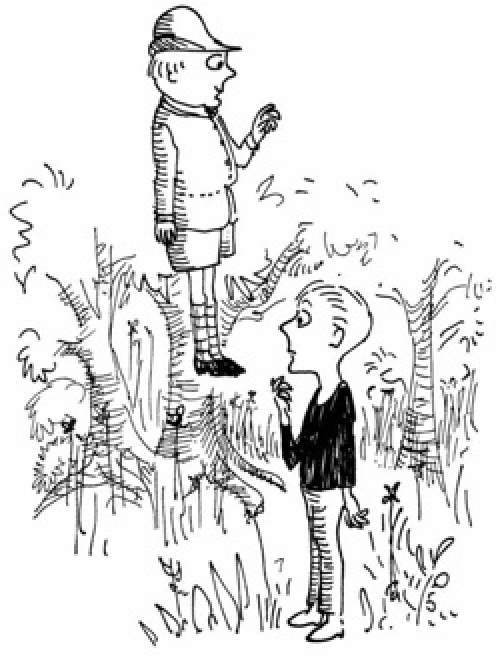
Image via fanpop.com
When I was seven, I got Norton Juster's brainy adventure YA The Phantom Tollbooth as a present. I skipped past the maps to the first Jules Feiffer illustration of Milo. Then all of a sudden this unquestioning boy was piloting a toy car past a tollbooth and stopping in front of a Whether Man, debating whether there'll be weather.
I was hooked. I loved the idea of another world. I had dreams about watching Chroma's orchestra putting color into the world. And of course I'd be able to spell hard words like "vegetable" just as fast as the Spelling Bee.
I even liked the film version. (I know. I know.)
There's a really cool scene where Milo goes back and forth in the tollbooth, switching from human to cartoon to human. That was when I started seriously wondering what I would look like if I was cartoonified.
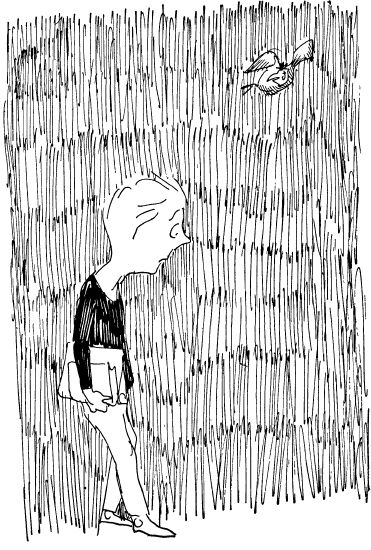
I told my dad about this idea while we were eating pie at Tippin's. And then my dad, the nuclear engineer, turned my world upside down: he told me to read Flatland. We went to the library, and my jaw dropped as I saw this picture of a sphere moving through a two-dimensional world:

Now over a century old, Flatland is the story of a Square living in a two-dimensional world: houses are their blueprints, and women, being lines, are required to hum as they move so that polygonal men aren't accidentally run through in their silence. The Square meets a Sphere one day, perceiving the three-dimensional being at first as a circle that expands and contracts at frightening speeds. Once the Square finally understands the third dimension, he tries in vain to convince the Sphere that there may be even higher ones.
It was a Copernican revolution of my mind. I imagined what an amoeba floating on the surface of a pool would see as an Olympic diver broke that surface: ten circles for fingers joining into two arms, a third circle for the head joining with the arms into an elongated torso...and then, my brain shifting in the opposite direction, I tried to imagine the fourth dimension.
Which I couldn't do. I saw drawings of hypercubes, and realized that they were exactly as useless as one-dimensional drawings of cubes. I couldn't get my head around the dimension extending outward from our world. My excitement faded. I didn't want to be cartoonified anymore.
I went back to The Phantom Tollbooth. In the end, Milo rescues the twin princesses Rhyme and Reason from the Castle in the Air. Then the entourage comes back and there's a great big festival before Milo heads back to his real world, no worse for the wear. It wasn't until much later that I laughed; I finally understood that even the three-dimensional world would make no sense without rhyme or reason.
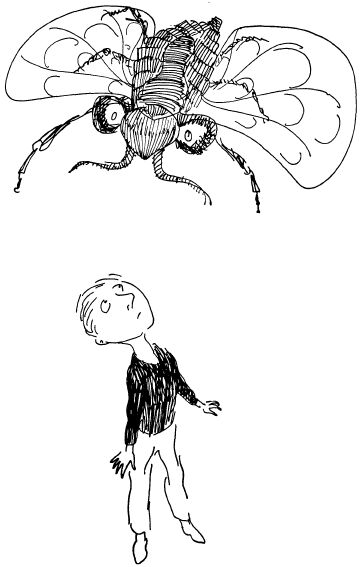
Image: Alec Bings, the boy who sees through things, drawn by Jules Feiffer


When the 2012 Pulitzer Prizes were announced this week, no award was presented for fiction. Bewildered fans of fiction such as myself could find no sufficient explanation. Juror Maureen Corrigan wrote in the Washington Post that she and her two co-jurors "have heard only the same explanation that everyone else has heard: The board could not reach a majority vote on any of the novels.” An explanation so lame, so absolutely devoid of effort, that it smells to me like a cover-up.
I wouldn’t be surprised if the eighteen board members were too busy with Columbian prostitutes to pick a winner. What happens to the $10,000 prize? More prostitutes?
The conspiracy theorist in me suspects a hidden motive of ill will toward publishers of fiction. Novels have perhaps sold too well this past year, and it’d be extravagant, even congratulatory, for one book to get the extra sales boost that inevitably results from the Pulitzer stamp. We can still award poetry because poetry needs the help, but those uppity fiction bitches can suck it.
As suspicious as such negligent behavior is, this has happened before. The last year no prize was awarded in fiction was 1977. No prize was awarded in 1974 or 1971 either. Do these years have any special significance? Was fiction just too good for one book to stand out? Maybe these years were more somber than others (Vietnam and the death of Elvis come to mind); maybe they were so distraught that prizes and celebrations seemed inappropriate. Sorry, Denis Johnson, but we don’t have the energy to anoint Train Dreams because we’re too sad about the Republican primaries.
What if Karen Russell’s Swamplandia! was the top choice but the board thought that exclamation point was just too enthusiastic in the face of the 100th anniversary of the sinking of the Titanic? Maybe David Foster Wallace, whose unfinished novel The Pale King was also a finalist, is haunting all of the board members. Or simply confusing them by adding footnotes to each eligible novel by means of his awesome ghost powers.
One last thing to consider. The Pulitzer Prize in fiction is “For distinguished fiction by an American author, preferably dealing with American life.” Maybe the board doesn’t believe in America. Maybe it’s American life, rather than fiction, that can’t get a majority vote.
Image: Wikipedia

 A Black Balloon Publication ©