



Did you hear the news? Books have the power to change laws.
And some people would like to make a law to keep the Gatsby movie from ever happening.
Though, if they can make a Ulysses movie, I suppose anything is possible.
Just ask Hannah from Girls, whose literary ambition is the stuff of awkward legend.
If only newspapers had more ambition when it came to diversifying their reviews.
Or they could reach out to unorthodox book reviewers, like LeBron James's take on the Hunger Games.
He could even take on a few poems by our country's latest poet laureate.
Let's just hope the zombie invasion doesn't take place before any of that can happen.
Photo Credit: Michael R. Perry


On my recent trip to Tokyo, I saw three indie bands with slightly funny-sounding names over three consecutive nights. J-Pop megagroups likeAKB48 (and their “warring” sister factions SKE48 and badass Kansai-basedNMB48) may blanket airwaves and adverts, but the indie scene is a-boomin'. I learn something new each time I attend a Tokyo indie-rock show. Considering these three were back-to-back, I learned a lot. Here's some of that!
* Who the Bitch: everyone gets to mosh, if you want to! Two riot-grrrls and a dude resembling an extra from Nagasaki jet-rockers Guitar Wolf playing punchy pop-punk. The crowd had been circle-pitting nonstop when the band launched into riff-heavy 「ベクトル」 (uh: “Vector”?), guitarist Ehi crooning “come back to me in my bed” (in English!). Want some of the action? The big crowd-control dude moshing along will see to it you get your moment of stage-diving fame. Don't want to? Cross your arms NYC-style, and even the wildest kids will politely avoid crashing into you.
* 住所不定無職: ease back on taking photos and just have fun! These vintage clothing-coordinated indie-pop girls met at the unemployment office, hence the translation of their name: “no job nor fixed address”. I was up front and right-of-center to photograph cutie Yoko, co-vocalist and player of a glittering double-neck bass/guitar—but I held off. I alluded in my previous Tokyo indie-rock post that photography is generally verboten. How refreshing to just experience their upbeat, singalong anthems without studying an iPhone screen!
(speaking of Guitar Wolf: they headlined this show, and I've never seen so many white people at a Tokyo indie show before. Guess how many were taking photos!)
* Plastic Girl in Closet: Japanese shoegaze rules! J-Pop may rule, but the Japanese do some mighty fine—and ferociously loud—shoegaze. The adorable four-piece Plastic Girl in Closet celebrated their third LP ekubo(“dimple”, a nod to their twee-ness) with their first-ever “one-man show”, ripping through their back catalogue for nearly two hours of sonic bliss. That the long-delayed My Bloody Valentine reissues coincided with this show felt particularly auspicious. For beyond the guitar squalls and ethereal vox, it was Ayako's muscular basslines that really shined, up there with MBV's Debbie Googe.
* reserving tickets: perhaps it's thanks to these bands' indie-ness, but each offers to reserve advance tickets, so long as you email them. You still have to pay, but at least you've secured a spot in one of Tokyo's “cozy” 100-person capacity live-houses.
Image collage: (clockwise from top) courtesy 住所不定無職, Plastic Girl in Closet, Who the Bitch

Both The Guardian and the NYDailyNews recently posted articles about a new study that seems to suggest that modern writers are becoming less and less influenced by past literature. In trying to come to grips with the terms of the study itself – ‘influence’ was measured by non-content word usage, measuring style not content, the sampling was of books available on Project Gutenberg that were published between 1550 and 1952 (which were then all written in English?) – I’ve come to a few of my own conclusions.
Conclusion #1 There are more people who know how to read and write now. Or, I should more accurately say, more people knew how to read and write in 1952 than there were people who knew how to read and write in 1920, let alone 1870, or 1660, etc.
Conclusion #2 More books became more available as more people had more time and money to read them. There were also an increasing number of people writing who weren’t rich white males, though I bet it was still pretty difficult in 1952 to get published if you were not male or not white.
Conclusion #3 Just because I have a shitty attitude about widespread generalizations based on out-dated source material quantified in meaningless ways doesn’t mean we shouldn’t get very upset and all up in arms about society crumbling because we’re all not reading the classics.
Conclusion #4 All of the people I’ve known who studied the Classics – as in Greek and Latin Classics – were incredibly dark and fatalistic. They were the smartest people I knew but by and large the most dangerously depressive.
Conclusion #5 Dead authors I’ve personally been heavily influenced by: Dostoevsky, Sherwood Anderson, Chekov, Raymond Carver, John Updike, Nabokov, Hemingway, Faulkner. Dead authors I could write like without coming off as a complete and total ass: 0.
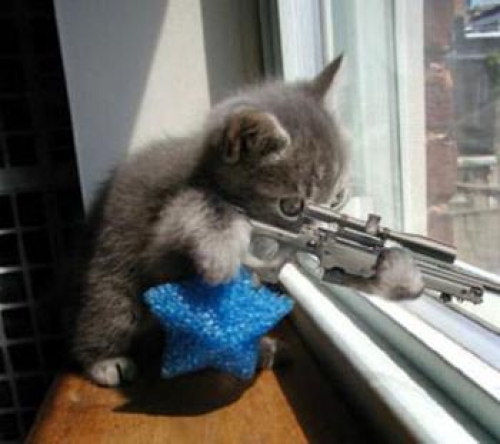
Conclusion #6 Meow meow meow meow, meow meow meow.
Image: sodahead.com


It is believed that Boston crime boss James "Whitey" Bulger may have had something to do with the infamous Gardner Heist, in which Rembrandt's "Storm on the Sea of Galilee," among other works, was stolen. Yesterday, Catherine Greig, the long-time companion of Bulger, was sentenced to eight years in prison for harboring her boyfriend while he remained atop the FBI’s most wanted list. In a sentencing memo Grieg’s lawyer invites us, by way of Shakespeare, to consider why people love criminals.
1. “Why people fall in love has been debated since before Shakespeare’s sonnets…The truth of the matter is that she was and remained in love with Mr. Bulger…It is not justice to use the law as a cudgel to exact the proverbial ‘pound of flesh’ from a kind, gentle 60-year-old woman who is at the mercy of this court for a fair sentencing commensurate with her conduct which arose out of the love she had for Mr. James Bulger.’’
—Kevin Reddington, sentencing memorandum, filed 11 June, 2012
2. If my dear love were but the child of state,
It might for Fortune’s bastard be unfather'd,
As subject to Time’s love or to Time’s hate,
Weeds among weeds, or flowers with flowers gather'd.
No, it was builded far from accident;
It suffers not in smiling pomp, nor falls
Under the blow of thralled discontent,
Whereto th'inviting time our fashion calls:
It fears not policy, that heretic,
Which works on leases of short-number'd hours,
But all alone stands hugely politic,
That it nor grows with heat, nor drowns with showers.
To this I witness call the fools of time,
Which die for goodness, who have lived for crime.
—William Shakespeare, Sonnet 124, 1609
3. “It helped…that his brother, William Bulger, was the president of the Massachusetts state senate. The base of Bulger’s personal kingdom was Southie, where he served as the judge and jury, the hometown hero who never left, and teenagers would sometimes scrawl on their notebooks:WHITEY RULES.”
—Ulrich Boser, The Gardner Heist, 2009.
Let Me Recite What History Teaches (LMRWHT) is a weekly column that flashes the gaslight, candlelight, torch, or starlight of the past on something that is happening now. The citational constellations work to recover what might be best about the “wide-eyed presentation of mere facts.” They are offered with astonishment and largely without comment. The title is taken from the last line of Stein’s poem “If I Told Him (A Completed Portrait of Picasso)."
Image: Rembrandt van Rijn, The Storm on the Sea of Galilee via Wikimedia Commons


Since it turns out that writers aren't all that influenced by past writers, what goes into novels then? The author's own life? I realized that every author was getting asked the same thing, and I started worrying about the assumptions behind the question, “Is your fiction autobiographical?”
Jonathan Franzen, author of The Corrections and Freedom, gave an eloquent, but direct reply in The Guardian, looking at the relationship between actual, real events and how much his writing relates to the things he’s seen:
In 30 years, I don't think I've published more than 20 or 30 pages of scenes drawn directly from real-life events that I participated in...What is fiction, after all, if not a kind of purposeful dreaming? The writer works to create a dream that is vivid and has meaning, so that the reader can then vividly dream it and experience meaning. And work like Kafka's, which seems to proceed directly from dream, is therefore an exceptionally pure form of autobiography. There is an important paradox here that I would like to stress: the greater the autobiographical content of a fiction writer's work, the smaller its superficial resemblance to the writer's actual life. The deeper the writer digs for meaning, the more the random particulars of the writer's life become impediments to deliberate dreaming.
And this is why writing good fiction is almost never easy.
It’s a good answer, but Franzen’s colluding with the interviewer. Both of them are propagating the idea that fiction is necessarily rooted in the visible world, and that once the relationship between experience and fiction is established, then anybody can put a pen to paper and make a masterpiece.
But fiction is not always based on the world we see around us. Sometimes things have to just be made up wholesale—with more logic than a dream. Genre fiction in particular depends on this fact: science fiction and historical fiction fixate on details that for the authors only exist in the imagination. A recent bestseller in France, Hate: A Romance, is about two men during the AIDS epidemic, and was written by a man born during the last years of the political activism related to that. Tristan Garcia’s book landed like a hand grenade amid the piles of monotonous French autobiographical fiction. And when asked why he didn’t write from his own life and experience, he said:
I wanted to write about something far removed from myself, which has nothing to do with my existence, even my nature—I’m too well-behaved, my soul is too well-adapted to the world, in a sense.Autofiction doesn’t interest me, and I’m not very interested in myself either. For a time, it was believed that because people were writing to tell their stories—as if to a psychoanalyst or a confessor—literature was self-expression, first and foremost, and, sometimes, the fictional expression of self: speech, a voice, the voice of the person writing. For me, it is the contrary. Writing is a refined form of empathy through which man extends his ability to be an Other, to feel what someone else feels, to trade his sensibility and voice with others without losing his soul.
There you have it. Fiction as a form of negative capability. This is why the question “Is your fiction autobiographical?” is so useless. When you have to imagine someone else’s life, you do so by ignoring the details of your own life. A correlation between the two is simply a coincidence. And, as we all know, correlation does not imply causation.
It’s best, really, not to worry about the parallels between fiction and life; the author writes to keep his soul whole. He’s not a memoirist. Those writers pay dearly for aestheticizing their lives, as in the case of Karl Ove Knausgaard, the Norwegian author of the record-breaking bestseller My Struggle. He openly admits:
I wrote this in a kind of autistic mood. Just me and my computer in a room, by myself. It never occurred to me that it might cause problems – I was just telling the truth, wasn't I? But I was also being very naïve. I sent a copy to everyone involved before the first volume was published, and then I discovered how difficult this was going to be. It was like hell ... I couldn't have done it any other way. I will never do anything like this again, though, for sure. I have given away my soul.


It’s five servings a day, it’s the slow-blossoming bloom on a tree, it’s the most colorful part of the grocery store, it’s shaped like stars or circles or cardiods—it’s fruit.
And, according to the New York Times, for people in India, it’s specifically the mango. No other fruit has so many cultural and religious connotations, nor is any other fruit considered as sensual. In a related blog post, Heather Timmons insists that “the mango finds a more exalted, and frequent, place in Hindu mythology that the apple does in Christianity.”
But if India has claimed the mango as its national fruit, then what about the other countries of the world?
For America, regardless of its Puritan roots, it's apples. Johnny Appleseedhas been enshrined in legend here. (He actually was a real person—a devout Swedenborgian in fact.) But my memories are of picking apples at Eckert’s orchard; when I went to college, there were bus trips to go apple-picking in New England. My aunt in California has fruit trees in her backyard, including an apple tree. At home we have an apple peeler and corer for apple pie and apple tarts and apple crisps. George Washington’s cherries and Georgia’s peaches just don’t represent America as perfectly. As mangos are to India, so apples are to America.
Sweden has been co-opted by IKEA, which advertises lingonberry jam and straight-up lingonberries as authentically Swedish. One of my college roommates from Norway couldn’t stop raving about cloudberries, especially with cream. On the other side of the world, rambutans are intertwined with my notions of Malaysia.
My close friend insists that Russia once had the best strawberries, near Chechnya, and the Chechen writer German Sadulaev agrees. In I Am a Chechen! he begins an digression with the unforgettable words, “Once my memory was a strawberry field. Now my memory is a minefield.” From there, he describes how he used to pick strawberries in a field near his home. But, he writes, mines were laid in those fields, many of which exploded when people stepped on them, and “strawberries grow well in fields watered with thick, rich human blood.” On the horizon, as well as in his mind, the strawberry fields have become minefields.
But Russia might have to settle for a different, less bloody fruit. France boasts many delicacies, but I’ve never been able to forget Edouard Levé’s beautiful formulation: “When I look at a strawberry, I think of a tongue, when I lick one, of a kiss.” Since then, I’ve never been able to taste strawberries without being reminded of French kisses.
Israel, for me, will always be the land of oranges. The weather is unforgivably hot and dry, and I can’t count how many shekels I’ve spent on fresh-pressed orange juice at a tiny stall after a thirst-inducing hike across sandy terrain. And I can still remember the small orange trees in Jerusalem and Tel Aviv’s plazas, whitewashed with fungicidal paint. Not figs, not olives, but Jaffa oranges.
What about the rest of the world? I’m waiting for my friend to come back from Japan with akebi. And then I need to start cataloging all the other countries: Nigeria, Ecuador, Sri Lanka, Italy, New Zealand . . .


Craig Mod sings a funeral dirge for book covers, yet another beautiful casualty of the shift toward digital distribution of “books.” Because they have lost their purpose, covers must die: as bookstores finally succumb to the efficiencies of Internet distribution, book covers themselves will lose the emphasis they currently have in the publishing world. Instead, clever designers will continually tweak covers—or app icons?—to leverage the characteristics of whichever particular method of distribution—Kindle, Apple Store, whatever—to their favor. Or so it would seem.
I wonder about this. I'm not so sure that major publishers will be keen to give up the "branding" achieved by iconic cover design. While Mod is definitely correct that the cover image at an Amazon book page doesn’t dominate your impression the way physical covers do when you approach a table display, I think he trivializes its importance. When you search for a book, there is the momentary, all important recognition of a particular cover: I want this edition; I recognize that book. And I bet, as was shown with comprehension and retention of hypertext compared to linear text, that the much vaunted “data” presented to customers on a typical Amazon book page rarely enters memory or affects cognition or purchasing behavior—at least, not as much as the initial impression of recognizing the book’s cover does. Certainly someone at Amazon has metrics on that. [See note on metrics below.]
It is this snap of recognition that makes bestsellers. The industry knows this. Hence, the dextrous marketeers have worked to craft immediately recognizable bestsellers through standardizing distribution channels, optimizing displays, and studying consumers perceptual habits. Marketing departments will want to continue to have control over of each book’s brand, hoping to win the lottery by hitting on the next Fifty Shades of Grey,Harry Potter, Twilight, etc. Covers will still get the most design attention, even if their function and role are in transition for some time.
Still, many of the observations Mod makes about the ghostly controls on electronic books are apt. For instance, the Kindle opens directly to the first page of text—I wonder if publishers make this choice or if it is an aspect of the product they’ve ceded to end retailers, along with price—tucking away the front matter and indicating that the information it contains is of little use to the usual reader. Who knows how to decipher that Library of Congress info, anyway?
Anyway, covers. We may mourn them. They’re doomed because they’re not essential to the non-object ebook. Virtual guts need no physical protection as they’re removed from a virtual shelf and “opened.” And it’s hard to see how methods of preventing remote deletion or emendation of your library would be integrated aesthetically into overall book design.
But fear not. You can still sticker your device.
[Note on metrics: There’s a difficulty in leveraging them as efficiently as possible. Publishers may well be interested doing so through the perpetual refinement of "customer experience" through things like A/B testing. Because of the constant accrual of data about customer behavior that is harvested, there is enormous potential to positively encourage sales. By having two versions of a cover and tracking if either seriously outperforms the other a retail site, marketing teams could, hypothetically, select the cover that performed better and make it, thereafter, the official cover for the book. Problem is, I doubt that Amazon or the other end retailers of ebooks would be enthusiastic about freely sharing the info they gather on customers. So there’d be less integration of data into decisions about which cover did best where. And I doubt publishers will be eager to cede ultimate control over their covers to Amazon, et al. Of course, this isn’t a problem for Amazon’s publishing wing. Then there’s the insidious side of A/B testing. It happens so fast now that marketeers rarely take the time to think about the why B outdoes A in this instance. This is because, essentially, why don't matter. Final causes aren’t as important as immediate effects—namely, money for the company—and so don’t need to be investigated. The danger of this is that marketeers tend lose sight of the fact that they have an impact on the results: you put meat and potatoes in front of a hungry person, they're going to eat it.]
Image: etsy user ilovedoodle


Ben Marcus, writing in the New Statesman, proposes the idea that the new fascination with apocalyptic fiction is partially in response to a need to raise the stakes of American drama after 9/11. Apocalyptic fiction is a playground realist writers can now traipse through because such fears and expectations are no longer considered mere fantasy. Marcus writes: “Nothing of the 9/11 attacks even remotely suggested an apocalypse but they certainly helped expose the troubling fiction of our immortality. Which might mean that fictions of our end times are now, through bad luck or comeuppance, however you wish to view it, among the truest and most realistic stories that we can tell.”
To begin with a small, but important, clarification: I do not intend here to suggest how or what novelists should write about. Novelists are under no obligation to anyone for how or what they write. I am interested only in examining further Marcus’ observation of the historical and psychological conditions in America post 9/11 that some novelists and readers might be responding to. I agree with Marcus when he says “If this is a new development, it is worth considering why the end of the world is poised to join the suburbs and bad marriages as a distinctly American literary fascination.”
A question that comes up for me is to what degree end times fiction is a reconciliation with the present (coming to terms with what American life is now), and to what degree it foretells our larger attitudes about the future. If we’re willing to consider the notion that some psychological need is being fulfilled – at least tapped – through literary means, I think it’s interesting to look at the difference between this new end times phenomenon and Cold War paranoia. In the Cold War, dropping the atom bomb always remained a threat. After the Cold War was over, school children huddling beneath their desks and families cowering underground in bomb shelters seemed like an overreaction. We most definitely understood the terms of the engagement during the Cold War – we knew the nature of the conflict and could identify the enemy. Even if the Commie was infiltrating your neighborhood, there was still a very clear sense of that Commie’s motivation. Then think of Orwell, Huxley, Bradbury (not all American writers but surely read widely by Americans) warning us of what society might become if we’re not careful. Those writers were responding to the changes and possibilities that were apparent in their time, all focused on the implications of larger societal structures and all very much imbedded with a sense of democratic responsibility.
In the decade leading up to 9/11 major events were the very swift Gulf War, Rodney King and the LA Riots, Bill Clinton spilling on a dress. America was not living in fear – uncertain or otherwise – at the time. The 1990s top seller lists were riddled with Steven King, Michael Crichton, and Tom Clancy. Regardless of where ‘serious’ lies on their list of priorities, King, Crichton and Clancy were all writing to thrill. This new insurgence of serious, literary writers tackling end times is likely due to the observation that we are more willing to take such things more seriously. Now, the subjects of thrillers are not solely relegated to fantasy. What is new is our sense of the reality of such fears. For the most part, the general public had no real or accurate conception of who was responsible for 9/11 or why America was attacked. The nature of this new threat remains slippery, intricate, complicated – elusively grand. We now fear everything. It’s also partly our fault, but there’s a sense that it’s too late to fix it. The new end times fiction isn’t about precaution, it’s the aftermath. These tales are post-culture, post-society.
If we don’t have a clear sense of ‘the enemy,’ we also don’t have a very clear sense of ourselves. To be American now seems to mean to be privileged, ignorant, shitty. Self-interested to a harmful degree, at every level of interaction. The freedom we hold dear to be the freedom to make and spend money. America contains much more than that but American identity is now so often talked about in such imprecise ways by people trying to sell something that it’s hard for someone not trying to sell something to join the conversation. Or at least be heard among all the noise. Marcus points out that the American suburban drama can now seem indulgent, irresponsible – how smug and lucky we are to pout over our incredibly safe, decadent, awesome lives: “To call the novel irrelevant because it couldn’t top 9/11 – that seemed strange, a botched diagnosis. But it did not prevent a shame from settling over writers who favoured domestic literary subject matter that could very well be deemed minor.” No serious, deep consideration of any subject should be considered minor, but there is now a compulsion to raise the stakes. I think it’s quite valuable to consider the new end times fiction as being a response to that. The levels of perceived and potential devastation have been turned up a notch or two.
I think it should also be noted that much of the current end times fiction is still largely domestic: in Marcus’ The Flame Alphabet and McCarthy’s The Road the protagonists are both fathers whose concerns are still centered on family. Family is, after all, what we have left (hopefully) once every other structure has collapsed. And American fiction does have a quite excellent tradition of rugged individualists. The drama of the end times is no doubt reassuring in that most end times stories are to a great extent survival stories. Even if everyone dies at the end they do so heroically – they have proven great spirit, valor, and humanity in their fight and thereby given meaning to their existence. These stories are in some way telling us that we can indeed persevere – even after it’s all gone to shit – and do so with something like integrity. Or, if not integrity, we will at least learn something valuable about ourselves.
I have no doubt that apocalypse fiction, in addition to vampires and werewolves, will be around for quite a long time, but I also sense end times fiction will lose its newly celebrated appeal. Literary fiction isn’t often that popular – and I think the perceived ‘anomaly’ of serious fiction taking on genre characteristics actually helped literary fiction writers get more attention – and the American imagination, for writers and readers both, demands reinvention quite often. My question then is: what comes next? Will novelists continue to feel the need for high drama? Can we stop quibbling over the distinctions between high and low subject matter? What will now be the course of American fiction?
image: www.ep.tc


Did you survive the tote bag frenzy that was BEA 2012?
Maybe take a breather and eat a mango if your nerves are still on edge.
And leave it to Oprah to make all your book selections from now on.
Though, if you ask Zadie Smith, she still holds complete faith in libraries.
Just try to avoid Amazon if you're not trustful of corporate behemoths.
But if you're not, just make sure you don't Nook a flame you can't put out.
You may end up with something worthy of the scariest post-apocalypse novel.
Which may come about from a war between the grammar gods.
Though the end already seems near for the Israeli publishing world.
Let's hope someone takes advantage of all of this drama and makes a good graphic novel out of it.
Image source: The Trustees of the British Museum


The Nation has devoted a substantial chunk of their new issue, including a post-apocalyptically gloomy cover, to the subject of the most revered and loathed retail behemoth on the planet. The issue, "Amazon and the Conquest of Publishing," offers three long essays on Jeff Bezos's company's origins, controversial labor practices, tax-evasion efforts, data mining tactics, and its conflict-of-interest-y slouching towards publishing its own titles. (Sidebar: Amazon quietly bought Avalon Books, an imprint specializing in romances and mysteries, this week.)
The best and most comprehensive of the essays is Steve Wasserman's "The Amazon Effect." Wasserman, a former editor of the Los Angeles Times Book Review (which folded its print edition in 2008), paints a startlingly dystopian picture of Amazon as a company which, like its social networking counterparts, seems to harbor a sinister messianic ambition for itself, a desire to braid itself into our neural pathways.
From street level, they seem to be succeeding. Amazon has always seemed to me less a company than an idea. As Wasserman notes, it has no physical space (at least none that it pays fair taxes on). No one walks into an Amazon store; there are no Amazon greeters. And news that the company would like to replace its human workers, ostensibly the ones who saran-wrap your paperbacks to pieces of cardboard, with robots, hardly surprises, even if it is speeding us towards a vision of the future that would have made Aldous Huxley give us a withering look.
And it seems as though Amazon is banking on the fact that, like it's social network counterparts, it has become an idea, an ingrained feeling, a Pavlovian reflex—a verb. "To Amazon," in my working definition, might refer to "the immediate silent flush of gratification felt upon purchasing a dozen books one has been meaning to read with only a few clicks of a mouse, some of the books hard-to-find novels at scandalous mark-downs."
My sensitive information is saved on the site; I click hectically through to checkout, not the least bit anxious that Amazon has this information, maybe even a bit annoyed to be reminded it does, because a kind of anticipatory saliva has already started accumulating in a part of my brain I didn't know existed before Amazon. Finally, the words "free shipping" mitigate any subsequent feelings of buyer's remorse I might feel as the confirmation emails start cluttering my inbox. My wallet has not moved from my pocket. I have not moved from my chair. Twelve books are on their way to me, and nevermind that it might realistically take me several years to finish them all (in between reading the other stacks of books I ordered last month, and the month before, etc.). The shipping was free. I win.
Understandably, Amazon has its evangelizers, people like Slate's Farhad Manjoo, who argued several months ago that Amazon is "the only thing saving" literary culture, because the company has increased the number of books people buy, which (fishily) leads Manjoo to wish death on public spaces that encourage the buying of said books, a.k.a. independent bookstores. (This seems especially fishy given that said journalist writes for said website which, he admits, is in business with said online retailing behemoth.)
You might recall that this is the same article in which novelist Richard Russo is taken to task for a New York Times op-ed in which he pleaded the case for independent bookstores, the same Richard Russo who spoke at BEA this week, urging publishers to "find a spine" against the Amazonian bully.
But Manjoo is right: Amazon is, in many ways, the ideal friend and accomplice to young literary persons of the Great Recession era. The company appeals seductively to our general poverty, agoraphobia, sense of entitlement, and desire for immediate gratification. And with e-books, which, unlike toaster ovens, can be downloaded to your Amazon Kindle™ instantaneously (in a proprietary format locked to other e-readers), you don't even have to get up and run an illegible squiggle representing your signature™ across the UPS™ guy's Delivery Information Acquisition Device (DIAD)™.
A number of us who return again and again to Amazon aren't even lazy or agoraphobic; we're just broke. We go to our independent bookstores to browse and read on the big "poofy" (Manjoo) couches, buy a coffee, engage the sales attendants in English major banter: a combination of activities which we like to think of as "showing our support." And then we go home and buy a dozen books in a few clicks from the enemy.
What to do, Independent Bookstore, when my heart is your husband, but, as Bezos knows, my wallet's a slut?
 A Black Balloon Publication ©